It is not unusual for this question to be found on general firearm forums, but those dedicated primarily to Glock handguns as well.
Some express concerns whether or not the stamped steel slide stop lever will eventually round off and no longer retain the slide after the last shot is fired if they use it to release the slide after inserting a loaded magazine. Others worry that the thin slide stop lever might round the rear vertical edge of the notch cut in the slide for hold-open after the last round is fired.
In some of these threads, the original question may actually be answered but in many instances it becomes very secondary to generally boorish behavior such as crude remarks, personal attacks and name-calling.
I thought it might be novel to attempt a sensible approach and check with the manufacturer. Looking on page 23 of Glock’s “Instructions for Use” (REV.11/08) manual under “Loading and Firing”, we see that Instruction 4 states: “After the last round has been fired, the slide remains open. Remove the empty magazine from the weapon by pushing the magazine catch (19). Insert and new magazine and then either push the slide stop lever (27) downward (see photo 2), or pull the slide slightly backward and allow it to spring forward. The weapon is now again ready to fire.” (Bold added for emphasis.)
My goodness gracious alive! Either method can be used. It seems that the shooter has a choice and will not be struck blind and dumb if he or she chooses either method...at least not according the pistol's actual manufacturer.
Someone frequently brings up the concept of fine motor skill loss under stress and suggests that retracting and releasing the much-larger slide is more easily accomplished than depressing the smallish slide stop lever. On one site this suggestion was countered with the claim that a very well-known competition shooter uses the slide stop exclusively to drop his Glocks’ slides, and reports no damage.
My opinion (and that’s all it is; feel free to disagree) is that anytime a steel part rubs against another steel part a tiny amount of wear occurs. For something to never wear out, it must never be used. It strikes me that despite the company’s claim of “perfection”, there will also be miniscule wear on the Glock slide stop lever if it is used to release the slide. The keyword here is miniscule. For those shooting their Glocks but moderately, it will probably never be an issue. Based on my own observations and conversations with “heavy duty” Glock users, it is quite unlikely that the practice will damage the lever (or slide for that matter). If it does, the part is quite inexpensive and very simple to install yourself.
Pick the method that works best for you. One requires but a single hand to accomplish but might induce a tiny bit of inconsequential wear to an inexpensive part that will not cause the pistol to “jam” or otherwise suffer a stoppage. The other requires the use of two hands, but both hands are already in close proximity if a fresh magazine has just been inserted and it is unlikely to be injured in the time taken after seating the new magazine to pulling the slide rearward and letting go.
That’s as honest, accurate and civil an answer as I can provide.
Best.
Saturday, December 19, 2009
Monday, December 07, 2009
9mm Glock Case Support: Adequate or Not?
Whether a fan of Glock handguns or not, most agree that the Glock “KB” (“Ka Boom”) is a topic that is both enduring and widely-discussed on many firearm boards. Glock detractors frequent speak of inadequate chamber support, flawed gun design allowing the pistol to be fired with the barrel slightly out of battery to skyrocketing pressures from shooting non-jacketed lead bullets through the factory barrel’s polygonal bore (which Glock does advise against). Glock enthusiasts blame these KB’s on improperly loaded ammunition, defective factory cartridge cases if factory ammo was being used, and worn-out cases reloaded too many times if handloads were being fired. Improper reloads mistakenly stoked with too much powder is frequently cited as a possible cause, too. Who is right?

Though not as much in 9mm, the widely-used Glock pistol does suffer from the stigma of blown cases in what is called Glock “KABOOM’s” or “KB’s”. Is this something just inherent in the Glock design or might it be the product of other factors?
The first Glock KB’s that I personally witnessed were with a state-issued Glock 22. Texas’ Department of Wildlife had recently issued them to the state’s game wardens, one of whom was a friend of mine. He fired a few shots using brand new factory .40 S&W 180-gr. JHP’s before he got a KB. He was not hurt but the extractor left the gun as did the magazine. The case was still in the chamber and had blown along the extractor groove ahead of the rim. His pistol was repaired in short order and within few days he took it back to the range with the same issue-ammunition…and with the same result, another KABOOM! Damage was about the same but he was losing his enthusiasm to fire his Glock 22, and I admit declining his invitation to shoot it as well!) About this same time, a friend of mine bought one of the first 40-caliber Hi Powers to arrive at the local gun shop. He had not fired it but with a few days received a call from the gun shop owner advising him to call a specific number at Browning. He did so and was asked to return the pistol for a free “upgrade” which had mistakenly not been performed on his brand-new Hi Power. Though it was like pulling teeth, he eventually learned that the Hi Power barrel was to be replaced with one that had been given a little bit more barrel support in the chamber due to possible KB’s with but one brand of factory ammunition: Federal. This was the same brand being used by the game warden in his Glock 22. (It should be noted here that I am both a fan and user of Federal ammunition and that the problem with their earliest initial runs of the then-new .40 S&W appears corrected long ago. I have personally shot lots of it through many 40’s (Glocks and others) over the years with exactly zero problems. I do not know if Glock has increased chamber support in their 40-caliber barrels or not.
Though I didn’t witness it, a friend of mine reported a KB in his Glock 21. Neither he or nor I can blame it on the pistol. Seems he mistakenly left a cleaning swab in the barrel. Though a “low-pressure” cartridge compared to the .40, 9mm or .457 SIG, escaping gases around the trigger-area nearly severed his trigger finger. (He checks barrels before firing now for some reason!)
I saw a minor Glock KB in 9mm while a police firearm instructor. The department was using “remanufactured ammunition” (commercially reloaded) from an obscure company because of the price. I saw this 115-gr. ammunition blow and expel magazines from both a Glock 19 and a Beretta 92. I had no problems with it in a Browning Hi Power but still refused to personally shoot or issue it for practice after that. It could be that the Browning just took the ammunition in stride or more likely, I happened not to get one of the company’s inadvertent overloads by pure luck or chance! It is possible for brand new factory ammunition as well as factory reloaded rounds to be out of spec.
I thought that it might be worth the time and effort to compare the Glock 9mm barrel with other factory barrels and see if anything can be deduced. (I understand that 9mm is not the primary caliber in which Glock KB’s are being reported, but 9mm is the only caliber in which my Glocks are chambered, so it will have to do, at least for this initial report.)
If interested, details are here:
http://hipowersandhandguns.com/9mm_glock_barrel_support.htm
Best.


Thursday, December 03, 2009
Anti-Freedom Lautenberg at it Again...
This is essentially federal registration of new firearms though by the FBI and not BATFe, though a separate amendment later own could certainly allow them a copy. Another amendment and the ten-year time-limit disappears and we have firearm registration and eventually confiscation with the “wrong” administration.
Note anti-gunner Attorney General Holder’s comments and recall that he has wanted firearm registration:
“ Last week, Attorney General (AG) Holder announced his support for a separate Lautenberg bill, the Denying Firearms and Explosives to Dangerous Criminal Act of 2009, which would give the Department of Justice discretion to deny a gun purchase to someone on the terrorist watch list.”
The question is, “Who or what constitutes being on the ‘terrorism watch list’? Does being a conservative, NRA member, current gun owner, military veteran (You already know of course that DHS has suggested that veterans are potential terrorists.”) The idea is to use fear instilled by the “terrorism” camouflage to do what they have so far been unable to: register firearms.
Here is the press release from Lautenberg:
“Press Release of Senator Lautenberg
Lautenberg Introduces Bill to Preserve Gun Records Critical to Law Enforcement, Terrorism Prevention
Contact: Lautenberg Press Office (202) 224-3224
Tuesday, December 1, 2009
WASHINGTON, DC – Sen. Frank R. Lautenberg (D-NJ) today introduced the PROTECT Act, legislation to preserve records of gun sales for longer periods of time to aid law enforcement officials in preventing gun crimes and terrorist acts. Under current law, the Federal Bureau of Investigation (FBI) must destroy these records in most cases within 24 hours of allowing a gun sale to proceed.
“It makes no sense to immediately destroy information linking a gun purchase to its buyer and seller,” said Sen. Lautenberg. “We are too often asking law enforcement to protect our communities with one hand tied behind their back. Preserving background check information would help law enforcement do its job and keep our families safe from criminals and terrorists. We must overturn the ill-conceived 24-hour destruction policy so we can successfully combat gun violence and terrorism in America.”
The Brady Law requires federally-licensed gun dealers to conduct background checks using the National Instant Criminal Background Check System (NICS) before they sell guns. The NICS system creates an audit log of the purchase during the course of the search. A rider that has been attached to appropriations bills each year since 2004 mandates that the FBI destroy this audit log within 24 hours of allowing the gun sale to proceed.
The 24-hour destruction requirement hinders the FBI’s ability to verify that gun dealers are conducting background checks properly and to retrieve guns from those who are prohibited from having them. In 2002 - prior to the 24-hour rule - the Government Accountability Office (GAO) reported that over a six-month period the FBI used retained records to initiate 235 actions to retrieve illegally possessed guns, 228 (97 percent) of which would not have been possible under a 24-hour destruction policy.
Records are also destroyed when known and suspected terrorists purchase firearms, since nothing in current federal law prohibits them from purchasing guns. The FBI’s current practice is to keep background check records for these purchases for 90 days. If, at the end of the 90-day period, the FBI still has not found any other disqualifying reason to prohibit the purchase under current federal law, all records related to the purchase are destroyed.
At the request of Sen. Lautenberg, the GAO released a report earlier this year finding that from February 2004 through February 2009 there were 963 cases in which a known or suspected terrorist identified in federal terrorist watch list records attempted to buy a gun or explosives. In 90 percent of these cases -- a total of 865 different times -- the known or suspected terrorist was cleared to buy a firearm or explosive. Last week, Attorney General (AG) Holder announced his support for a separate Lautenberg bill, the Denying Firearms and Explosives to Dangerous Criminal Act of 2009, which would give the Department of Justice discretion to deny a gun purchase to someone on the terrorist watch list.
Sen. Lautenberg’s legislation, the Preserving Records of Terrorist & Criminal Transactions (PROTECT) Act of 2009, would:
• require the FBI to retain for 10 years all records related to a NICS transaction involving a valid match to federal terrorist watch list records; and
• repeal the requirement that other background check records be destroyed after 24 hours, and instead require that the records of all non-terrorist transactions be maintained for 180 days.
When asked about the 24-hour destruction rule at a Senate Appropriations Subcommittee hearing in April 2007, FBI Director Robert Mueller said, “[T]here is a substantial argument in my mind for retaining records for a substantial period of time.” Video of Director Mueller’s remarks can be found here.
Last week, Tom Kean, former Republican governor of New Jersey and Chairman of the 9/11 Commission, and Mayor Bloomberg of New York City wrote an op-ed opposing the 24-hour destruction of gun records and the inability of law enforcement to block gun sales to terror suspects.
The measure is cosponsored by Sens. Charles Schumer (D-NY), Carl Levin (D-MI), Jack Reed (D-RI), Sheldon Whitehouse (D-RI) and Dianne Feinstein (D-CA). Sen. Lautenberg is a long-time advocate for responsible gun safety measures. He has also introduced legislation to close a loophole that allows guns to be sold at gun shows without a background check. And Sen. Lautenberg is the author of the domestic violence gun ban, which has successfully kept more than 170,000 guns away from domestic abusers.”
Note the usual anti-freedom co-sponsors.
Folks, it is time to contact our elected officials again and oppose this.
Note anti-gunner Attorney General Holder’s comments and recall that he has wanted firearm registration:
“ Last week, Attorney General (AG) Holder announced his support for a separate Lautenberg bill, the Denying Firearms and Explosives to Dangerous Criminal Act of 2009, which would give the Department of Justice discretion to deny a gun purchase to someone on the terrorist watch list.”
The question is, “Who or what constitutes being on the ‘terrorism watch list’? Does being a conservative, NRA member, current gun owner, military veteran (You already know of course that DHS has suggested that veterans are potential terrorists.”) The idea is to use fear instilled by the “terrorism” camouflage to do what they have so far been unable to: register firearms.
Here is the press release from Lautenberg:
“Press Release of Senator Lautenberg
Lautenberg Introduces Bill to Preserve Gun Records Critical to Law Enforcement, Terrorism Prevention
Contact: Lautenberg Press Office (202) 224-3224
Tuesday, December 1, 2009
WASHINGTON, DC – Sen. Frank R. Lautenberg (D-NJ) today introduced the PROTECT Act, legislation to preserve records of gun sales for longer periods of time to aid law enforcement officials in preventing gun crimes and terrorist acts. Under current law, the Federal Bureau of Investigation (FBI) must destroy these records in most cases within 24 hours of allowing a gun sale to proceed.
“It makes no sense to immediately destroy information linking a gun purchase to its buyer and seller,” said Sen. Lautenberg. “We are too often asking law enforcement to protect our communities with one hand tied behind their back. Preserving background check information would help law enforcement do its job and keep our families safe from criminals and terrorists. We must overturn the ill-conceived 24-hour destruction policy so we can successfully combat gun violence and terrorism in America.”
The Brady Law requires federally-licensed gun dealers to conduct background checks using the National Instant Criminal Background Check System (NICS) before they sell guns. The NICS system creates an audit log of the purchase during the course of the search. A rider that has been attached to appropriations bills each year since 2004 mandates that the FBI destroy this audit log within 24 hours of allowing the gun sale to proceed.
The 24-hour destruction requirement hinders the FBI’s ability to verify that gun dealers are conducting background checks properly and to retrieve guns from those who are prohibited from having them. In 2002 - prior to the 24-hour rule - the Government Accountability Office (GAO) reported that over a six-month period the FBI used retained records to initiate 235 actions to retrieve illegally possessed guns, 228 (97 percent) of which would not have been possible under a 24-hour destruction policy.
Records are also destroyed when known and suspected terrorists purchase firearms, since nothing in current federal law prohibits them from purchasing guns. The FBI’s current practice is to keep background check records for these purchases for 90 days. If, at the end of the 90-day period, the FBI still has not found any other disqualifying reason to prohibit the purchase under current federal law, all records related to the purchase are destroyed.
At the request of Sen. Lautenberg, the GAO released a report earlier this year finding that from February 2004 through February 2009 there were 963 cases in which a known or suspected terrorist identified in federal terrorist watch list records attempted to buy a gun or explosives. In 90 percent of these cases -- a total of 865 different times -- the known or suspected terrorist was cleared to buy a firearm or explosive. Last week, Attorney General (AG) Holder announced his support for a separate Lautenberg bill, the Denying Firearms and Explosives to Dangerous Criminal Act of 2009, which would give the Department of Justice discretion to deny a gun purchase to someone on the terrorist watch list.
Sen. Lautenberg’s legislation, the Preserving Records of Terrorist & Criminal Transactions (PROTECT) Act of 2009, would:
• require the FBI to retain for 10 years all records related to a NICS transaction involving a valid match to federal terrorist watch list records; and
• repeal the requirement that other background check records be destroyed after 24 hours, and instead require that the records of all non-terrorist transactions be maintained for 180 days.
When asked about the 24-hour destruction rule at a Senate Appropriations Subcommittee hearing in April 2007, FBI Director Robert Mueller said, “[T]here is a substantial argument in my mind for retaining records for a substantial period of time.” Video of Director Mueller’s remarks can be found here.
Last week, Tom Kean, former Republican governor of New Jersey and Chairman of the 9/11 Commission, and Mayor Bloomberg of New York City wrote an op-ed opposing the 24-hour destruction of gun records and the inability of law enforcement to block gun sales to terror suspects.
The measure is cosponsored by Sens. Charles Schumer (D-NY), Carl Levin (D-MI), Jack Reed (D-RI), Sheldon Whitehouse (D-RI) and Dianne Feinstein (D-CA). Sen. Lautenberg is a long-time advocate for responsible gun safety measures. He has also introduced legislation to close a loophole that allows guns to be sold at gun shows without a background check. And Sen. Lautenberg is the author of the domestic violence gun ban, which has successfully kept more than 170,000 guns away from domestic abusers.”
Note the usual anti-freedom co-sponsors.
Folks, it is time to contact our elected officials again and oppose this.
Sunday, November 29, 2009
Replying to Posts on Firearm Forums: What's the Real Motivation?
Hello. I doubt that I am alone in noticing that it is not unusual to see some poor soul, new to shooting or not, ask a legitimate question on a firearm forum only to be pummelled with worthless responses, be ridiculed or made the butt of jokes. Thankfully, some people genuinely attempt to provide a relevant answer or at least something tangentially-related to the original poster's topic. I truly appreciate those who provide meaningful responses. On the other hand, my contempt for the seemingly-increasing number of smart alecks is growing exponentially.
"Smart aleck" seems appropriate when we look at the definition as provided by the "Merriam Webster Dictionary":
"an obnoxiously conceited and self-assertive person with pretensions to smartness or cleverness"
Some reading these words are folks who have made long-term efforts to help others within the shooting community, provide information believed to be of interest and therefore enhance the quality of that firearm site (or sites). Kudos to these fine folks.
Sadly, others have selfish motivations such as:
1. trying to make themselves appear clever with some snide remark of exactly zero value to the original post, or
2. inserting their own opinion or belief regardless of the OP's original parameters.
Example: "I only own a XYZ caliber handgun and cannot afford another at the present time. It is my sole option for self-protection. What would be the best ammunition or load?" Some will offer different answers pertaining to specific loads in that caliber that they believe to be best in XYZ caliber and answers will probably be differ; in my view, that is fine. Hopefully, with the information presented, the original poster can read and maybe make a better decision than before. However, there will be some "genius" posting tripe like, "XYZ sucks. Get ABC caliber. 'nuff said.", or
3. trying to stimulate "spirited debate" which is actually an easily-spotted lie. It is clear that they are really only trying to ignite an "e-fight" and they usually succeed when rather than ignoring these trolls, people engage them in a "battle" that quickly becomes little more than "verbal masturbation". Intended or not, they help the troll hijack the OP's thread. In the vernacular of younger folks, "That sucks." I reckon that means people doing it suck as well, doesn't it? "Spirited debate" usually turns out to be nothing more than an infantile fight in which correct answers are no longer relevant, only winning. We see the carcasses of such threads bearing the little padlock symbol indicating that the thread has been locked. Think about it for a minute; supposedly mature men (and women) with a common love of firearms posting in such an infantile manner that they caused someone else's thread to be locked...if not their own?
I have pretty much given up on trying to communicate with the smart alecks, as are previously defined, but hope that maybe I might encourage others to:
1. not "feed" the trolls. (How can I put this? Hmmmmm? Ignore the arrogant, tasteless bastards.) I suggest that engaging in this behavior not only lowers the quality of the site, but possibly plays into the hands of the anti-gun tripe browsing gun forums not from any interest in firearms...other than to separate honest Americans from them,
2. and keep trying to provide helpful information and encouragement for folks legitmately asking a question, sharing a new prized firearm or revealing their latest "epiphany"...even if it is "old news" or has been known for decades.
There will always be differences of opinion and legitimate mistakes of fact but we should be able to consider the merits of differing opinions and either accept or reject them after doing so. Factual mistakes can be courteously corrected and the right information provided in my opinion.
If we can ignore the trolls and individually try to be helpful instead of hateful in answering firearm/ammunition-related queries, I bet we would see the gun forums become more interesting and useful than cess pools for "spirited debate" in which the participants too frequently appear to be finalists in a hydrophobia contest.
Best.
"Smart aleck" seems appropriate when we look at the definition as provided by the "Merriam Webster Dictionary":
"an obnoxiously conceited and self-assertive person with pretensions to smartness or cleverness"
Some reading these words are folks who have made long-term efforts to help others within the shooting community, provide information believed to be of interest and therefore enhance the quality of that firearm site (or sites). Kudos to these fine folks.
Sadly, others have selfish motivations such as:
1. trying to make themselves appear clever with some snide remark of exactly zero value to the original post, or
2. inserting their own opinion or belief regardless of the OP's original parameters.
Example: "I only own a XYZ caliber handgun and cannot afford another at the present time. It is my sole option for self-protection. What would be the best ammunition or load?" Some will offer different answers pertaining to specific loads in that caliber that they believe to be best in XYZ caliber and answers will probably be differ; in my view, that is fine. Hopefully, with the information presented, the original poster can read and maybe make a better decision than before. However, there will be some "genius" posting tripe like, "XYZ sucks. Get ABC caliber. 'nuff said.", or
3. trying to stimulate "spirited debate" which is actually an easily-spotted lie. It is clear that they are really only trying to ignite an "e-fight" and they usually succeed when rather than ignoring these trolls, people engage them in a "battle" that quickly becomes little more than "verbal masturbation". Intended or not, they help the troll hijack the OP's thread. In the vernacular of younger folks, "That sucks." I reckon that means people doing it suck as well, doesn't it? "Spirited debate" usually turns out to be nothing more than an infantile fight in which correct answers are no longer relevant, only winning. We see the carcasses of such threads bearing the little padlock symbol indicating that the thread has been locked. Think about it for a minute; supposedly mature men (and women) with a common love of firearms posting in such an infantile manner that they caused someone else's thread to be locked...if not their own?
I have pretty much given up on trying to communicate with the smart alecks, as are previously defined, but hope that maybe I might encourage others to:
1. not "feed" the trolls. (How can I put this? Hmmmmm? Ignore the arrogant, tasteless bastards.) I suggest that engaging in this behavior not only lowers the quality of the site, but possibly plays into the hands of the anti-gun tripe browsing gun forums not from any interest in firearms...other than to separate honest Americans from them,
2. and keep trying to provide helpful information and encouragement for folks legitmately asking a question, sharing a new prized firearm or revealing their latest "epiphany"...even if it is "old news" or has been known for decades.
There will always be differences of opinion and legitimate mistakes of fact but we should be able to consider the merits of differing opinions and either accept or reject them after doing so. Factual mistakes can be courteously corrected and the right information provided in my opinion.
If we can ignore the trolls and individually try to be helpful instead of hateful in answering firearm/ammunition-related queries, I bet we would see the gun forums become more interesting and useful than cess pools for "spirited debate" in which the participants too frequently appear to be finalists in a hydrophobia contest.
Best.
Tuesday, November 03, 2009
Hanging Together...
At the signing of this country's Declaration of Independence, Benjamin Franklin asserted, "We must all hang together, or assuredly we shall all hang separately."
That was true advice then and I believe that it still applies to gun owners and firearms enthusiasts today.
"Gun control" efforts are at their lowest approval levels in decades, something that has got to irritate those who would gut the Second Amendment and eventually the entire Bill of Rights. It is a time when gun enthusiasts from quail hunters to IPSC competitors, benchrest rifle shooters and black powder fans should be united but in my opinion, we simply are not.
If the shooting/gun-owning community in general would understand that if any one section or type of firearm ownership and use is threatened, all are.
But, no. We do not. If a gun control proponent begins a jihad against handgun ownership, magazine capacity, etc, some shooters not interested in handgun disciplines are frequently not too quick to join in the opposition. It appears that far too many of us refuse to react, much less be proactive unless we see our own particular "ox being gored".
That is sad.
It is also stupid and in my opinion, inexcusable. What happens is that a minority of shooters have to carry the complete burden and wage the entire fight that the lazy take no part in ... but gladly reap the rewards of.
How often do we hear things like (insert whiney voice here), "But the NRA (or whatever group) doesn't do everything the way I think it should be" or "They're always wanting money" and so forth?
I agree that some groups do push limits it seems on begging money but how many use this as their excuse to never financially help those who do fight the fight?
Folks, it is much easier to keep a freedom than to regain it if lost.
Please do not respond with, "Why should I have to fight for what is clearly supposed to be a Right?" Folks, I AGREE. We should NOT have to do this, but it is what it is and if we do not, we will lose this Right.
It really is that simple.
I hope that more and more of us will refuse to lay down to the anti-freedom politicians from federal to local levels and stand up for the Second Amendment. If we do not, it will be gutted and soon after its demise, the antis will be wiping their asses with what's left of the Bill of Rights.
Are you doing your part and at least carrying your end in the apparently neverending fight for what is supposed to be a Second Amendment Guarantee? If not, it is never too late to start. I've been doing this since the late '60's. I'll never quit fighting the elitist bastards who would deprive honest Americans of their Right to keep and bear Arms.
Remember in the '90's before the libtards lost control of both Houses of Congress? Schumer, et al, were smiling for the cameras and grinning about all of the gun prohibitions that they had planned?
I'll never forget these laughing, smiling, treacherous bastards.
We are still fighting them today. The only reason that we are NOT seeing their continuing attempts at gun control (and eventual gun prohibition) is that they fear for their jobs as gun control at this moment is not a popular idea when compared to the past. Further help came with the panic buying of arms and ammunition when The One was elected. Even though, these actions were individual, there were enough to show that these separate buyers would probably be united voters against pro-gun control politicians. Imagine what would happen if we as pistol shooters, or rifle fans, or hunters or trap and skeet shooters would REALLY make an effort at uniting behind each other! Think of what could be done if EACH of us signed up just one new NRA member! (It would at least double in size, wouldn't it?)
I believe that we within the shooting/gun community really do need to unite. If someone begans an assault on shotguns as "area weapons" (happened under Clinton) or begins referring to scoped sporting rifles as "sniper rifles", we should all vigorously oppose them tooth-and-nail. We should contact our elected officials over it and donate to those organizations opposing them. I personally am a "one-issue voter" and Second Amendment freedom is the issue. Rest assured that my elected representatives know that.
Instead of being separate, warring "shooting discipline tribes", let's unite and help guard all areas of firearm freedom. Let's do our legal utmost to protect the Second Amendment.
In short, let's help each other.
Are you doing your part?
Best.
That was true advice then and I believe that it still applies to gun owners and firearms enthusiasts today.
"Gun control" efforts are at their lowest approval levels in decades, something that has got to irritate those who would gut the Second Amendment and eventually the entire Bill of Rights. It is a time when gun enthusiasts from quail hunters to IPSC competitors, benchrest rifle shooters and black powder fans should be united but in my opinion, we simply are not.
If the shooting/gun-owning community in general would understand that if any one section or type of firearm ownership and use is threatened, all are.
But, no. We do not. If a gun control proponent begins a jihad against handgun ownership, magazine capacity, etc, some shooters not interested in handgun disciplines are frequently not too quick to join in the opposition. It appears that far too many of us refuse to react, much less be proactive unless we see our own particular "ox being gored".
That is sad.
It is also stupid and in my opinion, inexcusable. What happens is that a minority of shooters have to carry the complete burden and wage the entire fight that the lazy take no part in ... but gladly reap the rewards of.
How often do we hear things like (insert whiney voice here), "But the NRA (or whatever group) doesn't do everything the way I think it should be" or "They're always wanting money" and so forth?
I agree that some groups do push limits it seems on begging money but how many use this as their excuse to never financially help those who do fight the fight?
Folks, it is much easier to keep a freedom than to regain it if lost.
Please do not respond with, "Why should I have to fight for what is clearly supposed to be a Right?" Folks, I AGREE. We should NOT have to do this, but it is what it is and if we do not, we will lose this Right.
It really is that simple.
I hope that more and more of us will refuse to lay down to the anti-freedom politicians from federal to local levels and stand up for the Second Amendment. If we do not, it will be gutted and soon after its demise, the antis will be wiping their asses with what's left of the Bill of Rights.
Are you doing your part and at least carrying your end in the apparently neverending fight for what is supposed to be a Second Amendment Guarantee? If not, it is never too late to start. I've been doing this since the late '60's. I'll never quit fighting the elitist bastards who would deprive honest Americans of their Right to keep and bear Arms.
Remember in the '90's before the libtards lost control of both Houses of Congress? Schumer, et al, were smiling for the cameras and grinning about all of the gun prohibitions that they had planned?
I'll never forget these laughing, smiling, treacherous bastards.
We are still fighting them today. The only reason that we are NOT seeing their continuing attempts at gun control (and eventual gun prohibition) is that they fear for their jobs as gun control at this moment is not a popular idea when compared to the past. Further help came with the panic buying of arms and ammunition when The One was elected. Even though, these actions were individual, there were enough to show that these separate buyers would probably be united voters against pro-gun control politicians. Imagine what would happen if we as pistol shooters, or rifle fans, or hunters or trap and skeet shooters would REALLY make an effort at uniting behind each other! Think of what could be done if EACH of us signed up just one new NRA member! (It would at least double in size, wouldn't it?)
I believe that we within the shooting/gun community really do need to unite. If someone begans an assault on shotguns as "area weapons" (happened under Clinton) or begins referring to scoped sporting rifles as "sniper rifles", we should all vigorously oppose them tooth-and-nail. We should contact our elected officials over it and donate to those organizations opposing them. I personally am a "one-issue voter" and Second Amendment freedom is the issue. Rest assured that my elected representatives know that.
Instead of being separate, warring "shooting discipline tribes", let's unite and help guard all areas of firearm freedom. Let's do our legal utmost to protect the Second Amendment.
In short, let's help each other.
Are you doing your part?
Best.
Thursday, October 22, 2009
Finding Myself Posting Less and Less ...
...on some boards!
I wasn't sure why, but over the past several months I find that I no longer post to the degree I did a few years ago on shooting/firearm boards. I think that the reason has worked its way out of my subconscious and it's actually quite simple: It appears that a greater number of the shooting forums' posters view confrontational, in-your-face responses as acceptable behavior. More frequent just does not necessarily equate with acceptable or necessarily even intelligent in my opinion.
Initially, there were a few subjects that could almost be guaranteed to degrade into near-threatening cyberspace shouting matches. Threads on self-defense calibers are still very frequent but are now described as "caliber wars" and for good reason. Instead of reasoned responses based on personal belief, observation or studies, name-calling and often thread-hijacking to praise or belittle various "stopping power" researchers occurs.
Why? I have pondered this question quite a bit. Why is it that some people simply refuse or find themselves unable to discuss some firearm-tangential threads without the the rude bluster that's far too common now? Perhaps it is that some egos are tied to choices in caliber or specific firearms? Could it be that a suggestion that something other than heavy caliber (or take your choice) for defensive use threatens some people's egos for choosing precisely that very particular heavy caliber (or take your choice)? I've wondered if they somehow felt that because not all would make the same choices that:
A. Such people are morons or,
B. Those not making the same decisions think that they are morons?
That neither option is universally correct somehow seems to elude them.
But "caliber wars" are not the only hotspots for "spirited debate"...which is just a cop-out or excuse for emotional "cyber-screaming" at each other, at least in my observation. When this sort of thing occurs, temperatures may rise, but not the knowledge level, I bet. How about you? What do you think on it?
Consider merely discussing different handgun brands. How long before someone makes a derogatory statement usually containing the terms "kool aid" or "fan boys" in reference to those choosing a different brand handgun? Sadly, it is not very long. Though I see it often in seemingly endless Glock vs. 1911 threads, it can pop up with about any brand and don't forget that if you happen to prefer a firearm costing more than others believe is prudent, you are labeled a "snob" for that brand. Do they really believe that or is it more likely that they are either jealous or trying to justify their (less-expensive) choice? It is patently ridiculous in my view. The reason is that many people (including myself) have and enjoy firearms pretty much ranging the price spectrum! In my own case, while I own and use some high-end custom Hi Powers and 1911's, I also use, respect and enjoy shooting the inexpensive but great-shooting 9x18mm Makarov pistols. They get the same treatment and cleaning regimine all my handguns receive. I just do not understand the mindset, but sadly see what can breed it when some claim that only the most-costly firearms serve any purpose adequately. An example of this very thing can be found in a recent article relating to what one fellow referred to as a "valid 1911 experience". If interested, it is here:
http://hipowers-handguns.blogspot.com/2009/09/what-is-1911-experience.html
In any event, over the last decade I have tried to honestly answer as many questions as I could based on either personal observation or experienced shooters whose opinions I trust. If expressing an opinion, I said so and did not try and disguise it as a fact. (Watch for opinion being pushed as fact.)
To me it appears that the general tone on the boards is coarser and such things as thread hijacking, irrelevant answers, and just plain rude comments are more and more common. For example: Let's say that an original poster asks, "I am going to buy a 380 automatic. Which .380 pistol would you choose?" The poster did NOT ask about other calibers only which .380 handgun others would choose. Inevitably, he will be answered with something like, "Get a .45," or "Why get a .380 when you can get a compact 9mm that's the same size?" Understand that I am NOT speaking against the .45 for defense; it's a favorite choice of mine. I am NOT suggesting that a small 9mm wouldn't provide more "ballistic power" than a similar size pistol in .380 ACP. I AM saying that neither answer is what the poster asked for! Personally, I would have no problem with the compact 9mm suggestion IF it also contained something like, "...but if you want to stick with a .380, I've had good luck with Beretta (or Walther, Bersa, SIG-Sauer; take your pick) and explain why. At least the original question has received a relevant response rather than irrelevant responses such as, "Get a .45" or "380 sucks", etc.
In any event, this is why I just don't spend nearly as much time on many of the boards as in the past. I still try and help out folks having problems or asking questions, but frequently it is by either email or PM.
I wonder if others share my observations? I believe so since I've received more than a few emails from folks where the topic came up. Some R&D folks in the ammunition manufacturing sector as well as shooting instructors and 'smiths have advised me that they just won't post much anymore due to rude nature of some posts. As a result, I think that we all lose another source of information. In any event, I do not blame them for their withdrawal from Internet gun forums.
At the same time, I think some of us may attach too much importance to these forums. Maybe I am one? I just don't know yet but while I will continue reviewing, researching and studying various handguns and related tangential topics, I'll probably be less "universal" in posting it. If you happen to enjoy reading my stuff, more and more often it will be only at a few select forums or my own site at http://www.hipowersandhandguns.com/ or here.
Some will be interested and others won't give a hoot, but I wanted to explain why I have not been posting as much as in the past. My interest in firearms has not diminished even a tiny bit in the 50+ years I've been so facinated with them and I will continue to research, review and report my findings on them and other tangential subjects but in significantly fewer places.
Best to you and yours.
I wasn't sure why, but over the past several months I find that I no longer post to the degree I did a few years ago on shooting/firearm boards. I think that the reason has worked its way out of my subconscious and it's actually quite simple: It appears that a greater number of the shooting forums' posters view confrontational, in-your-face responses as acceptable behavior. More frequent just does not necessarily equate with acceptable or necessarily even intelligent in my opinion.
Initially, there were a few subjects that could almost be guaranteed to degrade into near-threatening cyberspace shouting matches. Threads on self-defense calibers are still very frequent but are now described as "caliber wars" and for good reason. Instead of reasoned responses based on personal belief, observation or studies, name-calling and often thread-hijacking to praise or belittle various "stopping power" researchers occurs.
Why? I have pondered this question quite a bit. Why is it that some people simply refuse or find themselves unable to discuss some firearm-tangential threads without the the rude bluster that's far too common now? Perhaps it is that some egos are tied to choices in caliber or specific firearms? Could it be that a suggestion that something other than heavy caliber (or take your choice) for defensive use threatens some people's egos for choosing precisely that very particular heavy caliber (or take your choice)? I've wondered if they somehow felt that because not all would make the same choices that:
A. Such people are morons or,
B. Those not making the same decisions think that they are morons?
That neither option is universally correct somehow seems to elude them.
But "caliber wars" are not the only hotspots for "spirited debate"...which is just a cop-out or excuse for emotional "cyber-screaming" at each other, at least in my observation. When this sort of thing occurs, temperatures may rise, but not the knowledge level, I bet. How about you? What do you think on it?
Consider merely discussing different handgun brands. How long before someone makes a derogatory statement usually containing the terms "kool aid" or "fan boys" in reference to those choosing a different brand handgun? Sadly, it is not very long. Though I see it often in seemingly endless Glock vs. 1911 threads, it can pop up with about any brand and don't forget that if you happen to prefer a firearm costing more than others believe is prudent, you are labeled a "snob" for that brand. Do they really believe that or is it more likely that they are either jealous or trying to justify their (less-expensive) choice? It is patently ridiculous in my view. The reason is that many people (including myself) have and enjoy firearms pretty much ranging the price spectrum! In my own case, while I own and use some high-end custom Hi Powers and 1911's, I also use, respect and enjoy shooting the inexpensive but great-shooting 9x18mm Makarov pistols. They get the same treatment and cleaning regimine all my handguns receive. I just do not understand the mindset, but sadly see what can breed it when some claim that only the most-costly firearms serve any purpose adequately. An example of this very thing can be found in a recent article relating to what one fellow referred to as a "valid 1911 experience". If interested, it is here:
http://hipowers-handguns.blogspot.com/2009/09/what-is-1911-experience.html
In any event, over the last decade I have tried to honestly answer as many questions as I could based on either personal observation or experienced shooters whose opinions I trust. If expressing an opinion, I said so and did not try and disguise it as a fact. (Watch for opinion being pushed as fact.)
To me it appears that the general tone on the boards is coarser and such things as thread hijacking, irrelevant answers, and just plain rude comments are more and more common. For example: Let's say that an original poster asks, "I am going to buy a 380 automatic. Which .380 pistol would you choose?" The poster did NOT ask about other calibers only which .380 handgun others would choose. Inevitably, he will be answered with something like, "Get a .45," or "Why get a .380 when you can get a compact 9mm that's the same size?" Understand that I am NOT speaking against the .45 for defense; it's a favorite choice of mine. I am NOT suggesting that a small 9mm wouldn't provide more "ballistic power" than a similar size pistol in .380 ACP. I AM saying that neither answer is what the poster asked for! Personally, I would have no problem with the compact 9mm suggestion IF it also contained something like, "...but if you want to stick with a .380, I've had good luck with Beretta (or Walther, Bersa, SIG-Sauer; take your pick) and explain why. At least the original question has received a relevant response rather than irrelevant responses such as, "Get a .45" or "380 sucks", etc.
In any event, this is why I just don't spend nearly as much time on many of the boards as in the past. I still try and help out folks having problems or asking questions, but frequently it is by either email or PM.
I wonder if others share my observations? I believe so since I've received more than a few emails from folks where the topic came up. Some R&D folks in the ammunition manufacturing sector as well as shooting instructors and 'smiths have advised me that they just won't post much anymore due to rude nature of some posts. As a result, I think that we all lose another source of information. In any event, I do not blame them for their withdrawal from Internet gun forums.
At the same time, I think some of us may attach too much importance to these forums. Maybe I am one? I just don't know yet but while I will continue reviewing, researching and studying various handguns and related tangential topics, I'll probably be less "universal" in posting it. If you happen to enjoy reading my stuff, more and more often it will be only at a few select forums or my own site at http://www.hipowersandhandguns.com/ or here.
Some will be interested and others won't give a hoot, but I wanted to explain why I have not been posting as much as in the past. My interest in firearms has not diminished even a tiny bit in the 50+ years I've been so facinated with them and I will continue to research, review and report my findings on them and other tangential subjects but in significantly fewer places.
Best to you and yours.
Thursday, September 17, 2009
Ruger SP101: A Thousand Rounds Later...
Hello. Four years ago I wound up with a NIB Ruger SP101 with the 3 1/16" barrel. Almost exclusively an S&W revolver shooter, I was not sure if I'd keep the thing or not, but do admit that there was sort of an "instant attraction" to the little .357 after handling it.
I shot it during a few range trips and then wound up doing an initial evaluation of the gun. Here's the link should anyone want it read it:
I also used it as one of the "test guns" when trying out Corbon's then-new .357 Magnum 125-gr. DPX ammunition:
http://www.hipowersandhandguns.com/Corbon%20357%20Magnum%20125%20gr%20DPX%20Ammo.htm
Since those reports, I've continued to shoot the little thing off and on, but not with great amounts of ammunition each range session, but over time, my somewhat skimpy notes indicate that it has put at least another thousand rounds of 357 ammunition downrange.
 This SP101 has been a reliable performer for not only me but thousands of other shooters since its debut.
If interested, here's report on the same SP101 and a few minor alterations I've had done to it:
http://www.hipowersandhandguns.com/range_report%20-%20Ruger%20SP101%20-%20A%20Thousand%20Rnds%20Later.htm
Best.
I shot it during a few range trips and then wound up doing an initial evaluation of the gun. Here's the link should anyone want it read it:
http://www.hipowersandhandguns.com/Corbon%20357%20Magnum%20125%20gr%20DPX%20Ammo.htm
Since those reports, I've continued to shoot the little thing off and on, but not with great amounts of ammunition each range session, but over time, my somewhat skimpy notes indicate that it has put at least another thousand rounds of 357 ammunition downrange.
This SP101 has been a reliable performer for not only me but thousands of other shooters since its debut. If interested, here's report on the same SP101 and a few minor alterations I've had done to it:
Best.
Tuesday, August 25, 2009
Can the Browning Hi Power Still Make the Cut?
I read and responded to a firearm forum post in which a fellow was concerned about an upcoming IDPA match. It seems that he expected I to be more of a challenge than a previous one and he noted that he would probably be the only Hi Power shooter amongst folks using Glocks, XD’s, S&W’s and other handguns. At one point he wrote, “Hope I’m up to it”. He then expressed concern about the Hi Power being rated at No. 9 in the latest American Rifleman’s article, “Top Ten Handguns of All Time”, in which the 1911 got first billing, Gaston Glock’s creation claimed third place with the Browning/Saive Hi Power way back in 9th place.
At the time he posted, the match was still several days away and he sought advice on whether or not to trade his Hi Powers for some Glocks and practice with them before the match.
At the time he posted, the match was still several days away and he sought advice on whether or not to trade his Hi Powers for some Glocks and practice with them before the match.
My response was, “The gun will do its part if you do yours, assuming that the Hi Power is in good working order. They've been in tight spots all over the globe for decades. If you think you'd prefer Glocks, get them, but I wouldn't make any decisions based on a magazine article.” I believe my answer, though short is true and to the point, but also thought I might elaborate on why I believe it to be so, even though the original poster later advised his post was “tongue-in-cheek” and that he had no intentions of trading his Hi Power for Glocks or any other pistols.
 Here is a Norinco 1911 that was “home-tinkered” and has made comfortable and reliable shooter for not much additional money. The only things done by the gunsmith were to fit the fixed sights and reblue the slide. Though not “match accurate”, this one shoots 3” or so @ 25 yards with most loads. This one is toward the lower end of the 1911 “cost envelope” but provides loads of fun and has proven itself capable of self-protection duties if necessary. I do not expect to see the 1911 fade from the scene for decades.
The 1911 is the longest-serving military pistol to date unless I’m sorely mistaken. Though no longer our military’s standard -issue sidearm, it is still used by some military units having a choice. It has held top billing as a competition gun in both formal bullseye shooting as well as the more practical types of defense-oriented shooting sports. Fans are legion and ‘smiths with the skills of artisans can make this long-lived design a thing of true beauty capable of both extreme reliability and superb accuracy. Some police agencies do allow this design to be carried by both plainclothes and uniformed personnel, though those doing so are (sadly) a distinct minority. In my view, the fault is not the 1911’s; it is bureaucracies of the uninformed caving into baseless complaints based on perceptions of unsafe carry or looking “too aggressive” rather than facts based on decades of carry. Combine an unsafe officer’s handling and the resultant negligent discharge and the first move is usually to no longer allow the cocked-and-locked 1911 for that agency’s use. I believe that it is true that the 1911 doesn’t suffer foolish handling well but the ease with which it can be shot depends on both safeties being disengaged and someone’s finger on the trigger when it shouldn’t have been. (There are plenty of Glock mishaps as well but the Glock remains a very popular duty gun with many law enforcement agencies. It, too, isn’t all that tolerant of safety violations but it has no exposed, cocked hammer to frighten the masses.)
1911’s come in price ranges from but a few hundred bucks to as much as one can afford to spend. We can usually find one that fits our budget and have a myriad of parts from which to choose if personalizing our pistol. With 1911 manufacturers in fierce competition with this high-volume seller, some do get out that don’t run reliably. In my view, this is due primarily to subcontracted parts being out of spec as well as sometimes just missing a lemon due to the sheer numbers being produced as quickly as possible to meet market demand.
1911’s come in price ranges from but a few hundred bucks to as much as one can afford to spend. We can usually find one that fits our budget and have a myriad of parts from which to choose if personalizing our pistol. With 1911 manufacturers in fierce competition with this high-volume seller, some do get out that don’t run reliably. In my view, this is due primarily to subcontracted parts being out of spec as well as sometimes just missing a lemon due to the sheer numbers being produced as quickly as possible to meet market demand.

This Glock 34 is popular with both competitors and some police tactical teams. If a person favors this design over either the Hi Power or the 1911, I suggest that they learn its manual of arms and do their utmost to excel with it. Learn its strong points but never turn a blind eye to any design’s weaker points. Any handgun design excels in some areas but not in others. That includes them all in my view.
One of the Glock’s major strong points in my view is its reliability. Were I told that I had to use an untested autoloader straight from the box, I’d choose either a Glock or a Hi Power; I’ve had near 100% reliability with both, usually from the first shot on!
Mr. Glock’s line of pistols has proven the precursor to today’s glut of polymer-framed pistols. Lighter weight and lower manufacturing costs go hand-in-hand with the Glock’s design as well as the pistols it spawned. Add in its usual extreme reliability and at least adequate service accuracy, and we have the ingredients for an extremely popular and quick-selling handgun to be sure. The Glock’s appearance on the US police scene when most were transitioning to the “Wonder Nines” of the day couldn’t have been better for the Austrian firm and I am not convinced that the Glock didn’t help hasten it! Many law enforcement agencies as well as military users chose the Glock pistol and the “acceptance barriers” broken by the company paved the way for a myriad of “plastic pistols” to follow.
The Hi Power being either 9mm or .40 (but NOT a .45) simply has not got the following of the 1911 amongst more “traditional” shooters nor the light weight or quite as high of magazine-capacity as many of the newer designs with more “contemporary” pistoleros. Its usually less-than-stellar trigger-pull doesn’t endear it to the 1911 fans and its high price doesn’t attract folks comparing it to that of the Glock, XD, etc. Police administrators not happy with the 1911’s Condition One Carry are less enthralled with the Hi Power since it (“Gasp!”) has no grip safety!
That the Hi Power is usually not accurized to the same levels as some 1911’s does not mean that it is not already more than accurate enough for the vast majority of tasks it will be called upon to perform. Though the FN Competition Model as well as Hi Powers fitted with oversized match-grade barrels can certainly shrink group-size, the average 9mm Hi Power will usually shoot into about 3” or less at 25-yards with ammunition the gun “likes”. To me, this is quite acceptable for a pistol designed and intended as a service arm, not a formal bullseye pistol.
Claims of its being reliable only with ball are outdated to the tune of over two decades; the Mk II, which hit the scene in the ‘80’s, came from the factory without the old “humped” feed ramp that did cause some problems with the older Hi Powers. From the Mk II pistols right on through today’s Mk III Hi Powers, feeding is reliable in the extreme with FMJ and almost any and all JHP’s.
I submit that the Hi Power’s out-of-the-box trigger-pull remains the pistol’s major distraction, especially when considering today’s prices for a new Hi Power…when one can be found! For this kind of money, I think that the buyer should rightfully expect a lighter, crisper trigger-pull than we usually see on this design. For those enchanted with the Hi Power and willing to spend the money, Hi Power specialists can provide very useable triggers in the 4 to 5-lb. range with or without the magazine disconnect in place.
The Hi Power’s 13-round 9mm or 10-round .40 magazines do not hold as many cartridges as do some later autoloaders but for real world use, I hardly think that either is deficient! I continue to believe that if we cannot end the close-in and immediate threat with our first few shots, we will be beyond caring. In other words, I believe that we still run out of time before ammunition. The highest-capacity 9mm magazine for the Hi Power that is reliable and that I am aware of holds twenty rounds. This is over ten rounds shy of the Glock 18’s magazine sometimes used by Glock 17 and 19 fans. This really doesn’t concern me but if it does you, maybe the Glock would be the better choice. Each of us needs to go with what we believe we need and what we have faith in…at least to a degree.
The Hi Power is not going to be the favorite of the majority. At least I’ve not seen it in my near 4-decades of using them. The law enforcement agency I worked for allowed Hi Powers for duty use and as a police firearm instructor, I saw Hi Powers on the firing-lines next to Glocks, SIG-Sauer pistols, S&W’s, Berettas and others. The determining factor on who shot best, passed or failed was never determined by the particular pistol, but rather the shooter.
Can the Hi Power still tow the mark? I think so. It has for decades in both public and private bloodlettings all over the globe, in varied climates by “good” and “bad” guys alike.
 This is my old “Duty Hi Power”. After retirement, I had it reblued as much had been worn away. It now sports Novak fixed sights and a C&S hammer and sear. The right-side thumb safety lever has been removed and the shaft rounded off. This pistol’s magazine disconnect has been removed. It has proven reliable in the extreme with both FMJ and expanding rounds. It is heavier than the Glock, but I shoot it better as well. It is the pistol I chose to protect my life should push come to very hard shove in police service. Other, more modern designs were available but I chose what I shot best and had faith in.
The Hi Power’s fans will probably remain with it, at least for the foreseeable future for to us, no other single-action auto has that “special feel” to it. They fit our hands as though extensions of our bodies and many of us find the things works of art. In short, we’re pretty well wed to the design.
But does that mean that everyone has to be?
In my opinion, the answer is a resounding, “No.” align="justify">
If the Hi Power just isn’t your “cup of tea” or you simply trust another design more and shoot it better, go with it, but do so for real reasons and not just what was read in a magazine article. That you just “want” to is good enough in my opinion…not that anyone’s decisions have to meet my OK. I only suggest that we make this decision based on other than what we read in a magazine article on pistol popularity.
Choosing a particular action-type, caliber or firearm make are choices all shooters have to make. None are usually cost-free! I suggest that we try and honestly evaluate what we want and why and be able to articulate it to ourselves. If we cannot be either honest with ourselves or put forth a convincing argument, we’re almost certain to suffer “buyer’s remorse”, a malady suffered by most of us…on a repeated basis!
I know that I’ve had a dose (or ten) of it and always for not thinking my decisions through.
I hope that you do better than I did.
Best.
Tuesday, June 02, 2009
"Portuguese Hi Powers"
Hello. I recently read a post in which a fellow referred to the "Portuguese Hi Power", saying that they were "built" in that country. Now and again, I've seen this same thing written about by others. Such claims are simply in error.
The fact is that no FN or Browning Hi Power has ever been manufactured in Portugal.
For the last several years, Browning-marked Hi Powers usually have the familiar "Made in Belgium" on them along with "Assembled in Portugal" but so far absolutely none have been made in Portugal. (FWIW, since some may not be aware of it, FN makes the Browning Hi Power. Browning does not make it. Browning has never manufactured a Hi Power. FN (Fabrique Nationale in Belgium makes the Browning Hi Power. Browning is the US importer.)
Kurt Wickman, who was one of the early 'smiths at Novaks, told me that some of the very best Hi Powers he'd ever seen were early "Assembled in Portugal" guns. When I asked why, he advised that FN sent folks to Portugal to make sure that their tolerances were held. Since I own both early and later-run "Assembled in Portugual Hi Powers", I examined examples of each. I can find no major differences at all! It would appear to me that either the Portuguese assemblers take pride in their work or have their "feet held to the fire" by FN, but I find no consistently measurable differences; the work remains very nice indeed. (As I understand it, the original reason for having the guns assembled there was simply lower labor costs.)
I shoot a lot of 9mm Hi Powers and have for right at four decades now. In my observation, current guns do not usually have trigger pulls that are either as light or break quite as cleanly as the older guns from the '60's, '70's, and even '80's but they group just as well or better! They definitely feed a much wider variety of blunt-nosed ammunition, ie: JHP's.
 This refinished Mk III has flawlessly fired many, many rounds. It was "Assembled in Portugal". It continues to serve well and function flawlessly. I would trust my life and those of my family to it.
 This is fairly typical of what I expect Hi Power Mk III 9mm pistols to do at about 15 yards. For me, this is accurate enough. These pistols were never intended as Camp Perry match guns. That said, I think that they offer very excellent service accuracy. This gun used to shoot the group in this picture was also assembled in Portugal.
Some of the T-series Hi Powers had a fine a polished blue as could ever be in my opinion but I am in no way convinced that they grouped any better or were any more reliable than current Hi Powers. I like both the "old classic" Hi Powers and the newer Mk II and Mk III pistols. I actually prefer the Mk III for a heavy-use Hi Power.
The older guns are getting harder to find to be sure and will only continue to do so. Find 'em while you can and buy them if you want examples of the earlier Hi Powers. I find them as gorgeous a pistol as has ever been made! Having said that, do not think that you have a "second-rate Hi Power" if you happen to have a "C" series, Mk II, Mk III or one of its variants.
You don't...and it wasn't "made in Portugal"!
Best.
The fact is that no FN or Browning Hi Power has ever been manufactured in Portugal.
For the last several years, Browning-marked Hi Powers usually have the familiar "Made in Belgium" on them along with "Assembled in Portugal" but so far absolutely none have been made in Portugal. (FWIW, since some may not be aware of it, FN makes the Browning Hi Power. Browning does not make it. Browning has never manufactured a Hi Power. FN (Fabrique Nationale in Belgium makes the Browning Hi Power. Browning is the US importer.)
Kurt Wickman, who was one of the early 'smiths at Novaks, told me that some of the very best Hi Powers he'd ever seen were early "Assembled in Portugal" guns. When I asked why, he advised that FN sent folks to Portugal to make sure that their tolerances were held. Since I own both early and later-run "Assembled in Portugual Hi Powers", I examined examples of each. I can find no major differences at all! It would appear to me that either the Portuguese assemblers take pride in their work or have their "feet held to the fire" by FN, but I find no consistently measurable differences; the work remains very nice indeed. (As I understand it, the original reason for having the guns assembled there was simply lower labor costs.)
I shoot a lot of 9mm Hi Powers and have for right at four decades now. In my observation, current guns do not usually have trigger pulls that are either as light or break quite as cleanly as the older guns from the '60's, '70's, and even '80's but they group just as well or better! They definitely feed a much wider variety of blunt-nosed ammunition, ie: JHP's.
 This refinished Mk III has flawlessly fired many, many rounds. It was "Assembled in Portugal". It continues to serve well and function flawlessly. I would trust my life and those of my family to it.
 This is fairly typical of what I expect Hi Power Mk III 9mm pistols to do at about 15 yards. For me, this is accurate enough. These pistols were never intended as Camp Perry match guns. That said, I think that they offer very excellent service accuracy. This gun used to shoot the group in this picture was also assembled in Portugal.
Some of the T-series Hi Powers had a fine a polished blue as could ever be in my opinion but I am in no way convinced that they grouped any better or were any more reliable than current Hi Powers. I like both the "old classic" Hi Powers and the newer Mk II and Mk III pistols. I actually prefer the Mk III for a heavy-use Hi Power.
The older guns are getting harder to find to be sure and will only continue to do so. Find 'em while you can and buy them if you want examples of the earlier Hi Powers. I find them as gorgeous a pistol as has ever been made! Having said that, do not think that you have a "second-rate Hi Power" if you happen to have a "C" series, Mk II, Mk III or one of its variants.
You don't...and it wasn't "made in Portugal"!
Best.
Friday, April 24, 2009
Defensive Snubs: Conventional DA/SA or DAO?
The double-action revolver is so named because a single press of the trigger performs two functions:
1. Moves the hammer rearward and,
2. Releases it, firing the gun
The vast majority also have single-action capability. In other words, the hammer can be manually cocked so that a lighter and shorter trigger-pull discharges the weapon. It is generally believed that this allows for more precise shooting, perhaps at a greater-than-expected distance.
Do we need or even want both on a defensive revolver, particularly a compact snubnose?
Opinions vary on this question so let’s examine this area in more depth.
Folks wanting conventional DA/SA capability on their defensive revolver usually cite wanting to be more able to make a very precise (head) shot in the event of a hostage situation or if firing across a parking lot. They also like the idea of thumb-cocking in an emergency should a slightly high primer be causing the cylinder rotation to “drag”.
Shooters preferring double-action-only can argue that the longer, more deliberate trigger-pull necessary to discharge the revolver, makes is less likely that an unscrupulous attorney would try to claim that they cocked their deadly weapon and then “negligently” shot his criminal client. Older shooters as well as law enforcement officers trained on the wheel gun frequently prefer DAO. With proper training, double-action defensive revolver shooting can deliver very effective results.
Nothing in this world is for certain, but I’ll cast my lot for the DAO snub with a bobbed hammer if carried via a pocket holster and the same for the revolver that’s to be carried inside-the-waistband, regardless of barrel length. If it’s being carried in an outside-the-waistband holster, I still prefer DAO for self-protection but am ambivalent about the hammer spur being removed or not.
My choice does not necessarily have to be yours. If you already own or simply prefer a double-action revolver that also retains single-action capabilities, no problem here but I strongly suggest learning to shoot it double-action for defensive purposes.
Though nothing actually requires it, many DAO revolvers with exposed hammers have the spur removed or “bobbed”. The idea is that the spur is unnecessary as the revolver cannot be manually cocked so why leave it there to possibly snag on clothing if carried concealed?
Can revolvers still having single-action capability have their hammers bobbed? Sure, but I’d treat them as though they were DAO. That said, some folks have revolvers just that way, some having the tops of the bobbed hammers serrated for (somewhat) easier lowering from the cocked position. In the past, I have had such revolvers. Normally, I don’t get nearly so wrapped around the axel with lower cocked hammers over live rounds as do some. Yes, it requires one’s full attention and the potential for an accidental discharge is present, but it is just not as difficult as disarming say a live atomic bomb as in “Goldfinger” if the spur is present. Remove it and I do believe that the potential to inadvertently fire the revolver goes up considerably. Certainly, the reader should make his/her own decisions on this matter, but my bobbed hammers are on DAO revolvers.
Best.
1. Moves the hammer rearward and,
2. Releases it, firing the gun
The vast majority also have single-action capability. In other words, the hammer can be manually cocked so that a lighter and shorter trigger-pull discharges the weapon. It is generally believed that this allows for more precise shooting, perhaps at a greater-than-expected distance.
Do we need or even want both on a defensive revolver, particularly a compact snubnose?
Opinions vary on this question so let’s examine this area in more depth.
Folks wanting conventional DA/SA capability on their defensive revolver usually cite wanting to be more able to make a very precise (head) shot in the event of a hostage situation or if firing across a parking lot. They also like the idea of thumb-cocking in an emergency should a slightly high primer be causing the cylinder rotation to “drag”.
Shooters preferring double-action-only can argue that the longer, more deliberate trigger-pull necessary to discharge the revolver, makes is less likely that an unscrupulous attorney would try to claim that they cocked their deadly weapon and then “negligently” shot his criminal client. Older shooters as well as law enforcement officers trained on the wheel gun frequently prefer DAO. With proper training, double-action defensive revolver shooting can deliver very effective results.
Nothing in this world is for certain, but I’ll cast my lot for the DAO snub with a bobbed hammer if carried via a pocket holster and the same for the revolver that’s to be carried inside-the-waistband, regardless of barrel length. If it’s being carried in an outside-the-waistband holster, I still prefer DAO for self-protection but am ambivalent about the hammer spur being removed or not.
My choice does not necessarily have to be yours. If you already own or simply prefer a double-action revolver that also retains single-action capabilities, no problem here but I strongly suggest learning to shoot it double-action for defensive purposes.
Though nothing actually requires it, many DAO revolvers with exposed hammers have the spur removed or “bobbed”. The idea is that the spur is unnecessary as the revolver cannot be manually cocked so why leave it there to possibly snag on clothing if carried concealed?
Can revolvers still having single-action capability have their hammers bobbed? Sure, but I’d treat them as though they were DAO. That said, some folks have revolvers just that way, some having the tops of the bobbed hammers serrated for (somewhat) easier lowering from the cocked position. In the past, I have had such revolvers. Normally, I don’t get nearly so wrapped around the axel with lower cocked hammers over live rounds as do some. Yes, it requires one’s full attention and the potential for an accidental discharge is present, but it is just not as difficult as disarming say a live atomic bomb as in “Goldfinger” if the spur is present. Remove it and I do believe that the potential to inadvertently fire the revolver goes up considerably. Certainly, the reader should make his/her own decisions on this matter, but my bobbed hammers are on DAO revolvers.
Best.
Saturday, January 31, 2009
A "New" Old .38 Special Revolver...
Hello. A while back I got the opportunity to buy a Model 64-5 revolver at a very good price. This one sports a 4" heavy barrel and came with the factory smooth trigger and bobbed hammer. It still wore factory checkered service stocks and that was fine with me. The gun is capable only of double-action firing, ie: it cannot be cocked for single-action shooting. Reportedly, this was a revolver being retired from an armored car service that had been toted quite a bit but shot little. A few basic "checks" convinced me that it was sound and worth the tarrif. Though not an NYPD gun, this set up is sometimes referred to as "NY-1" and FWIW, I like it. In fact, I like it a lot.
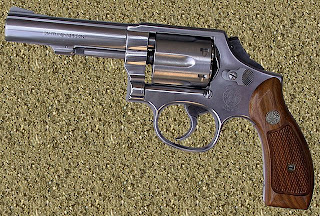 This Model 64's trigger and hammer are not "flash chromed" to appear stainless nor are they stainless steel. They're "regular" chrome moly and that's fine by me. The revolver had a few dings and scratches, but they were cleaned up a bit with fine wet-to-dry sandpaper and the stocks were refinished with Birchwood Casey's Tru-Oil. The Model 64 is merely a stainless version of the classic Model 10 and is built on the popular K-frame that many found extremely comfortable to use for decade upon decade.
 These six shots were the first I fired out of the revolver. Distance was seven yards from a standing position and using a two-hand hold. Ammunition was Georgia Arms 158-gr. SWC's. These shots were fired in slow-fire with absolutely no effort at speed.
This Model 64's trigger and hammer are not "flash chromed" to appear stainless nor are they stainless steel. They're "regular" chrome moly and that's fine by me. The revolver had a few dings and scratches, but they were cleaned up a bit with fine wet-to-dry sandpaper and the stocks were refinished with Birchwood Casey's Tru-Oil. The Model 64 is merely a stainless version of the classic Model 10 and is built on the popular K-frame that many found extremely comfortable to use for decade upon decade.I have been told by those more "tactical" than I that one cannot adequately defend home, hearth and heinie with a wheel gun. While I agree fully that the 6-shot revolver has to be reloaded more often than a comparable size autoloader, I also believe that we "solve our problem" in the first few shots and run out of time before ammunition. In other words, in most deadly force scenarios involving private citizens, I think that the revolver can hold its own if he can get the hits. This is true with any handgun and I've said before that "placement is power". In other words, I still believe that placement remains a primary component in "stopping power" and whether we survive or don't! (Do not make a mistake here and think that I support anything like "high-capacity magazine bans". I am firmly opposed to such anti-Second Amendment tripe and do all that I legally can to oppose it and I always will.)
Taking the revolver to the range, I was pleased but not surprised to find that the fixed sights were perfectly regulated for 158-gr. ammunition.
These six shots were the first I fired out of the revolver. Distance was seven yards from a standing position and using a two-hand hold. Ammunition was Georgia Arms 158-gr. SWC's. These shots were fired in slow-fire with absolutely no effort at speed. More "practical" defensive-type drills such as the common Failure to Stop drill were tried and a timer revealed them well within accepted standards.
In my opinion, the 4" .38 Special (quality) revolver with defensive ammunition is still a very viable defense gun and one that can be easily understood by shooters having less experience. That said, I definitely do not relegate this as a gun suitable only for a "beginner". I am aware of some very seasoned retired (and current) lawmen and shooters who stick with the DA revolver by choice and I assure you, they can get the hits and in a hurry.
These service-style Smith & Wessons turn up not infrequently for sale at pretty nice prices ($250 to $300, depending upon condition), but I fear that frequency will decrease with each passing year. I submit that these revolvers make a most useful addition to the owner's collection for both fun and more serious aspects of shooting. I think that at these or similar prices one gets more rather than less quality! These wheel guns are capable of extremely accurate grouping and if a person's willing to learn accurate double-action shooting, that person's probably going to be very surprised at what can be accomplished with the time-proven double-action revolver.
I am certainly not about to part with my 13-shot Hi Powers or other semiautomatic pistols but neither do I feel unarmed in the least with this retired old work horse. As this is written, it's loaded with Remington 158-gr. LHP +P less than a foot from my strong shooting hand.
If you get the opportunity, I strongly recommend one (or more) of these for your collection.
Best.
Friday, January 16, 2009
My Hi Power Fails to Eject on the Last Shot. Why?
Hello. One of the reasons for the Hi Power's continued popularity must be its very fine reliability. Having said that, I note that a somewhat FAQ concerns the Hi Power not ejecting the last fired case. Prior shots always extract and eject but that last round fires, the slide locks back and sure 'nuff, the empty case is lying atop the magazine.
Why?
I have a Hi Power in which this frequently occurs. It has not affected reliability at all but I can see how it could cause some concerns for those considering the pistol in a self-defense setting.
On all but the last shot, there is a cartridge in the magazine beneath the fired case being extracted as the gun fires. This keeps the hull from sliding downward on the breechface if the gun's extractor claw doesn't hold the case quite tightly enough to keep it from doing so. On marginal cases, the Hi Power might fail to eject the last hull with Brand X but never do it with Brand Y. The reason is slightly different rim thicknesses on the different makers' rounds.
The problem can usually be corrected by very lightly stoning the pad that bottoms against the slide in the groove in which the (external) extractor rides. Not much is necessary to eliminate the problem and this frequently takes care of it.
If the gun is failing to extract/eject on all shots, the problem is either a damaged extractor claw, a weak extractor spring, or both.
Best.
Why?
I have a Hi Power in which this frequently occurs. It has not affected reliability at all but I can see how it could cause some concerns for those considering the pistol in a self-defense setting.
On all but the last shot, there is a cartridge in the magazine beneath the fired case being extracted as the gun fires. This keeps the hull from sliding downward on the breechface if the gun's extractor claw doesn't hold the case quite tightly enough to keep it from doing so. On marginal cases, the Hi Power might fail to eject the last hull with Brand X but never do it with Brand Y. The reason is slightly different rim thicknesses on the different makers' rounds.
The problem can usually be corrected by very lightly stoning the pad that bottoms against the slide in the groove in which the (external) extractor rides. Not much is necessary to eliminate the problem and this frequently takes care of it.
If the gun is failing to extract/eject on all shots, the problem is either a damaged extractor claw, a weak extractor spring, or both.
Best.
Sunday, December 28, 2008
Informal Tests: Hornady Critical Defense .380 & .38 Special
Hello. The arena of self-defense remains one area of concern for many handgun owners. For some, it is their only concern for their handgun(s) purpose(s) is strictly to save their hides from violent felons and to a lesser degree, dangerous animals.
In recent years we have seen much improvement in ammunition intended for such serious purposes.
But a few decades past, one couldn't expect jacketed hollow points to expand reliabily (if at all in some cases) unless driven to very high speeds for caliber or reducing bullet weight in order to achieve the higher-than-normal speeds essential for expansion.
Eventually we did get ammunition with bullets that would expanded reliably a great deal of the time, but little thought was given to penetration. Expansion was the name of the game, the "be-all-end-all" in "stopping power".
We did hear of failures to be sure but there were also successes but the truth is that results could be quite varied. Some quit worrying about expanding ammunition and went strictly with solids so that penetration, at least, could be counted upon. Others remained sure that hyper-velocity rapid-expansion or fragmenting ammo was the sure cure for those pesky, violent felons.
"Back to the drawing board" must have been a repeated clarion call for serious handgun ammunition developers these past decades. Today's shooting community has a better and probably most varied ammunition selection than ever before. (Let us hope that the current crop of freedom-hating, anti-gun politicians are not able to change that!)
Hornady has been manufacturing very fine handgun and rifle bullets for decades. Their handgun bullets for reloading were pretty traditional until the introduction of the "XTP" line after the infamous 1986 FBI "Miami Shootout" in which several FBI agents lost their lives after one miscreant had been nicely popped with a 9mm 115-gr. Winchester Silvertip Hollow Point that punched through an arm before entering the upper torso from the side. The expanded bullet stopped just short of the heart. I will not get into the (vast) number of shots fired vs. the (small) number of hits but this incident did bring both bullet expansion and penetration requirements to the forefront of "stopping power" discussions.
The "XTP" (eXtreme Terminal Performance) handgun bullets from Hornady were designed to expand to about 1.5 times the original caliber rather than the previously-desired expanded "lead pancake". They did this nicely and XTP handgun bullets have been among the most accurate I've ever shot in either factory or handloaded handgun ammunition.
 Here is typical performance for the XTP bullet. This one is a factory Hornady 90-gr. in .380 ACP. Results in "wet pack" or water were consistently about 1.5 calibers and accuracy was first-rate in several .380 pistols I tried it in. It would average about 920 ft/sec from a Bersa Thunder with a 3.5" barrel. This is usually very consistent ammo from my guns and would have very small extreme spreads. This one was from a lot having an extreme spread of 16 ft/sec!
While the old claim that bullets traveling under 1000 ft/sec wouldn't expand had not been true for quite a few years, it was true that a majority of expanding bullets simply wouldn't if forced to pass through intermediate barriers before striking their intended "soft target". A bullet that might be a reliable expander in tissue would often times act like a solid if passing through leather (as in a coat), plywood, drywall, or other fabrics. Even penetration remained adequate, the wound channel was greatly reduced. This reduced the bullet's effectiveness and the fear of overpenetration reared its head again in handgun ammunition and self-protection.
I was happy to see these standard pressure loads being first available in .380 ACP and .38 Special and here's why.
In any event, I was hopeful in finally getting to see a .380 ACP round that might offer its users both adequate penetration and reliable expansion
This Bersa's POA has always matched 90 to 95-gr. .380 ACP POI out to about 15 or 20 yards and I was not surprised today to find that such remains the case with this 90-gr. Critical Defense load.
I did not achieve the listed 1000 ft/sec velocity with my Bersa.
Cutting to the chase, expansion was extremely consistent. I could not tell which expanded bullets had punched the towel vs. which had not by looking at the results. Penetration was extremely consistent as well. With the .380, the greatest variation in penetration depths was a surprisingly small 1/10"!
 The .380 Critical Defense load was amazingly consistent. Note how the two expanded bullets at the right on the box so closely match the pictured ones. Virtually no bullet weight was lost nor were their signs of bullet fragmentation. Average expanded bullet dimensions: 0.469 x 0.474 x 0.337" tall.
In recent years we have seen much improvement in ammunition intended for such serious purposes.
But a few decades past, one couldn't expect jacketed hollow points to expand reliabily (if at all in some cases) unless driven to very high speeds for caliber or reducing bullet weight in order to achieve the higher-than-normal speeds essential for expansion.
Eventually we did get ammunition with bullets that would expanded reliably a great deal of the time, but little thought was given to penetration. Expansion was the name of the game, the "be-all-end-all" in "stopping power".
We did hear of failures to be sure but there were also successes but the truth is that results could be quite varied. Some quit worrying about expanding ammunition and went strictly with solids so that penetration, at least, could be counted upon. Others remained sure that hyper-velocity rapid-expansion or fragmenting ammo was the sure cure for those pesky, violent felons.
"Back to the drawing board" must have been a repeated clarion call for serious handgun ammunition developers these past decades. Today's shooting community has a better and probably most varied ammunition selection than ever before. (Let us hope that the current crop of freedom-hating, anti-gun politicians are not able to change that!)
Hornady has been manufacturing very fine handgun and rifle bullets for decades. Their handgun bullets for reloading were pretty traditional until the introduction of the "XTP" line after the infamous 1986 FBI "Miami Shootout" in which several FBI agents lost their lives after one miscreant had been nicely popped with a 9mm 115-gr. Winchester Silvertip Hollow Point that punched through an arm before entering the upper torso from the side. The expanded bullet stopped just short of the heart. I will not get into the (vast) number of shots fired vs. the (small) number of hits but this incident did bring both bullet expansion and penetration requirements to the forefront of "stopping power" discussions.
The "XTP" (eXtreme Terminal Performance) handgun bullets from Hornady were designed to expand to about 1.5 times the original caliber rather than the previously-desired expanded "lead pancake". They did this nicely and XTP handgun bullets have been among the most accurate I've ever shot in either factory or handloaded handgun ammunition.
Here is typical performance for the XTP bullet. This one is a factory Hornady 90-gr. in .380 ACP. Results in "wet pack" or water were consistently about 1.5 calibers and accuracy was first-rate in several .380 pistols I tried it in. It would average about 920 ft/sec from a Bersa Thunder with a 3.5" barrel. This is usually very consistent ammo from my guns and would have very small extreme spreads. This one was from a lot having an extreme spread of 16 ft/sec!While the old claim that bullets traveling under 1000 ft/sec wouldn't expand had not been true for quite a few years, it was true that a majority of expanding bullets simply wouldn't if forced to pass through intermediate barriers before striking their intended "soft target". A bullet that might be a reliable expander in tissue would often times act like a solid if passing through leather (as in a coat), plywood, drywall, or other fabrics. Even penetration remained adequate, the wound channel was greatly reduced. This reduced the bullet's effectiveness and the fear of overpenetration reared its head again in handgun ammunition and self-protection.
Hornady was first to try and meet the FBI's 12" penetration minimum in 10% ballistic gelatin with their XTP line of bullets. They also sold these bullets in loaded ammunition as well. (It should be noted here that this 12" minimum includes such things as shooting through laminated automobile windshields, something not nearly so likely for the private citizen. The honest private citizen unlucky enough to be involved in a deadly force scenario is very likely to be face-to-face with his/her attacker and very close and we can probably get by just fine with ammunition penetrating a bit less than 12". Some ammunition that I've used on small to medium Texas game penetrates less than 12" but has repeatedly proven itself capable of human, rapid "stops". Likewise, visiting with folks who've used similar ammunition against human beings has shown that bullets penetrating less than 12" can be effective for head-on, unobstructed shots. At the same time, I cannot fault anyone who insists on ammunition doing no less than 12" in ballistic gelatin after passing through 4-layers of denim. (The denim barrier doesn't necessarily mean that one's attacker will be wrapped up like a tamale; it is described as a "worst case senario" and one that IF a bullet passes, it can be expected to almost always expand on the street.) The flagship loads from today's handgun ammunition manufacturers will usually pass this test and come with other desireable traits such as being sealed against moisture and having flash-retardant powders.
 This Texas whitetail was cleanly and legally taken with a handloaded 45-caliber 200-gr. XTP. Penetration was complete and expansion evident. Overpenetration is not a worry under most hunting conditions. It is considered a serious potential problem by some concerned with having to shoot in an urban area. The XTP offered plenty of penetration but sometimes didn't expand satisfactorily if passing through intermediate barriers before striking gelatin...or tissue. Hornady's Critical Defense ammunition is reported to expand consistently, regardless of whether an intermediate target is struck or not.
Hornady's XTP appears to have been more appreciated by the handgun hunting community than those focusing on self-defense, and to that end, Hornady has come out with a new line of ammunition that reportedly passes through almost any barrier and still reliably expands. It is called "Critical Defense" and is currently (Dec. '08) available in .380 ACP and .38 Special. Hornady says up front that they didn't focus on its passing each and every FBI requirement and in at least one caliber, it doesn't make the 12" minium, but it gets darned close, as in 10 /12" or so when fired from the little Ruger .380 auto.
It utilizes a cannulured jacketed bullet and has a lead core as well as a hollow cavity at the nose. However, this cavity is filled with a red, flexible substance. Hornady calls this their FTX bullet.
Find out more about the FTX bullet here: http://www.hornady.com/story.php?s=786
It seems reasonable to assume that this ammunition is Hornady's competition for Speer's Gold Dot, Remington's Golden Saber, Winchester's Ranger (LE ammo), and Federal's Personal Defense ammunition.
While not inexpensive, there are other lines of self-protection ammunition from other makers that is more costly. Each box of Hornady's .380 ACP Critical Defense line of ammo cost me $17.95 or about $0.72/shot. The 110-gr. .38 Special costs $19.95 a box or $0.80/shot. While this is certainly not too much for premium ammunition to save one's life, it is enough to make one try and be conservative in informal "tests" like this one...at least on my retirement abilities.I was happy to see these standard pressure loads being first available in .380 ACP and .38 Special and here's why.
The .380, be it in one of today's really compact hideout pistols or the more traditional Walther PPK, SIG-Sauer P230/232, Bersa, etc, size has had to be a "compromise" caliber. What I mean by that is that if one used expanding ammunition that actually did, penetration was frequently very lacking. These lightweight bullets and the caliber's limited case capacity combined with the shooting platform's (almost always) straight blowback design prevented ammunition powerful enough to provide adequate penetration and reliable expansion. Thus, a goodly section of the .380 ACP toters opt to use FMJ ammunition. This will penetrate but with no expansion wound channels are small. The idea is that while expansion is desireable, penetration is essential. It is also usually mentioned that FMJ round nose is more reliable than blunter ogive JHP's. (It's been my observation that some guns are extremely reliable with most JHP's while others are not. I do not believe that FMJ is necessarily more reliable than expanding ammo in all 380-caliber pistols. I do not believe it has to be an absolute.)
Shooting: The handguns used in today's informal tests were my old Bersa Thunder 380, which has a 3.5" barrel and is in stock condition. It has had several thousand rounds through it with exactly zero malfunctions. For the .38 Special, I opted for my old BUG, an S&W Model 042. It is not rated for +P ammunition and sports the old J-frame rather than the Magnum J-frame common to current S&W J-frames.In any event, I was hopeful in finally getting to see a .380 ACP round that might offer its users both adequate penetration and reliable expansion
Likewise, I was hoping to see a .38 Special round loaded to standard pressures that could be used w/o concern in some of the lightweight revolvers not rated for +P loads. In the past, I've seen some light-for-caliber-standard-pressure rounds fired from snubs provide ballistic results similar to the .380. In other words, expansion but 6 1/2 to 7 1/2" penetration. (Speaking only for myself, this is too shallow to be trusted. I can go with 10" penetration and certainly prefer the FBI 12" minimum, but just am not confident with less than 10" penetration in 10% ballistic gelatin.)
One can certainly get adequate penetration coupled with reliable expansion from the snub .38, though it has to be "worked at" with more judicious load selection than for the longer barrel revolvers...but it has to be +P ammunition. Though I've personally experienced no problems with the occassional use of +P ammunition in quality .38 Special revolvers that are not so-rated, some folks really don't like the idea. Others cannot tolerate the increased felt recoil and some just settle on standard pressure solids, with results similar to those of the .380 ACP.
 These handguns are essentially stock and both have proven reliable and accurate over the years. The snub sports Precision's black nylon "Hide Out" grips that I modified to work with an HKS speedloader.
 These five shots were fired standing from an unsupported position and in single-action. No effort was made at speed. My goal was to see if this load would group satisfactorily within most self-defense shooting distances for private citizens. I believe that the ammunition is capable of one-hole groups at this distance; I simply am not.
This Bersa's POA has always matched 90 to 95-gr. .380 ACP POI out to about 15 or 20 yards and I was not surprised today to find that such remains the case with this 90-gr. Critical Defense load.
I did not achieve the listed 1000 ft/sec velocity with my Bersa.
Average velocity was a respectable 911 ft/sec with an extreme velocity spread of but 11 ft/sec and a tiny extreme spread of 5 ft/sec! This is based on 10 shots fired 10 feet from the chronograph screens! In my experience, this is about as consistent of ammunition as one can ever hope to get. Does this mean that the same will be true in all .380 pistols? No, but I'll bet it groups nicely and has pretty darned consistent properties when fired out of any quality 380.
 The 110-gr. standard pressure Critical Defense .38 Special loads grouped nicely as well. The shot to the far right was my fault. I knew it when I fired it. It was not due to any inconsistency with the ammunition. Being a DAO revolver, all shots were DA. Like with the Bersa, POA was the center of the bullseye. These light-for-caliber bullets hit immediately below POA. At greater distances, the divergence of POA from POI might be an issue but not at ten yards and under.
Expansion Testing: Not having access to either caliberated 10% ballistic gelatin or a climate-controlled lab in which to achieve repeatable tests with it, I just used the old "wet pack" approach. I used plain old supersaturated news print. I soaked it for 24-hours and then drained it 30 minutes before shooting. Bullet penetration is definitely not the same as for the gelatin, but it seems roughly comparible in showing how a bullet expands. Through trial-and-error and comparing actual, repeated gelatin penetration tests with ammunition in wet pack, it seems that multiplying the penetration in wet pack by 3 and then dividing by 2 gives a pretty fair expectation of what the bullet would do in calibrated 10% gelatin.
Ten shots of each caliber was fired into wet pack from a distance of 5 feet. The depth of each "wound channel" was measured using a probe before retrieving the bullet. The measured height of each expanded bullet was added to each depth to give the true penetration distance from the wet pack surface to the front of the expanded bullet. I didn't have any denim but did fire five of each ten shots per caliber through 4 layers of the common cotton/polyester bathtowel.Cutting to the chase, expansion was extremely consistent. I could not tell which expanded bullets had punched the towel vs. which had not by looking at the results. Penetration was extremely consistent as well. With the .380, the greatest variation in penetration depths was a surprisingly small 1/10"!
Hornady .380 ACP 90-gr. Critical Defense averaged 6.75" in wet pack. This should be about 10.12" in 10% ballistic gelatin.
The .380 Critical Defense load was amazingly consistent. Note how the two expanded bullets at the right on the box so closely match the pictured ones. Virtually no bullet weight was lost nor were their signs of bullet fragmentation. Average expanded bullet dimensions: 0.469 x 0.474 x 0.337" tall.Fired from the S&W's 1 7/8" barrel, average penetration of the 110-gr. FTX bullet used in the Critical Defense line of ammo was 7.6". The greatest variation in penetration depths was 6/10". Based on what I saw today, I would expect this load to penetration approximately 11.4 to 12" or so in ballistic gelatin.
 The .38 Special load was also very consistent and performed admirably in my opinion. In this picture, I also included the red, pliable material that fills the bullet's hollow point. Because the hollow point cannot be plugged up with debris from an intermediate target, expansion is almost certain to occur. The little red "fillers" were visible in the wet pack "wound tracks" of both the .380 ACP and .38 Special. Average expanded bullet diameter: 0.481 x 0.451 x 0.408" tall.
Conclusion: I believe that Hornady has come up with some pretty darned nice standard pressure ammunition for "serious use" in 380-caliber pistols as well as .38 revolvers. I have not seen any ammunition from any maker that is more consistent and any more likely to expand under varied conditions as this.
Even with its advanced FTX bullet and super-consistent Critical Defense ammunition, I just don't believe that we can transform the .380 or .38 snub into rhino-rolling handguns of nuclear destruction capabilities, i.e.: the FTX bullet isn't magic. That definitely does not mean that it isn't one of the best choices to maximize the ballistic potential of what a given handgun caliber has to offer.
I'll stick with the .38 snub over the .380 ACP but were I using a .380, I might very well go with this load from Hornady. In my opinion, it bests the very nice Corbon .380 DPX but only because Corbon had to use a lighter (80-gr.) bullet due to its being all copper alloy and longer than the lead core bullet used in the Critical Defense load. I am not at all convinced that this line will stand out above other premium ammunition makers' premium, best-quality defense loads.
In the .38 Special snub, for now I'll just stay with the "old technology" LHP +P from Remington. In my guns, it hits point of aim and the load has a pretty nice actual "street record" but if I were worried about the +P thing and was determined to carry an aluminum alloy slug, this would be a standard pressure load that I might very well use.
Best to all.
Monday, December 15, 2008
SIG-Sauer P232 vs. Beretta Model 85 F Cheetah...
Hello. The choice between these two quality .380 pistols will probably be decided by which one feels and looks best to the individual buyer, factors that are admittedly subjective. I am not saying that there's a thing in the world wrong with that but there are some differences that might be worthy of some consideration.
I am not going to get into the "Why-get-a-380-when-there-are-small-9mm/40-caliber-pistols-available?", or the "stopping power" issue. The reason is simple: On the forums, folks asking about specific .380 pistols sometimes put in the request not to go into the 9mm/.40 options, stating that for whatever reasons, they are going with a 380-caliber handgun...and are routinely ignored with the usual Caliber A vs. Calber B arguments which sometimes results in the threads' never getting around to answering the original questions! The thread gets "hijacked" by well-meaning posters arguing over caliber rather than answering the questions originally asked!
I am not going to get into the "Why-get-a-380-when-there-are-small-9mm/40-caliber-pistols-available?", or the "stopping power" issue. The reason is simple: On the forums, folks asking about specific .380 pistols sometimes put in the request not to go into the 9mm/.40 options, stating that for whatever reasons, they are going with a 380-caliber handgun...and are routinely ignored with the usual Caliber A vs. Calber B arguments which sometimes results in the threads' never getting around to answering the original questions! The thread gets "hijacked" by well-meaning posters arguing over caliber rather than answering the questions originally asked!
With that caveat, let's see what we might see...

The SIG-Sauer P232 is an easy-to-carry .380 ACP that is easy to shoot, accurate and reliable.
SIG-Sauer P232:
LOA: 6.6"
Height: 5.7"
Width: 1.3"
Bbl: 3.6" w/1:10" twist
Weight: (aluminum frame) 18.5 ounces (all stainless) 23.6 ounces. (Both of these weights do not include magazines.)
Magazine Capacity: 7
Magazine Weight (empty): 1.4-oz blued and 1.6 oz-stainless
Internal Firing Pin Safety: Yes
Magazine Disconnect: No
Sights: Fixed
Grips: Black synthetic
Trigger Pull: 10-lbs.(DA) 4.4-lbs (SA)
Decocking Lever: Yes
External Thumb Safety: No
In addition, the gun is available in blue, stainless and two-tone finishes.
 The Beretta 85F has proven itself reliable as were its predecessors. The F-Series have the hooked "combat trigger guard. I prefer the more traditional rounded ones.
 I much prefer the rounded, "non-combat" trigger guard on the older Beretta Model 85 BB version and the SIG-Sauer P232 to that on the Beretta Model 85 F. The reason is simple; I do not hook a finger on the trigger guard. If you do, your preferences might be just the opposite.
 The Model 85F (Cheetah) is described:
LOA: 6.77"
Height: 4.8"
Width: 1.37"
Bbl: 3.81" w/1:10" twist (actually 9.84 but 10" is close enough)
Weight: 21.9-oz
Magazine Capacity: 8 shots
Sights: Fixed
Grips: Black, synthetic
Decocking Lever: Yes
External Thumb Safety: Yes, ambidextrous (Pushing these upward with the pistol cocked will safely decock the hammer and then the pistol cannot be fired until they are pushed downward (ala 1911) to disengage.
Some of the discontinued "B" and "BB" models were offered in either blue or nickle finishes. The current "F" models are available in the dark Brunitron finish which protects against corrosion.
Both the SIG-Sauer and the Beretta can be had with wooden stocks if desired. Both the front and rear grip straps on the Model 85 are serrated. These are smooth on the P232.
The SIG-Sauer P232 can be had in the lightweight aluminum frame/blue slide version or the heavier all-stainless "SL" version. The Beretta is offered only with the lighter aluminum alloy frame.
I do not have information on the DA/SA trigger pulls on the Beretta Model 85F, but to me it is similar to the SIG-Sauer. I do not find enough difference to be of any consequence. If it is of any importance, the P232's trigger face is smooth while the Beretta's is grooved and has a trigger stop. (I find neither trigger face or pull superior to the other in actual use on these pistols.)
The Beretta with its smaller serrated flats seems to generate more complaints about difficulties in racking the slide than the SIG-Sauer's if that is an issue. I find the SIG-Sauer easier to rack, but don't find either a problem. This might not be the case with some of our older folks or those with weaker hands or arms.
While both are "straight blowback" designs, the SIG-Sauer's bbl is fixed to the frame. The Beretta's is not; it is removable during the field-stripping process. That said, I have not been able to determine any accuracy degredation in the Beretta due to its "non-fixed" barrel. It is simply not an issue in my view. Neither is the slight difference in barrel length between the two. Average velocites with factory ammunition have proven very similar between these two little autos.
LOA: 6.77"
Height: 4.8"
Width: 1.37"
Bbl: 3.81" w/1:10" twist (actually 9.84 but 10" is close enough)
Weight: 21.9-oz
Magazine Capacity: 8 shots
Sights: Fixed
Grips: Black, synthetic
Decocking Lever: Yes
External Thumb Safety: Yes, ambidextrous (Pushing these upward with the pistol cocked will safely decock the hammer and then the pistol cannot be fired until they are pushed downward (ala 1911) to disengage.
Some of the discontinued "B" and "BB" models were offered in either blue or nickle finishes. The current "F" models are available in the dark Brunitron finish which protects against corrosion.
Both the SIG-Sauer and the Beretta can be had with wooden stocks if desired. Both the front and rear grip straps on the Model 85 are serrated. These are smooth on the P232.
The SIG-Sauer P232 can be had in the lightweight aluminum frame/blue slide version or the heavier all-stainless "SL" version. The Beretta is offered only with the lighter aluminum alloy frame.
I do not have information on the DA/SA trigger pulls on the Beretta Model 85F, but to me it is similar to the SIG-Sauer. I do not find enough difference to be of any consequence. If it is of any importance, the P232's trigger face is smooth while the Beretta's is grooved and has a trigger stop. (I find neither trigger face or pull superior to the other in actual use on these pistols.)
The Beretta with its smaller serrated flats seems to generate more complaints about difficulties in racking the slide than the SIG-Sauer's if that is an issue. I find the SIG-Sauer easier to rack, but don't find either a problem. This might not be the case with some of our older folks or those with weaker hands or arms.
While both are "straight blowback" designs, the SIG-Sauer's bbl is fixed to the frame. The Beretta's is not; it is removable during the field-stripping process. That said, I have not been able to determine any accuracy degredation in the Beretta due to its "non-fixed" barrel. It is simply not an issue in my view. Neither is the slight difference in barrel length between the two. Average velocites with factory ammunition have proven very similar between these two little autos.
 I've never shot a Beretta Model 84 or 85 that didn't mimick the Walther PP series in that shots hit about 1 1/2 to 2" high for me at ranges of 15 yards or more. (Most folks will not be interested in shooting these "pocket guns" at great distances and at closer ranges, the sights are "on" close enough in my experience.) Unlike shooting the Walthers, I do not suffer either slide or hammer bite with the Beretta or the SIG-Sauer.
For me, the SIG-Sauer P232's in .380 hit "dead on" for me at ranges from arm's length to about 25 yards or so. I much prefer the P232's sight picture to the Beretta's, but that might not be an issue for a pistol intended for close-in use and that was never intended as a formal match pistol.
The following is based on a relatively small number of handguns but I find either the 232 or the Cheetah to be very reliable with ball and JHP ammunition. (Most of the earlier P230's I shot were fine with ball and some were alright with JHP's but not all. I have not shot any Beretta Model 84 or 85 in any version that wasn't reliable with any and all ammunition. I think SIG-Sauer was aware of this issue because while I only own one P232, it's been 100% reliable with all FMJ and JHP ammo as have those owned by other shooters I know.)
If I shoot over about 200 rounds of standard-power .380 in a session with the P232, I do notice a couple of little "wear" areas where the edges of the tang rub my hand. None of this occurs for me with the Berettas in either the M84 or 85 versions.
Which is best? I flat do not know. Both are quality firearms. Between the two, I think I prefer the SIG-Sauer P232 but I don't intend to sell my Beretta 85F either!
I find either easy to shoot accurately in double-action mode and both are a piece-of-cake in single-action. I do not notice any difference in felt recoil between the two.
Sweeping "off" the thumb safety is easily done and comfortable for the Beretta, but it is perfectly safe to carry with the thumb safety disengaged as it has an internal firing pin safety like the P232. Some will opt for the gun having the external safety as it not only offers perhaps another level of safety but might prevent an attacker or unauthorized user from immediately grabbing and firing the pistol. If this is a major concern for you, the Beretta is the way to go as the P232 offers no such external safety; it is a "point-and-pull" design.
Both offer an external slide release.
The Beretta has the magazine release at the rear of the trigger guard like the 1911-pattern pistols, Hi Powers, etc. The SIG-Sauer's is a bottom-release design ala the Makarov and other European designs. (The Model 85F's push-button magazine release is not ambidextrous.)
While the Beretta's is probably quicker in the event of a speed magazine change, the SIG-Sauer's is considered less like to inadvertently release the magazine as might happen were the pistol sat on or carried tightly against the body. Again, what is actually "important" will be up to the individual buyer's perceptions.
I seldom carry pistols of this genre but were I depending upon a .380 for "serious purposes", I would absolutely not doubt the mechanical ability of either of these, though between the two, I would probably go with the P232, simply because I much prefer its sight picture and that POA matches POI for me better than the Beretta. (It is possible that this will not hold true for all or that it just won't be an issue for many.)
Again, speaking only for myself, I doubt that I'd pick the heavier all-stainless P232 and in my admittedly subjective observations, I don't find either the aluminum-framed P232 or Model 85 difficult to carry nor do I find one to have a "real world" advantage over the other in this regard. (Were I concerned with rust and corrosion, I'd go with the Brunitron finish on the Beretta.)
Hand-cycling ammunition through both guns seems to result in more positive ejection of the cartridges with the Beretta than the SIG-Sauer but in actual firing, both fling the fired cases well away from the shooter. Both use external, pivoting extractors and I've not noted one being better or tougher than the other.
Unlike the 1911, there is not a literal cottage industry of aftermarket parts for either of these well-made pistols, but both remain in production and OEM parts as well as aftermarket grips and recoil springs are available, as are extra single-stack magazines.
As mentioned earlier, I think that the choice between one or the other of these two pistols is not a choice between quality but between the guns' individual features as well as the buyer's subjective preferences. Either of these guns are well-made and quality firearms in my opinion.
Best.
Monday, November 17, 2008
FAQ on Self-Defense Handguns & "Stopping Power"
Hello. I frequently receive numerous questions concerning the "right" handgun for self-protection as well as requests for information on the "best" loads/calibers for "stopping" someone who is bent upon doing one harm.
I thought that it might be interesting to compile the most commonly asked questions I receive and answer them in an article, but let me hasten to add that I am not an expert and have never claimed otherwise. I am a retired police officer, police firearm instructor, tactical team leader, and have been seriously interested in what handgun bullets actually do to human aggressors for decades. I have seen felons shot and in each instance was seriously unimpressed with the actual incapacitation times required to truly render the bad guy harmless, be that through unconsciousness or death. Calibers involved ranged from .38 Special, 9mm, and .357 magnum through .45 ACP. Of those incidents, only two involved nonexpanding ammunition. The rest were with hollow points.
Over the years, it has been my privilege to visit with law enforcement/military personnel who had been forced to use handguns to "stop" another human being. More officers than soldiers actually had this experience since most soldiers are not issued pistols. I have not and will not disclose the names of those persons. Some of these contacts are recent while others are decades old. One faction of the "stopping power community" will declare any such information as "anecdotal" and useless because it is not documented. I honestly could not care less. It is not my goal, aim, or intention to be published in the scientific literature surrounding this topic. I truly respect the scientific method and understand its precepts from my college days as a double major in physics and mathematics, but have enough common sense to listen to those who have actually been in the urine stench atmosphere of life-and-death shootouts and close quarter combat. The laboratory approach to terminal ballistics is a fine thing and that I have great respect for. At the same time, results from the street are hard to just discount. Discussions with coroners have also occurred but on a less frequent basis. I find it interesting that when our military's scientific personnel engineer a new weapon, all that can be done in the lab to assure its reliability, etc, is no doubt done. Still, the weapon finds its way to a proving ground. Might not the street's real life conflicts be a direct parallel to the military proving ground?
I also hunt with a handgun and have since the early '70's. The largest animals I've repeatedly killed cleanly with one shot have been Texas whitetail deer. Most critters I've killed have ranged in size from the cagey and sly coyote to the tough-as-nails javelina, raccoon and fox. On these, I have been singularly unimpressed with solids used in any caliber from .38 Special to .45 ACP. (With .45 Colt using the large 255-gr. CSWC having a very wide meplat, things are much better. The .41 and .44 magnums with their smaller CSWC meplats apparently have the speed to make up for their slightly smaller flat compared to the .45 Colt.)
 Fired from a Browning Mk III at about 12 yards, I hit this Texas whitetail deer's heart with a Winchester 127-gr. Ranger JHP +P+. The animal was instantly decked, unable to get up but weakly kicking for about 15 seconds. This was done under handgun hunting conditions and the shot taken only with absolutely perfect conditions. The life-or-death scenario we might find ourselves having to use deadly force in will allow for neither perfect conditions or much time for steady and sure aim. A hit like this against a dangerous felon would surely be a good hit, but not necessarily an instantaneous stop. Always expect the unexpected and don't just assume that because you're using premium ammunition that your hits will do what you want as quickly as you want.
While the shooting of animals versus felons emphatically is not the same thing, I think that there are similarities involved in "stopping" or the mechanism of collapse. How pertinent these are will always be open to debate.
With regard to "proper" defensive handguns, I personally will not go lighter than a .38 snub using expanding +P ammunition for a hideout or backup gun. The belt gun should be 9mm, .38 Super, .40 S&W, .357 SIG, or .45 ACP in my opinion. Those opting for revolvers should not go lighter than .38 Special +P.
I have little tolerance or use for the dogma so often associated with either of these related topics. I have yet to see and much less understand how some people seem to believe that such discussion is license for rudeness and all around boorish behavior.
Hopefully, you see where I'm coming from and that I leave it entirely to the reader to decide how much of this is worthwhile, on the money, or just dead wrong. It is not my aim to try and sway a single soul to my beliefs, only to provide what I believe to be true and offer them more "food for thought" in making up their own minds on these topics.
With this in mind, let's proceed to the questions.
1. What is your preferred number one defensive handgun?
For pocket, hideout, or BUG use, my preference remains the S&W J-frame snub in .38 Special and with +P expanding ammunition. Right now, the top choice for me is the Airweight S&W Model 642 or 442. I prefer it to the all-steel snubs and only carry "pre-lock" revolvers. I also choose the aluminum gun over the newer lighter scandium/titanium revolvers because I am not limited to jacketed ammo. Those revolvers lighter than the "Airweight" series cannot be used with lead bullets; they unseat themselves in recoil and lock up the gun. I have personally tried this and such has been the case in caliber .38, .357, and .44 Special. If the snub is to be worn on the belt, I'd go with a steel revolver with at least a 3" bbl, if there is a choice. With regard to semiautomatic handguns, I have no real desire for those lighter than 9x19mm nor having less than a 3" barrel…and much prefer longer barrels. My favorite all around 9mm pistol remains the lightly modified Browning Hi Power Mk III. From a strictly defensive viewpoint, I do favor the .45 ACP from a 5" 1911 pattern pistol. Using a two-hand hold, I note no real difference in handling ability, but when using one hand, I do slightly better with the Hi Power.
2. Why are you against the .380 and 9x18mm Makarov for self-defense?
 This little Bersa Series 95 is a favorite of mine. I really like the gun's handling and concealment capabilities. I am not fond of the cartridge for self-protection but understand that more than a few folks find themselves able to more accurately shoot a .380 auto than a hot-loaded-but-lightweight-38-snub. Under some conditions, I have toted a .380 or 9mm Makarov for "serious purposes" but though I remained truly a staunch admirer of the guns, I never changed my belief that better defensive calibers can be had in similar size packages. I had rather face a poor shot, lousy tactician and undecided adversary who was armed with a .44 Magnum than a skilled shot, determined to survive and having but a .22! If you prefer the .380 or 9x18mm Makarov, use them; be competent, accurate and quick in their safe handling, but this is true for any caliber/gun combination to be used in the self-defense arena.
I thought that it might be interesting to compile the most commonly asked questions I receive and answer them in an article, but let me hasten to add that I am not an expert and have never claimed otherwise. I am a retired police officer, police firearm instructor, tactical team leader, and have been seriously interested in what handgun bullets actually do to human aggressors for decades. I have seen felons shot and in each instance was seriously unimpressed with the actual incapacitation times required to truly render the bad guy harmless, be that through unconsciousness or death. Calibers involved ranged from .38 Special, 9mm, and .357 magnum through .45 ACP. Of those incidents, only two involved nonexpanding ammunition. The rest were with hollow points.
Over the years, it has been my privilege to visit with law enforcement/military personnel who had been forced to use handguns to "stop" another human being. More officers than soldiers actually had this experience since most soldiers are not issued pistols. I have not and will not disclose the names of those persons. Some of these contacts are recent while others are decades old. One faction of the "stopping power community" will declare any such information as "anecdotal" and useless because it is not documented. I honestly could not care less. It is not my goal, aim, or intention to be published in the scientific literature surrounding this topic. I truly respect the scientific method and understand its precepts from my college days as a double major in physics and mathematics, but have enough common sense to listen to those who have actually been in the urine stench atmosphere of life-and-death shootouts and close quarter combat. The laboratory approach to terminal ballistics is a fine thing and that I have great respect for. At the same time, results from the street are hard to just discount. Discussions with coroners have also occurred but on a less frequent basis. I find it interesting that when our military's scientific personnel engineer a new weapon, all that can be done in the lab to assure its reliability, etc, is no doubt done. Still, the weapon finds its way to a proving ground. Might not the street's real life conflicts be a direct parallel to the military proving ground?
I also hunt with a handgun and have since the early '70's. The largest animals I've repeatedly killed cleanly with one shot have been Texas whitetail deer. Most critters I've killed have ranged in size from the cagey and sly coyote to the tough-as-nails javelina, raccoon and fox. On these, I have been singularly unimpressed with solids used in any caliber from .38 Special to .45 ACP. (With .45 Colt using the large 255-gr. CSWC having a very wide meplat, things are much better. The .41 and .44 magnums with their smaller CSWC meplats apparently have the speed to make up for their slightly smaller flat compared to the .45 Colt.)
Fired from a Browning Mk III at about 12 yards, I hit this Texas whitetail deer's heart with a Winchester 127-gr. Ranger JHP +P+. The animal was instantly decked, unable to get up but weakly kicking for about 15 seconds. This was done under handgun hunting conditions and the shot taken only with absolutely perfect conditions. The life-or-death scenario we might find ourselves having to use deadly force in will allow for neither perfect conditions or much time for steady and sure aim. A hit like this against a dangerous felon would surely be a good hit, but not necessarily an instantaneous stop. Always expect the unexpected and don't just assume that because you're using premium ammunition that your hits will do what you want as quickly as you want.While the shooting of animals versus felons emphatically is not the same thing, I think that there are similarities involved in "stopping" or the mechanism of collapse. How pertinent these are will always be open to debate.
With regard to "proper" defensive handguns, I personally will not go lighter than a .38 snub using expanding +P ammunition for a hideout or backup gun. The belt gun should be 9mm, .38 Super, .40 S&W, .357 SIG, or .45 ACP in my opinion. Those opting for revolvers should not go lighter than .38 Special +P.
I have little tolerance or use for the dogma so often associated with either of these related topics. I have yet to see and much less understand how some people seem to believe that such discussion is license for rudeness and all around boorish behavior.
Hopefully, you see where I'm coming from and that I leave it entirely to the reader to decide how much of this is worthwhile, on the money, or just dead wrong. It is not my aim to try and sway a single soul to my beliefs, only to provide what I believe to be true and offer them more "food for thought" in making up their own minds on these topics.
With this in mind, let's proceed to the questions.
1. What is your preferred number one defensive handgun?
For pocket, hideout, or BUG use, my preference remains the S&W J-frame snub in .38 Special and with +P expanding ammunition. Right now, the top choice for me is the Airweight S&W Model 642 or 442. I prefer it to the all-steel snubs and only carry "pre-lock" revolvers. I also choose the aluminum gun over the newer lighter scandium/titanium revolvers because I am not limited to jacketed ammo. Those revolvers lighter than the "Airweight" series cannot be used with lead bullets; they unseat themselves in recoil and lock up the gun. I have personally tried this and such has been the case in caliber .38, .357, and .44 Special. If the snub is to be worn on the belt, I'd go with a steel revolver with at least a 3" bbl, if there is a choice. With regard to semiautomatic handguns, I have no real desire for those lighter than 9x19mm nor having less than a 3" barrel…and much prefer longer barrels. My favorite all around 9mm pistol remains the lightly modified Browning Hi Power Mk III. From a strictly defensive viewpoint, I do favor the .45 ACP from a 5" 1911 pattern pistol. Using a two-hand hold, I note no real difference in handling ability, but when using one hand, I do slightly better with the Hi Power.
2. Why are you against the .380 and 9x18mm Makarov for self-defense?
This little Bersa Series 95 is a favorite of mine. I really like the gun's handling and concealment capabilities. I am not fond of the cartridge for self-protection but understand that more than a few folks find themselves able to more accurately shoot a .380 auto than a hot-loaded-but-lightweight-38-snub. Under some conditions, I have toted a .380 or 9mm Makarov for "serious purposes" but though I remained truly a staunch admirer of the guns, I never changed my belief that better defensive calibers can be had in similar size packages. I had rather face a poor shot, lousy tactician and undecided adversary who was armed with a .44 Magnum than a skilled shot, determined to survive and having but a .22! If you prefer the .380 or 9x18mm Makarov, use them; be competent, accurate and quick in their safe handling, but this is true for any caliber/gun combination to be used in the self-defense arena.While I like and admire several of the handgun designs in these calibers, they are just a tad below what I trust to offer both expansion and sufficient penetration from any angle. Both are probably "OK" for straight on, unobstructed shots, but I have serious qualms about them if an arm, etc is struck by the bullet while on the way to the torso. I own several handguns in .380 ACP and 9mm Makarov, but they simply are not my first choices. I freely acknowledge that many folks find them easier to shoot well than the lightweight snub nose 38 revolver. At the same time, getting a good hit with a bullet that cannot get deep enough while expanding vs. one that can but has to remain 36-caliber just doesn't play well with me, particularly when either are almost below 1100 ft/sec and less than 100-grains in weight.
3. But if you HAD to go with a 380 or 9mm Mak, what would your choices be?
I would chose the traditional size pistol in these calibers. They offer enough sight radius to get the hit or hits and enough velocity to get bullet expansion using many JHP rounds. For carry guns, I would go with smaller than the Beretta double-stacks or the CZ-83. Right now, my first choice would be the Bersa Thunder, but only after testing it for reliability as well as POA vs. POI. If going with the Mak round, I would go with the Makarov handgun over all others in t his caliber. In the .380, my ammo choices would be Corbon DPX (Later runs of this ammo have reportedly had the Barnes X-bullet tweaked for slightly deeper penetration.), or Hornady XTP. With the 9mm Makarov, I'd go with either Hornady XTP or the Brown Bear 115-gr. JHP. The latter round can cause problems in some Makarov pistols as it has a slightly longer LOA than most JHP's in this caliber but it is my top pick. After I made a small correction at the bottom of my guns' feed ramps, it runs as slick as a gut in my three Mak pistols.
 These expanded 115-gr. Brown Bear JHP's in 9x18mm expanded consistently for me when fired from a Makarov pistol into either super-saturated newsprint or water. Actual expansion/penetration tests when fired into calibrated 10% ballistic gelatin also show impressive expansion and penetration in the 11 to 12" range. Whether from Brown or Silver Bear, these loads are hard to find. Be sure that your pistol feeds them reliably before depending on them.
4. Which is more important, velocity or bullet weight?
It depends on the particular caliber being discussed in my view. For example, in my own informal testing I remain convinced that from the 4 to 5" barrels, the .45 ACP continues to do best with the traditional 230-gr. bullet. They usually strike at or very near POA compared to lighter, faster bullets and many JHP's are available. FWIW, my choices are Winchester Ranger JHP, Remington Golden Saber, followed by Federal Classic JHP. The Speer Gold Dot is favored by many and if it runs reliably in your pistol, it is a very good choice as well. It feeds nicely in some of my .45's but not all. The others run slick as a gut in all of them and with all magazines. In .38 Special I cling to the Remington 158-gr. LSWCHP +P. It expands more reliably than the Winchester counterpart from the 1 7/8" bbl in my experience, but either work fine from 3 or 4" tubes. Unless the bad guy is wrapped up like a 4-layer-of-denim tamale, the bullet expands. The two that I've seen recovered from felons expanded nicely, though not as evenly as when fired into homogeneous test media. FWIW, two new loads offer decent penetration and expansion. These are the Corbon 110-gr. DPX +P and Speer's "Short Barrel" 135-gr. Gold Dot +P. Though I am extremely fond of the DPX line of ammo, in this caliber, my second choice would be the Speer. In .357 magnum, I prefer bullets weighing 140-gr. upward if being used in service type revolvers. In the J-frame snubs, I currently use Corbon 125-gr. DPX followed by Remington 125-gr. Golden Saber. Both of these are mid-range loads offering more "whammy" than .38 Special +P, but less than the full power magnums. In the smaller guns it has been my experience that these lighter loads are distinctly easier to handle at speed and for repeat shots. I have verified this for myself using a timer. In the K-frames and up, the heavier loads work fine in practiced hands. In 9mm, my personal choices remain Corbon 115-gr. DPX +P and Winchester 127-gr. Ranger +P+. Going to standard pressure, I am pretty impressed with Speer 124-gr. Gold Dot and Remington's Golden Saber in the same weight. In the 147-gr. weight, I like the Speer Gold Dot, Remington Golden Saber, and Winchester's Ranger. Unlike the 1911 pattern pistol, most of the 9mm's I've tried run quite reliably with the Gold Dot. I guess you could say that I usually want as much velocity as I can get so long as bullet weight and penetration are not negatively affected. In small case/high pressure calibers like the 9mm, I do favor the 115-gr. DXP and several 124-127-gr bullets over the 147-gr. The .38 Special has more case capacity to be sure, but its lower maximum cartridge pressure seems best suited to bullets from 135 or 140 grains to the 158-gr. standard.
5. Do you prefer single or double-action automatics?
 I personally prefer the Browning Hi Power and 1911 pattern pistols to all others for personal protection. They are simply what I am most used to and their "feel" and operation are permanently imbedded in my brain. I also prefer their consistent and light trigger pulls for each shot, first to last. Internally, they are less complex than the DA/SA automatic and more easily lend themselves to detail stripping. If their cocked-and-locked appearance frightens some, others find their easy to disengage manual safeties comforting should a firearm-ignorant felon manage to wrest the gun from them. A point-and-pull pistol such as the Glock, SIG-Sauer, etc can be fired by anyone. Having said this, I am not nearly so adamantly opposed to the DA/SA automatic or DAO, as are some other folks. In fact, I am becoming quite a fan of SIG-Sauer's super-light DAK system and have it on two forty-five's.
6. If you had to choose a traditional double-action auto, what would it be?
I get this one a lot and the reason is simple. Some shooters simply are not comfortable (yet) with Condition One Carry and others are not allowed to carrying other than a DA/SA or DAO autopistol for police duty. They may have some latitude in brands and calibers, but single-action is not one of them. I definitely do not see them as "the badge of the incompetent" as has been said by some. In .45 ACP, I'd go with the SIG-Sauer P-220. I have shot these quite a bit and found them to almost always be reliable and surprisingly accurate out of the box. While they do exhibit a bit more muzzle flip than the Commander-size 1911's, a timer has repeatedly proven to me that very nice "work" can be done with them in both slow and rapid-fire. For carry I prefer the standard version of the gun, which has the aluminum alloy frame. In 9mm, my choice is the CZ-75. This gun offers both DA/SA as well as cocked-and-locked capability. The gun points well for me and has proven reliable and accurate. I did not list the excellent SIG-Sauer P-226 simply because the gun does not "feel" that great to me, but it has proven an excellent weapon in my observation of many being used by officers over the years.
7. I shoot a 9mm better than a .45, but am afraid that it's not powerful enough for protection. What do you think?
In my book, "Defensive Handguns", I cover this and "stopping power" (as I see it & pretty extensively), but here are my thoughts, which are based on both personal observation and "anecdotal" accounts of shootings by the shooters. Though I do not believe that .45 ball is quite so grand a stopper as others, I do believe that it is better than 9mm FMJ. I have shot jackrabbits with both and neither stopped the stringy things unless hit in the forward third of the body and then death was several seconds in coming. When struck in the mid-section or guts and they ran several yards before collapsing…even with the legendary 45 FMJ. With its better loads, I believe that the .45 ACP offers an edge over the best 9mm loads, but I remain unconvinced that the differences are so day-and-night different as espoused by some. The deer I've shot with expanding bullets in 9mm, .38 Super, .357 magnum, .44 Special, and .45 ACP, exhibited no major differences in terminal effect. All dropped immediately and kicked a few seconds or jumped and ran a few yards before collapsing. (FWIW, I've seen the very same thing when using the moderately loaded .45 Colt and full-power .44 magnum. The main advantage I've seen with the heavy magnums is extended practical range over the calibers commonly associated with self-protection.) Using the better .45 ACP loads, I do believe that there is a ballistic advantage, but that does not mean that I think the 9mm with the better loads is ineffective. I use a 9mm as a primary house gun and often as my primary carry gun. I would not do this if I did not trust the capability of the 9mm loads already mentioned.
8. I've heard that a jacket hollow point going less than a thousand-feet-per second will not expand. Is this true or not?
It depends upon the bullet design and the velocity envelope it was designed to "work" within. A couple of decades ago, the 1000 ft/sec thing was generally true, but there are more than a few JHP bullets around today that emphatically do expand at less velocity. Examples include Speer Gold Dots in .45 ACP, .38 Special, as well as 147-gr. 9mm. Ditto Winchester Ranger and Remington Golden Sabers. Let's assume that a JHP weighs 125-grains and is intended for a full-power .357 Magnum commercial cartridge traveling at 1350 ft/sec from the muzzle. That same bullet may not expand if it impacts at say 800 ft/sec; the velocity may be below its minimal threshold velocity to begin expansion. A bullet designed to expand at 800 ft/sec will certainly expand at 1350 ft/sec, but may not hold together, but the old saw that a bullet must be traveling at least a thousand-feet-per-second is simply not true as a general statement with today's better expanding handgun bullets. If you hear this from someone, they are just not up to date on the realities of current expanding handgun ammunition.
9. I want a stainless steel pistol but am afraid of galling. Should I be?
In my experience, no. This "problem" stems from early stainless steel pistols introduced decades ago. With guns from quality manufacturers, today's stainless pistols use different alloys in the frame and slide to eliminate the problem…and have for years. I truly believe it to be a non-issue.
10. Does it hurt to leave pistol magazines fully loaded? Do I need to let them "rest"?
In my experience, the answer is no… so long as they are not compressed to a shorter length than they were engineered for. Mr. Wolff of the gun spring company bearing his name advises that it is the repeated compressing and decompressing of springs that causes them to weaken. In other words, a magazine that is loaded and unloaded many times will weaken before one that is simply loaded to capacity. I have experimented with this over the years leaving a couple of magazines from different make handguns fully loaded. These included the Browning Hi Power, the Glock 26/17, various 1911 magazines, as well as the CZ-75 and Walther PP in both 380 and .32 ACP. Ditto all Beretta handguns from .25 ACP to 9mm. In all of these cases the magazines being used were from the maker or were made by quality manufacturers such as MecGar, Wilson, McCormick, etc. I definitely have seen spring weakening to the point of unreliability with some aftermarket magazine makers. Most of these were with the nameless "high capacity" magazines that flooded the market before the "high capacity feeding device" ban enacted in the dark days of 1994. The only quality magazines I've ever seen weaken when left fully loaded for approximately two years were one for the HK MP5 submachine gun and one Colt-marked 30-shot magazine for the AR/15-M16 type rifles. Others from the same makers left loaded for the same time-period worked fine.
11. I do not trust automatics and prefer a revolver for a house gun. What would you choose?
I do use revolvers for such purposes and am happy with .38 Special, .357 magnum, .44 Special, and .45 Colt. The magnum is loaded with the mid-power Corbon 125-gr. DPX. My mid-size .44 Special Taurus Model 431 is loaded with CCI/Speer 200-gr. Gold Dots while I would choose Corbon's DPX load for an N-frame S&W.
I honestly believe that the 3 or 4" 38 Special remains a very viable choice for both new as well as seasoned shooters. I am not ashamed in the least to admit that one of my most trusted defense revolvers remains a 4" .38 Special loaded with Remington 158-gr. LHP +P.
12. I know that you use the lightweight 38 snub as a carry gun. My wife wants a simple handgun for home protection when I am away. Would this be a good choice?
In my opinion, no. The very characteristics that work for the snub as a carry gun work against its being comfortable to shoot or relatively easy to shoot accurately. Despite some gun store salesmen saying otherwise, I truly believe that the relatively inexperienced shooter (male or female) is better served by a mid-size, all-steel handgun for home defense. It does not need to be super small for this purpose and will reduce felt recoil and offer better practical accuracy as well. My wife is not a shooter. What works best for her is an S&W 3" K-frame loaded with Remington 38 Special 158-gr. LSWCHP +P. By the same token, a 5" all-steel 1911 will have less felt recoil and should at least point better for many than the super compact, lightweight pistols of that breed.
 In my opinion, the 3 or 4" service size revolver makes much more sense for use as a house or car gun than the lightweight snub nose revolver in the same caliber. This Model 64 was bought used at a reasonable price. It has proven dependable in the extreme and can serve very well in the area of self-protection. It is also loads of fun at the range. Its size and weight make it just about "right" for many shooters and felt recoil is way less than with the lighter, more compact snubs, which also usually sacrifice one round.
13. I want a match barrel for my defense gun. Which do you recommend?
Unless the existing barrel is defective, I have very seldom seen a quality handgun that was inaccurate enough not to be used for self-defense in the private-citizen-versus-the-bad-guy type scenario. For us, distances involved are usually going to be marked by single digits with the unit of measurement being feet, not yards, but to answer the question, in the 1911 I'd go with Kart. In the Hi Power and others, BarSto.
14. What do you think is the very most important characteristic of the defensive handgun?
Reliability is first by a wide margin in my book followed by caliber/load and practical accuracy. (This refers to how easy it is for the individual user to competently shoot a particular handgun.)
15. Which defense caliber do you trust the most and why don't you just use weapons in that caliber?
I don't "trust" any of them. Compared to most rifle rounds and shotgun loads (at close range), handguns offer a ballistically weak payload in my observation. I do not trust any commonly accepted defensive handgun caliber to deliver the all elusive "one shot stop" against a human aggressor unless it destroys the brain or cuts the spinal column above the heart. It is true that many folks drop to a single shot but keep in mind that people fall down for a couple of reasons: They have to due to physical damage or because they want to for psychological reasons. The choice of the "right" defense handgun should be based on several factors in my opinion. These include the gun's "shootability" for the individual for one. Caliber and load are but one part of the equation. In whatever caliber I use, it is my view that we're better served by picking an effective load and then practicing rather than worry so much about the ne plus ultra stopping power caliber. (I begin to believe that a cartridge has sufficient "stopping power" with .223 and certain expanding rounds and am happy as a clam with .308 using expanding ammo…but understand that even these can fail to deck the bad guy…just less often it seems. I carry a defensive handgun or handguns because they are portable and with me 24/7 for the unexpected.
16. What do you consider the minimal acceptable penetration depth for a protection handgun round?
I pretty well believe the often-quoted 12" is fine. Some prefer more penetration, but I think that this depth should work on most full-grown men from about any angle. That said, it should be noted that I've received several reports of aggressive-expanding ammunition that repeatedly makes the bad guys drop with decent hits. Most of these penetrate around 9 to 10" in calibrated 10% ballistic gelatin. Two examples are Corbon's 9mm 115-gr. JHP +P and the same company's .45 ACP 185-gr. JHP +P. Go figure. One of my best friends used this load against a human aggressor with very dramatic and instantaneous results.
17. I have seen the 148-grain .38 Special wadcutter recommended as a top standard pressure load for the .38 snub. Do you agree?
I do not. Most of the commercially loaded rounds I've chronographed have been well under 600 ft/sec when fired from a snub! As I understand it, the recommendation comes because most of the .38 +P loads fired from a snub do not reliably expand in gelatin after passing through intermediate barriers such as denim. So, why put up with the extra recoil and wear on the gun? As others have said, there is no free lunch with handgun calibers. What if the target is not wearing denim? The expanding bullet will probably be more effective than the slow wadcutter, assuming equal hits. Even when the often-used LSWCHP +P doesn’t expand, it frequently flattens or deforms to mimic the wadcutter and smacks at 800 ft/sec or so. As I've mentioned in the past, I spoke with a man who had been shot through the heart with a .38 wadcutter. He was sitting on a curb and didn't feel very good to be sure, but he could talk and could've used a gun. That he died 4 minutes later is not the point; the load was simply not effective in that statistically insignificant incident. Unless a person has physical limitations or simply cannot handle recoil, I would not go with the .38 wadcutter at target velocities. Were I personally faced with having to do so, I'd prefer a .380 or 9mm Makarov with ball in this power range; I have more shots in an easier to shoot handgun. If using the .38 snub, it is my belief that the top loads are required and these simply have more recoil than the much more lightly loaded wadcutter. When I opted to go with the snub 38 as an "always" gun for the pocket, I did so understanding that this breed of revolver required frequent practice. I still believe that. With its limited 5-shot capacity (in most cases) and what I believe to be minimal power for protection, being able to get the hit(s) requires some dedication and serious practice.
18. I want a small automatic for carry and prefer 9mm. What would you choose?
The super compact 9mm's don't interest me all that much so as a result, I've tried only three extensively. These were the Kahr K9, the Kahr P9, and the Glock 26. The K9 was reliable and accurate. I had trouble with the P9. If using +P 9mm ammo, the slide would frequently lock to the rear with ammo still in the magazine. In all fairness I must admit that mine was an early production P9 and the problem may have been solved by now. Both of the Kahr pistols gnawed holes at the base of my shooting hand thumb. This was due to the way my hand fit the gun and may not be a problem for others. For me, the Glock 26 has worked reliably, is easy to shoot, and continues to prove itself durable. I continue to be surprised with how easy it is to get good defense-type hits at speed with the thing considering that I do not find it particularly comfortable. At this moment, I'd cast my lot with the Glock 26, but remind you that I've not tried this genre of compact 9mm's very much. It is the only one I can recommend based on personal observation.
19. I've been told to use ball ammo only in my self-protection pistols because it is more reliable. Is this true?
Maybe, but I've seen autos that would feed certain JHP's and not ball! In my opinion, unless one lives where round nose FMJ is mandated by law or personal choice, the defensive handgun should be reliable with most JHP's. If I have a handgun that is only reliable with ball, it usually goes the way of the goose or is not used for self-protection, usually the former.
20. If choosing a gun for the all-important task of self-survival, shouldn't I go with the best or most expensive?
This can be argued from either viewpoint, but in my experience a decent quality handgun, not necessarily the most expensive, offers about all of the qualities one can ask for in a protection handgun. It doesn't have to be the particular company's flagship model; it does have to be reliable.
21. I think I want a 1911 in .45, but it seems that this design is not reliable. Are they?
In my experience, the design is reliable, but its cutthroat competition production rate sometimes is not. The result is a sound design that is poorly executed in the finished product. The 1911 pattern pistol remains a most popular gun today and everybody and their dog seem to cranking them out to meet demand. I've seen some "entry level" 1911's that worked great and others that choked repeatedly. Sadly, I've seen this not only at the lower end of the price range, but at the middle and top as well. Based on my own experiences, if the gun is in spec, it will run reliably. Many times, if you know what to do, correcting problem guns is a snap and they become examples of reliability in the extreme. Though this is a very favored type of handgun for me and countless others, the rapid production pace and methods seen today can result in a less than stellar 1911. That said, I believe that the reliable 1911 can be found without spending thousands as some claim. I've "built" two from the ground up and they are reliable and accurate, but I paid extremely close attention to detail and dimension. If a layman such as myself can do this, I'd think the major manufacturers could too.
22. I much prefer the revolver in .357 Magnum for protection but am concerned with its only holding six shots. Should I go with the high-capacity automatic?
In the man vs. bad guy or two or three, I think the revolver can hold its own IF and ONLY IF the shooter can. There is no ammo to waste and if the dudes are determined not to stop unless forced to, every single shot is important. In general, I believe that we run out of time before ammunition and that our first shots are probably the most important ones. It's my view that the revolver shooter should really practice reloading as well as the use of cover, concealment, etc…which we all should. If one has reason to fear dedicated gang assaults, but still doesn't feel comfortable with the automatic, I'd carry at least one more revolver, ideally one chambered for the same cartridge as the primary and one that would use the same speed loaders.
23. I've been told that a .22 makes a good defense round because the little bullet bounces around within the body and does a lot of damage. Is this true?
I don't know. It could happen I suppose but most of the people I have seen shot with .22lr handguns were not stopped; they were injured and some seriously, but they didn't have to stop from immediate physical damage. The majority did opt to leave the scene rather quickly but one didn't and severely injured the man who shot him by beating him nearly to death with his own revolver. I personally do not consider the .22 a viable defense caliber. That it has been used successfully as a quiet killer in suppressed firearms doesn't translate to effective stopper. Its use in assassinations by certain military personnel or criminal contract killers is done with stealth surprise and head shots. Any handgun caliber can kill with a torso shot, but it simply may not stop the individual for several minutes vs. seconds with a more appropriate caliber.
24. What about Glocks? Are they safe? I've heard that they can explode.
The Glock pistols, particularly those in their original 9mm seem to be about as reliable as a pistol can be in my experience. I find them reasonably accurate in the G17, 19, and 26 out to about twenty or twenty-five yards. I do admit to not being able to shoot these pistols as well at extended distances, but for most of us, extended distances are not a significant concern in self-defense scenarios. I have seen 3 Glocks in which cases from factory ammo let go and the often-discussed "kaboom" occurred. These were in the Glock 22 40-caliber in each instance that I saw. It should also be noted that this was shortly after the forty hit the market. Such incidents seem to have declined and I'm not convinced that it is an issue anymore. Still, I personally prefer the 9mm Glocks to the rest. My Glock 17 sees "duty" as a house gun and is sometimes carried concealed as a belt gun. Glocks have near fanatical devotees and equally adamant detractors. I fall in the middle; to me they are decent pistols that have a well-deserved reputation for reliability right out of the (plastic) box in most instances. For me, the grip angle is not the greatest, but I've learned it and the gun should serve well as a protection piece if I do my part. Mine is loaded with Winchester 127-gr. +P+. Because of their polygonal rifling, Glock warns against the use of lead or cast bullets. Leading can build up and pressures can be increased it seems. I've shot lead reloads in my Glocks, but no more than 200 before I thoroughly cleaned the barrel. For folks interested in shooting lead, match grade barrels with conventional rifling are available from more than one manufacturer. The Glock can serve well in my view, but it is very unforgiving of poor gun handling: Especially with the Glock, keep the trigger finger off of the trigger until ready to shoot. Also make sure that if the holster has a retaining strap or device that it cannot inadvertently get into the trigger guard. If it can or does, the pistol can fire when being reholstered.
 This Glock 17 has proven to be both reliable as homemade sin and plenty accurate enough for any self-defense role one is likely to envision. These guns, like single-action autos are not very tolerant of improper handling. In competent hands, these things are capable of surprisingly good performances.
25. Some say that we should use only one type of handgun if we carry a handgun for defense. Do you think this is right?
I do not think it is wrong, but neither do I think it is universally right, either. Let me explain. When firing under calm "range conditions" we are under no stress. Firing in competition adds some, but nothing like what can and does occur in an in-your-face-do-or-die-right-now situation where some dude is determined to kill you. This is when a person can completely forget about accuracy or disengaging a thumb safety, etc. For this reason some advise using a single type action so that with repeated use, its operation is second nature and can be done instantly without having to consciously think about it. If a person shoots only for self-protection and is not really into shooting all that much, this is probably a pretty good idea. In my own case, I am a certifiable firearm enthusiast and shoot all types of handguns, but the ones I shoot most are single-action automatics. This has been true over 3 decades and manipulating the thumb safety just "happens" and has never been an issue on the street. Often times when shooting at speed but using a revolver or a Glock, etc, I still find myself disengaging a thumb safety that is not there! It hurts nothing, but the reverse might very well not be true. In other words, let's say that my primary handgun used for years is a point-and-pull handgun like a revolver, Glock, SIG-Sauer, etc and I decided to start toting a Browning Hi Power after but a few weeks familiarization. If the balloon went up, it might very well be that I'd revert to just point-and-pull rather than disengaging the thumb safety on the way to the target and such an error could be fatal. I cannot speak for everyone on this issue, but this is the way I see it. I do think that if one opts to use two different types of automatics having external safeties they should both operate the same way. In other words I wouldn't suggest carrying a 1911 with which "off safety" requires a downward push one day and an S&W 9mm requiring an upward push to disengage the safety, the next.
26. Do you use 7 or 8-round .45 magazines in your 1911's?
I prefer the 7-shot magazines. The reason is simple. They are reliable all of the time in all of my 1911 pattern guns. The 8-round magazines I've used are reliable most of the time in some of my pistols, but not all. For me, the problem usually occurs with the last shot failing to feed or holding the slide back. That said, I've had the best luck with McCormick and Wilson 8-shot magazines, but am in the process of converting all of my magazines to seven-shooters using the Tripp CobraMag upgrade kit. In 8-shot magazines other than Tripp's, capacity goes to 7 shots. If used in any 7-shot magazine, capacity remains seven. This inexpensive upgrade has made even problem magazines paragons of virtue in several different makes of 1911 pattern pistols.
Hopefully, the preceding has been of some interest and use to the reader. Some will agree with all or some of it while others will not. As I mentioned at the beginning, it is not my aim to sway anyone's point of view. Each of us bases reality on what some call individual "life filters" but what I've written here is the truth as I see it.
Believe it or not, my primary interest in handguns doesn't focus on self-defense. I see them as interesting works of art and am drawn to shooting them like the proverbial moth to a flame. At the same time, I realized long ago that the handgun can be a lifesaver and that self-protection aspects should be considered by those willing to take on the responsibility for their own well being. It is an unfortunate reality that in today's world, it is necessary (in my opinion) to be able to defend one's self and loved ones against unprovoked criminal attack both at home and elsewhere. For that reason I remain armed 24/7 whenever possible and am distinctly uncomfortable when I am not.
Best.
3. But if you HAD to go with a 380 or 9mm Mak, what would your choices be?
I would chose the traditional size pistol in these calibers. They offer enough sight radius to get the hit or hits and enough velocity to get bullet expansion using many JHP rounds. For carry guns, I would go with smaller than the Beretta double-stacks or the CZ-83. Right now, my first choice would be the Bersa Thunder, but only after testing it for reliability as well as POA vs. POI. If going with the Mak round, I would go with the Makarov handgun over all others in t his caliber. In the .380, my ammo choices would be Corbon DPX (Later runs of this ammo have reportedly had the Barnes X-bullet tweaked for slightly deeper penetration.), or Hornady XTP. With the 9mm Makarov, I'd go with either Hornady XTP or the Brown Bear 115-gr. JHP. The latter round can cause problems in some Makarov pistols as it has a slightly longer LOA than most JHP's in this caliber but it is my top pick. After I made a small correction at the bottom of my guns' feed ramps, it runs as slick as a gut in my three Mak pistols.
These expanded 115-gr. Brown Bear JHP's in 9x18mm expanded consistently for me when fired from a Makarov pistol into either super-saturated newsprint or water. Actual expansion/penetration tests when fired into calibrated 10% ballistic gelatin also show impressive expansion and penetration in the 11 to 12" range. Whether from Brown or Silver Bear, these loads are hard to find. Be sure that your pistol feeds them reliably before depending on them.4. Which is more important, velocity or bullet weight?
It depends on the particular caliber being discussed in my view. For example, in my own informal testing I remain convinced that from the 4 to 5" barrels, the .45 ACP continues to do best with the traditional 230-gr. bullet. They usually strike at or very near POA compared to lighter, faster bullets and many JHP's are available. FWIW, my choices are Winchester Ranger JHP, Remington Golden Saber, followed by Federal Classic JHP. The Speer Gold Dot is favored by many and if it runs reliably in your pistol, it is a very good choice as well. It feeds nicely in some of my .45's but not all. The others run slick as a gut in all of them and with all magazines. In .38 Special I cling to the Remington 158-gr. LSWCHP +P. It expands more reliably than the Winchester counterpart from the 1 7/8" bbl in my experience, but either work fine from 3 or 4" tubes. Unless the bad guy is wrapped up like a 4-layer-of-denim tamale, the bullet expands. The two that I've seen recovered from felons expanded nicely, though not as evenly as when fired into homogeneous test media. FWIW, two new loads offer decent penetration and expansion. These are the Corbon 110-gr. DPX +P and Speer's "Short Barrel" 135-gr. Gold Dot +P. Though I am extremely fond of the DPX line of ammo, in this caliber, my second choice would be the Speer. In .357 magnum, I prefer bullets weighing 140-gr. upward if being used in service type revolvers. In the J-frame snubs, I currently use Corbon 125-gr. DPX followed by Remington 125-gr. Golden Saber. Both of these are mid-range loads offering more "whammy" than .38 Special +P, but less than the full power magnums. In the smaller guns it has been my experience that these lighter loads are distinctly easier to handle at speed and for repeat shots. I have verified this for myself using a timer. In the K-frames and up, the heavier loads work fine in practiced hands. In 9mm, my personal choices remain Corbon 115-gr. DPX +P and Winchester 127-gr. Ranger +P+. Going to standard pressure, I am pretty impressed with Speer 124-gr. Gold Dot and Remington's Golden Saber in the same weight. In the 147-gr. weight, I like the Speer Gold Dot, Remington Golden Saber, and Winchester's Ranger. Unlike the 1911 pattern pistol, most of the 9mm's I've tried run quite reliably with the Gold Dot. I guess you could say that I usually want as much velocity as I can get so long as bullet weight and penetration are not negatively affected. In small case/high pressure calibers like the 9mm, I do favor the 115-gr. DXP and several 124-127-gr bullets over the 147-gr. The .38 Special has more case capacity to be sure, but its lower maximum cartridge pressure seems best suited to bullets from 135 or 140 grains to the 158-gr. standard.
5. Do you prefer single or double-action automatics?
I personally prefer the Browning Hi Power and 1911 pattern pistols to all others for personal protection. They are simply what I am most used to and their "feel" and operation are permanently imbedded in my brain. I also prefer their consistent and light trigger pulls for each shot, first to last. Internally, they are less complex than the DA/SA automatic and more easily lend themselves to detail stripping. If their cocked-and-locked appearance frightens some, others find their easy to disengage manual safeties comforting should a firearm-ignorant felon manage to wrest the gun from them. A point-and-pull pistol such as the Glock, SIG-Sauer, etc can be fired by anyone. Having said this, I am not nearly so adamantly opposed to the DA/SA automatic or DAO, as are some other folks. In fact, I am becoming quite a fan of SIG-Sauer's super-light DAK system and have it on two forty-five's.6. If you had to choose a traditional double-action auto, what would it be?
I get this one a lot and the reason is simple. Some shooters simply are not comfortable (yet) with Condition One Carry and others are not allowed to carrying other than a DA/SA or DAO autopistol for police duty. They may have some latitude in brands and calibers, but single-action is not one of them. I definitely do not see them as "the badge of the incompetent" as has been said by some. In .45 ACP, I'd go with the SIG-Sauer P-220. I have shot these quite a bit and found them to almost always be reliable and surprisingly accurate out of the box. While they do exhibit a bit more muzzle flip than the Commander-size 1911's, a timer has repeatedly proven to me that very nice "work" can be done with them in both slow and rapid-fire. For carry I prefer the standard version of the gun, which has the aluminum alloy frame. In 9mm, my choice is the CZ-75. This gun offers both DA/SA as well as cocked-and-locked capability. The gun points well for me and has proven reliable and accurate. I did not list the excellent SIG-Sauer P-226 simply because the gun does not "feel" that great to me, but it has proven an excellent weapon in my observation of many being used by officers over the years.
7. I shoot a 9mm better than a .45, but am afraid that it's not powerful enough for protection. What do you think?
In my book, "Defensive Handguns", I cover this and "stopping power" (as I see it & pretty extensively), but here are my thoughts, which are based on both personal observation and "anecdotal" accounts of shootings by the shooters. Though I do not believe that .45 ball is quite so grand a stopper as others, I do believe that it is better than 9mm FMJ. I have shot jackrabbits with both and neither stopped the stringy things unless hit in the forward third of the body and then death was several seconds in coming. When struck in the mid-section or guts and they ran several yards before collapsing…even with the legendary 45 FMJ. With its better loads, I believe that the .45 ACP offers an edge over the best 9mm loads, but I remain unconvinced that the differences are so day-and-night different as espoused by some. The deer I've shot with expanding bullets in 9mm, .38 Super, .357 magnum, .44 Special, and .45 ACP, exhibited no major differences in terminal effect. All dropped immediately and kicked a few seconds or jumped and ran a few yards before collapsing. (FWIW, I've seen the very same thing when using the moderately loaded .45 Colt and full-power .44 magnum. The main advantage I've seen with the heavy magnums is extended practical range over the calibers commonly associated with self-protection.) Using the better .45 ACP loads, I do believe that there is a ballistic advantage, but that does not mean that I think the 9mm with the better loads is ineffective. I use a 9mm as a primary house gun and often as my primary carry gun. I would not do this if I did not trust the capability of the 9mm loads already mentioned.
8. I've heard that a jacket hollow point going less than a thousand-feet-per second will not expand. Is this true or not?
It depends upon the bullet design and the velocity envelope it was designed to "work" within. A couple of decades ago, the 1000 ft/sec thing was generally true, but there are more than a few JHP bullets around today that emphatically do expand at less velocity. Examples include Speer Gold Dots in .45 ACP, .38 Special, as well as 147-gr. 9mm. Ditto Winchester Ranger and Remington Golden Sabers. Let's assume that a JHP weighs 125-grains and is intended for a full-power .357 Magnum commercial cartridge traveling at 1350 ft/sec from the muzzle. That same bullet may not expand if it impacts at say 800 ft/sec; the velocity may be below its minimal threshold velocity to begin expansion. A bullet designed to expand at 800 ft/sec will certainly expand at 1350 ft/sec, but may not hold together, but the old saw that a bullet must be traveling at least a thousand-feet-per-second is simply not true as a general statement with today's better expanding handgun bullets. If you hear this from someone, they are just not up to date on the realities of current expanding handgun ammunition.
9. I want a stainless steel pistol but am afraid of galling. Should I be?
In my experience, no. This "problem" stems from early stainless steel pistols introduced decades ago. With guns from quality manufacturers, today's stainless pistols use different alloys in the frame and slide to eliminate the problem…and have for years. I truly believe it to be a non-issue.
10. Does it hurt to leave pistol magazines fully loaded? Do I need to let them "rest"?
In my experience, the answer is no… so long as they are not compressed to a shorter length than they were engineered for. Mr. Wolff of the gun spring company bearing his name advises that it is the repeated compressing and decompressing of springs that causes them to weaken. In other words, a magazine that is loaded and unloaded many times will weaken before one that is simply loaded to capacity. I have experimented with this over the years leaving a couple of magazines from different make handguns fully loaded. These included the Browning Hi Power, the Glock 26/17, various 1911 magazines, as well as the CZ-75 and Walther PP in both 380 and .32 ACP. Ditto all Beretta handguns from .25 ACP to 9mm. In all of these cases the magazines being used were from the maker or were made by quality manufacturers such as MecGar, Wilson, McCormick, etc. I definitely have seen spring weakening to the point of unreliability with some aftermarket magazine makers. Most of these were with the nameless "high capacity" magazines that flooded the market before the "high capacity feeding device" ban enacted in the dark days of 1994. The only quality magazines I've ever seen weaken when left fully loaded for approximately two years were one for the HK MP5 submachine gun and one Colt-marked 30-shot magazine for the AR/15-M16 type rifles. Others from the same makers left loaded for the same time-period worked fine.
11. I do not trust automatics and prefer a revolver for a house gun. What would you choose?
I do use revolvers for such purposes and am happy with .38 Special, .357 magnum, .44 Special, and .45 Colt. The magnum is loaded with the mid-power Corbon 125-gr. DPX. My mid-size .44 Special Taurus Model 431 is loaded with CCI/Speer 200-gr. Gold Dots while I would choose Corbon's DPX load for an N-frame S&W.
I honestly believe that the 3 or 4" 38 Special remains a very viable choice for both new as well as seasoned shooters. I am not ashamed in the least to admit that one of my most trusted defense revolvers remains a 4" .38 Special loaded with Remington 158-gr. LHP +P.
12. I know that you use the lightweight 38 snub as a carry gun. My wife wants a simple handgun for home protection when I am away. Would this be a good choice?
In my opinion, no. The very characteristics that work for the snub as a carry gun work against its being comfortable to shoot or relatively easy to shoot accurately. Despite some gun store salesmen saying otherwise, I truly believe that the relatively inexperienced shooter (male or female) is better served by a mid-size, all-steel handgun for home defense. It does not need to be super small for this purpose and will reduce felt recoil and offer better practical accuracy as well. My wife is not a shooter. What works best for her is an S&W 3" K-frame loaded with Remington 38 Special 158-gr. LSWCHP +P. By the same token, a 5" all-steel 1911 will have less felt recoil and should at least point better for many than the super compact, lightweight pistols of that breed.
In my opinion, the 3 or 4" service size revolver makes much more sense for use as a house or car gun than the lightweight snub nose revolver in the same caliber. This Model 64 was bought used at a reasonable price. It has proven dependable in the extreme and can serve very well in the area of self-protection. It is also loads of fun at the range. Its size and weight make it just about "right" for many shooters and felt recoil is way less than with the lighter, more compact snubs, which also usually sacrifice one round.13. I want a match barrel for my defense gun. Which do you recommend?
Unless the existing barrel is defective, I have very seldom seen a quality handgun that was inaccurate enough not to be used for self-defense in the private-citizen-versus-the-bad-guy type scenario. For us, distances involved are usually going to be marked by single digits with the unit of measurement being feet, not yards, but to answer the question, in the 1911 I'd go with Kart. In the Hi Power and others, BarSto.
14. What do you think is the very most important characteristic of the defensive handgun?
Reliability is first by a wide margin in my book followed by caliber/load and practical accuracy. (This refers to how easy it is for the individual user to competently shoot a particular handgun.)
15. Which defense caliber do you trust the most and why don't you just use weapons in that caliber?
I don't "trust" any of them. Compared to most rifle rounds and shotgun loads (at close range), handguns offer a ballistically weak payload in my observation. I do not trust any commonly accepted defensive handgun caliber to deliver the all elusive "one shot stop" against a human aggressor unless it destroys the brain or cuts the spinal column above the heart. It is true that many folks drop to a single shot but keep in mind that people fall down for a couple of reasons: They have to due to physical damage or because they want to for psychological reasons. The choice of the "right" defense handgun should be based on several factors in my opinion. These include the gun's "shootability" for the individual for one. Caliber and load are but one part of the equation. In whatever caliber I use, it is my view that we're better served by picking an effective load and then practicing rather than worry so much about the ne plus ultra stopping power caliber. (I begin to believe that a cartridge has sufficient "stopping power" with .223 and certain expanding rounds and am happy as a clam with .308 using expanding ammo…but understand that even these can fail to deck the bad guy…just less often it seems. I carry a defensive handgun or handguns because they are portable and with me 24/7 for the unexpected.
16. What do you consider the minimal acceptable penetration depth for a protection handgun round?
I pretty well believe the often-quoted 12" is fine. Some prefer more penetration, but I think that this depth should work on most full-grown men from about any angle. That said, it should be noted that I've received several reports of aggressive-expanding ammunition that repeatedly makes the bad guys drop with decent hits. Most of these penetrate around 9 to 10" in calibrated 10% ballistic gelatin. Two examples are Corbon's 9mm 115-gr. JHP +P and the same company's .45 ACP 185-gr. JHP +P. Go figure. One of my best friends used this load against a human aggressor with very dramatic and instantaneous results.
17. I have seen the 148-grain .38 Special wadcutter recommended as a top standard pressure load for the .38 snub. Do you agree?
I do not. Most of the commercially loaded rounds I've chronographed have been well under 600 ft/sec when fired from a snub! As I understand it, the recommendation comes because most of the .38 +P loads fired from a snub do not reliably expand in gelatin after passing through intermediate barriers such as denim. So, why put up with the extra recoil and wear on the gun? As others have said, there is no free lunch with handgun calibers. What if the target is not wearing denim? The expanding bullet will probably be more effective than the slow wadcutter, assuming equal hits. Even when the often-used LSWCHP +P doesn’t expand, it frequently flattens or deforms to mimic the wadcutter and smacks at 800 ft/sec or so. As I've mentioned in the past, I spoke with a man who had been shot through the heart with a .38 wadcutter. He was sitting on a curb and didn't feel very good to be sure, but he could talk and could've used a gun. That he died 4 minutes later is not the point; the load was simply not effective in that statistically insignificant incident. Unless a person has physical limitations or simply cannot handle recoil, I would not go with the .38 wadcutter at target velocities. Were I personally faced with having to do so, I'd prefer a .380 or 9mm Makarov with ball in this power range; I have more shots in an easier to shoot handgun. If using the .38 snub, it is my belief that the top loads are required and these simply have more recoil than the much more lightly loaded wadcutter. When I opted to go with the snub 38 as an "always" gun for the pocket, I did so understanding that this breed of revolver required frequent practice. I still believe that. With its limited 5-shot capacity (in most cases) and what I believe to be minimal power for protection, being able to get the hit(s) requires some dedication and serious practice.
18. I want a small automatic for carry and prefer 9mm. What would you choose?
The super compact 9mm's don't interest me all that much so as a result, I've tried only three extensively. These were the Kahr K9, the Kahr P9, and the Glock 26. The K9 was reliable and accurate. I had trouble with the P9. If using +P 9mm ammo, the slide would frequently lock to the rear with ammo still in the magazine. In all fairness I must admit that mine was an early production P9 and the problem may have been solved by now. Both of the Kahr pistols gnawed holes at the base of my shooting hand thumb. This was due to the way my hand fit the gun and may not be a problem for others. For me, the Glock 26 has worked reliably, is easy to shoot, and continues to prove itself durable. I continue to be surprised with how easy it is to get good defense-type hits at speed with the thing considering that I do not find it particularly comfortable. At this moment, I'd cast my lot with the Glock 26, but remind you that I've not tried this genre of compact 9mm's very much. It is the only one I can recommend based on personal observation.
19. I've been told to use ball ammo only in my self-protection pistols because it is more reliable. Is this true?
Maybe, but I've seen autos that would feed certain JHP's and not ball! In my opinion, unless one lives where round nose FMJ is mandated by law or personal choice, the defensive handgun should be reliable with most JHP's. If I have a handgun that is only reliable with ball, it usually goes the way of the goose or is not used for self-protection, usually the former.
20. If choosing a gun for the all-important task of self-survival, shouldn't I go with the best or most expensive?
This can be argued from either viewpoint, but in my experience a decent quality handgun, not necessarily the most expensive, offers about all of the qualities one can ask for in a protection handgun. It doesn't have to be the particular company's flagship model; it does have to be reliable.
21. I think I want a 1911 in .45, but it seems that this design is not reliable. Are they?
In my experience, the design is reliable, but its cutthroat competition production rate sometimes is not. The result is a sound design that is poorly executed in the finished product. The 1911 pattern pistol remains a most popular gun today and everybody and their dog seem to cranking them out to meet demand. I've seen some "entry level" 1911's that worked great and others that choked repeatedly. Sadly, I've seen this not only at the lower end of the price range, but at the middle and top as well. Based on my own experiences, if the gun is in spec, it will run reliably. Many times, if you know what to do, correcting problem guns is a snap and they become examples of reliability in the extreme. Though this is a very favored type of handgun for me and countless others, the rapid production pace and methods seen today can result in a less than stellar 1911. That said, I believe that the reliable 1911 can be found without spending thousands as some claim. I've "built" two from the ground up and they are reliable and accurate, but I paid extremely close attention to detail and dimension. If a layman such as myself can do this, I'd think the major manufacturers could too.
22. I much prefer the revolver in .357 Magnum for protection but am concerned with its only holding six shots. Should I go with the high-capacity automatic?
In the man vs. bad guy or two or three, I think the revolver can hold its own IF and ONLY IF the shooter can. There is no ammo to waste and if the dudes are determined not to stop unless forced to, every single shot is important. In general, I believe that we run out of time before ammunition and that our first shots are probably the most important ones. It's my view that the revolver shooter should really practice reloading as well as the use of cover, concealment, etc…which we all should. If one has reason to fear dedicated gang assaults, but still doesn't feel comfortable with the automatic, I'd carry at least one more revolver, ideally one chambered for the same cartridge as the primary and one that would use the same speed loaders.
23. I've been told that a .22 makes a good defense round because the little bullet bounces around within the body and does a lot of damage. Is this true?
I don't know. It could happen I suppose but most of the people I have seen shot with .22lr handguns were not stopped; they were injured and some seriously, but they didn't have to stop from immediate physical damage. The majority did opt to leave the scene rather quickly but one didn't and severely injured the man who shot him by beating him nearly to death with his own revolver. I personally do not consider the .22 a viable defense caliber. That it has been used successfully as a quiet killer in suppressed firearms doesn't translate to effective stopper. Its use in assassinations by certain military personnel or criminal contract killers is done with stealth surprise and head shots. Any handgun caliber can kill with a torso shot, but it simply may not stop the individual for several minutes vs. seconds with a more appropriate caliber.
24. What about Glocks? Are they safe? I've heard that they can explode.
The Glock pistols, particularly those in their original 9mm seem to be about as reliable as a pistol can be in my experience. I find them reasonably accurate in the G17, 19, and 26 out to about twenty or twenty-five yards. I do admit to not being able to shoot these pistols as well at extended distances, but for most of us, extended distances are not a significant concern in self-defense scenarios. I have seen 3 Glocks in which cases from factory ammo let go and the often-discussed "kaboom" occurred. These were in the Glock 22 40-caliber in each instance that I saw. It should also be noted that this was shortly after the forty hit the market. Such incidents seem to have declined and I'm not convinced that it is an issue anymore. Still, I personally prefer the 9mm Glocks to the rest. My Glock 17 sees "duty" as a house gun and is sometimes carried concealed as a belt gun. Glocks have near fanatical devotees and equally adamant detractors. I fall in the middle; to me they are decent pistols that have a well-deserved reputation for reliability right out of the (plastic) box in most instances. For me, the grip angle is not the greatest, but I've learned it and the gun should serve well as a protection piece if I do my part. Mine is loaded with Winchester 127-gr. +P+. Because of their polygonal rifling, Glock warns against the use of lead or cast bullets. Leading can build up and pressures can be increased it seems. I've shot lead reloads in my Glocks, but no more than 200 before I thoroughly cleaned the barrel. For folks interested in shooting lead, match grade barrels with conventional rifling are available from more than one manufacturer. The Glock can serve well in my view, but it is very unforgiving of poor gun handling: Especially with the Glock, keep the trigger finger off of the trigger until ready to shoot. Also make sure that if the holster has a retaining strap or device that it cannot inadvertently get into the trigger guard. If it can or does, the pistol can fire when being reholstered.
This Glock 17 has proven to be both reliable as homemade sin and plenty accurate enough for any self-defense role one is likely to envision. These guns, like single-action autos are not very tolerant of improper handling. In competent hands, these things are capable of surprisingly good performances.25. Some say that we should use only one type of handgun if we carry a handgun for defense. Do you think this is right?
I do not think it is wrong, but neither do I think it is universally right, either. Let me explain. When firing under calm "range conditions" we are under no stress. Firing in competition adds some, but nothing like what can and does occur in an in-your-face-do-or-die-right-now situation where some dude is determined to kill you. This is when a person can completely forget about accuracy or disengaging a thumb safety, etc. For this reason some advise using a single type action so that with repeated use, its operation is second nature and can be done instantly without having to consciously think about it. If a person shoots only for self-protection and is not really into shooting all that much, this is probably a pretty good idea. In my own case, I am a certifiable firearm enthusiast and shoot all types of handguns, but the ones I shoot most are single-action automatics. This has been true over 3 decades and manipulating the thumb safety just "happens" and has never been an issue on the street. Often times when shooting at speed but using a revolver or a Glock, etc, I still find myself disengaging a thumb safety that is not there! It hurts nothing, but the reverse might very well not be true. In other words, let's say that my primary handgun used for years is a point-and-pull handgun like a revolver, Glock, SIG-Sauer, etc and I decided to start toting a Browning Hi Power after but a few weeks familiarization. If the balloon went up, it might very well be that I'd revert to just point-and-pull rather than disengaging the thumb safety on the way to the target and such an error could be fatal. I cannot speak for everyone on this issue, but this is the way I see it. I do think that if one opts to use two different types of automatics having external safeties they should both operate the same way. In other words I wouldn't suggest carrying a 1911 with which "off safety" requires a downward push one day and an S&W 9mm requiring an upward push to disengage the safety, the next.
26. Do you use 7 or 8-round .45 magazines in your 1911's?
I prefer the 7-shot magazines. The reason is simple. They are reliable all of the time in all of my 1911 pattern guns. The 8-round magazines I've used are reliable most of the time in some of my pistols, but not all. For me, the problem usually occurs with the last shot failing to feed or holding the slide back. That said, I've had the best luck with McCormick and Wilson 8-shot magazines, but am in the process of converting all of my magazines to seven-shooters using the Tripp CobraMag upgrade kit. In 8-shot magazines other than Tripp's, capacity goes to 7 shots. If used in any 7-shot magazine, capacity remains seven. This inexpensive upgrade has made even problem magazines paragons of virtue in several different makes of 1911 pattern pistols.
Hopefully, the preceding has been of some interest and use to the reader. Some will agree with all or some of it while others will not. As I mentioned at the beginning, it is not my aim to sway anyone's point of view. Each of us bases reality on what some call individual "life filters" but what I've written here is the truth as I see it.
Believe it or not, my primary interest in handguns doesn't focus on self-defense. I see them as interesting works of art and am drawn to shooting them like the proverbial moth to a flame. At the same time, I realized long ago that the handgun can be a lifesaver and that self-protection aspects should be considered by those willing to take on the responsibility for their own well being. It is an unfortunate reality that in today's world, it is necessary (in my opinion) to be able to defend one's self and loved ones against unprovoked criminal attack both at home and elsewhere. For that reason I remain armed 24/7 whenever possible and am distinctly uncomfortable when I am not.
Best.
Subscribe to:
Posts (Atom)
