Tuesday, November 03, 2009
Hanging Together...
That was true advice then and I believe that it still applies to gun owners and firearms enthusiasts today.
"Gun control" efforts are at their lowest approval levels in decades, something that has got to irritate those who would gut the Second Amendment and eventually the entire Bill of Rights. It is a time when gun enthusiasts from quail hunters to IPSC competitors, benchrest rifle shooters and black powder fans should be united but in my opinion, we simply are not.
If the shooting/gun-owning community in general would understand that if any one section or type of firearm ownership and use is threatened, all are.
But, no. We do not. If a gun control proponent begins a jihad against handgun ownership, magazine capacity, etc, some shooters not interested in handgun disciplines are frequently not too quick to join in the opposition. It appears that far too many of us refuse to react, much less be proactive unless we see our own particular "ox being gored".
That is sad.
It is also stupid and in my opinion, inexcusable. What happens is that a minority of shooters have to carry the complete burden and wage the entire fight that the lazy take no part in ... but gladly reap the rewards of.
How often do we hear things like (insert whiney voice here), "But the NRA (or whatever group) doesn't do everything the way I think it should be" or "They're always wanting money" and so forth?
I agree that some groups do push limits it seems on begging money but how many use this as their excuse to never financially help those who do fight the fight?
Folks, it is much easier to keep a freedom than to regain it if lost.
Please do not respond with, "Why should I have to fight for what is clearly supposed to be a Right?" Folks, I AGREE. We should NOT have to do this, but it is what it is and if we do not, we will lose this Right.
It really is that simple.
I hope that more and more of us will refuse to lay down to the anti-freedom politicians from federal to local levels and stand up for the Second Amendment. If we do not, it will be gutted and soon after its demise, the antis will be wiping their asses with what's left of the Bill of Rights.
Are you doing your part and at least carrying your end in the apparently neverending fight for what is supposed to be a Second Amendment Guarantee? If not, it is never too late to start. I've been doing this since the late '60's. I'll never quit fighting the elitist bastards who would deprive honest Americans of their Right to keep and bear Arms.
Remember in the '90's before the libtards lost control of both Houses of Congress? Schumer, et al, were smiling for the cameras and grinning about all of the gun prohibitions that they had planned?
I'll never forget these laughing, smiling, treacherous bastards.
We are still fighting them today. The only reason that we are NOT seeing their continuing attempts at gun control (and eventual gun prohibition) is that they fear for their jobs as gun control at this moment is not a popular idea when compared to the past. Further help came with the panic buying of arms and ammunition when The One was elected. Even though, these actions were individual, there were enough to show that these separate buyers would probably be united voters against pro-gun control politicians. Imagine what would happen if we as pistol shooters, or rifle fans, or hunters or trap and skeet shooters would REALLY make an effort at uniting behind each other! Think of what could be done if EACH of us signed up just one new NRA member! (It would at least double in size, wouldn't it?)
I believe that we within the shooting/gun community really do need to unite. If someone begans an assault on shotguns as "area weapons" (happened under Clinton) or begins referring to scoped sporting rifles as "sniper rifles", we should all vigorously oppose them tooth-and-nail. We should contact our elected officials over it and donate to those organizations opposing them. I personally am a "one-issue voter" and Second Amendment freedom is the issue. Rest assured that my elected representatives know that.
Instead of being separate, warring "shooting discipline tribes", let's unite and help guard all areas of firearm freedom. Let's do our legal utmost to protect the Second Amendment.
In short, let's help each other.
Are you doing your part?
Best.
Thursday, October 22, 2009
Finding Myself Posting Less and Less ...
I wasn't sure why, but over the past several months I find that I no longer post to the degree I did a few years ago on shooting/firearm boards. I think that the reason has worked its way out of my subconscious and it's actually quite simple: It appears that a greater number of the shooting forums' posters view confrontational, in-your-face responses as acceptable behavior. More frequent just does not necessarily equate with acceptable or necessarily even intelligent in my opinion.
Initially, there were a few subjects that could almost be guaranteed to degrade into near-threatening cyberspace shouting matches. Threads on self-defense calibers are still very frequent but are now described as "caliber wars" and for good reason. Instead of reasoned responses based on personal belief, observation or studies, name-calling and often thread-hijacking to praise or belittle various "stopping power" researchers occurs.
Why? I have pondered this question quite a bit. Why is it that some people simply refuse or find themselves unable to discuss some firearm-tangential threads without the the rude bluster that's far too common now? Perhaps it is that some egos are tied to choices in caliber or specific firearms? Could it be that a suggestion that something other than heavy caliber (or take your choice) for defensive use threatens some people's egos for choosing precisely that very particular heavy caliber (or take your choice)? I've wondered if they somehow felt that because not all would make the same choices that:
A. Such people are morons or,
B. Those not making the same decisions think that they are morons?
That neither option is universally correct somehow seems to elude them.
But "caliber wars" are not the only hotspots for "spirited debate"...which is just a cop-out or excuse for emotional "cyber-screaming" at each other, at least in my observation. When this sort of thing occurs, temperatures may rise, but not the knowledge level, I bet. How about you? What do you think on it?
Consider merely discussing different handgun brands. How long before someone makes a derogatory statement usually containing the terms "kool aid" or "fan boys" in reference to those choosing a different brand handgun? Sadly, it is not very long. Though I see it often in seemingly endless Glock vs. 1911 threads, it can pop up with about any brand and don't forget that if you happen to prefer a firearm costing more than others believe is prudent, you are labeled a "snob" for that brand. Do they really believe that or is it more likely that they are either jealous or trying to justify their (less-expensive) choice? It is patently ridiculous in my view. The reason is that many people (including myself) have and enjoy firearms pretty much ranging the price spectrum! In my own case, while I own and use some high-end custom Hi Powers and 1911's, I also use, respect and enjoy shooting the inexpensive but great-shooting 9x18mm Makarov pistols. They get the same treatment and cleaning regimine all my handguns receive. I just do not understand the mindset, but sadly see what can breed it when some claim that only the most-costly firearms serve any purpose adequately. An example of this very thing can be found in a recent article relating to what one fellow referred to as a "valid 1911 experience". If interested, it is here:
http://hipowers-handguns.blogspot.com/2009/09/what-is-1911-experience.html
In any event, over the last decade I have tried to honestly answer as many questions as I could based on either personal observation or experienced shooters whose opinions I trust. If expressing an opinion, I said so and did not try and disguise it as a fact. (Watch for opinion being pushed as fact.)
To me it appears that the general tone on the boards is coarser and such things as thread hijacking, irrelevant answers, and just plain rude comments are more and more common. For example: Let's say that an original poster asks, "I am going to buy a 380 automatic. Which .380 pistol would you choose?" The poster did NOT ask about other calibers only which .380 handgun others would choose. Inevitably, he will be answered with something like, "Get a .45," or "Why get a .380 when you can get a compact 9mm that's the same size?" Understand that I am NOT speaking against the .45 for defense; it's a favorite choice of mine. I am NOT suggesting that a small 9mm wouldn't provide more "ballistic power" than a similar size pistol in .380 ACP. I AM saying that neither answer is what the poster asked for! Personally, I would have no problem with the compact 9mm suggestion IF it also contained something like, "...but if you want to stick with a .380, I've had good luck with Beretta (or Walther, Bersa, SIG-Sauer; take your pick) and explain why. At least the original question has received a relevant response rather than irrelevant responses such as, "Get a .45" or "380 sucks", etc.
In any event, this is why I just don't spend nearly as much time on many of the boards as in the past. I still try and help out folks having problems or asking questions, but frequently it is by either email or PM.
I wonder if others share my observations? I believe so since I've received more than a few emails from folks where the topic came up. Some R&D folks in the ammunition manufacturing sector as well as shooting instructors and 'smiths have advised me that they just won't post much anymore due to rude nature of some posts. As a result, I think that we all lose another source of information. In any event, I do not blame them for their withdrawal from Internet gun forums.
At the same time, I think some of us may attach too much importance to these forums. Maybe I am one? I just don't know yet but while I will continue reviewing, researching and studying various handguns and related tangential topics, I'll probably be less "universal" in posting it. If you happen to enjoy reading my stuff, more and more often it will be only at a few select forums or my own site at http://www.hipowersandhandguns.com/ or here.
Some will be interested and others won't give a hoot, but I wanted to explain why I have not been posting as much as in the past. My interest in firearms has not diminished even a tiny bit in the 50+ years I've been so facinated with them and I will continue to research, review and report my findings on them and other tangential subjects but in significantly fewer places.
Best to you and yours.
Thursday, September 17, 2009
Ruger SP101: A Thousand Rounds Later...
I shot it during a few range trips and then wound up doing an initial evaluation of the gun. Here's the link should anyone want it read it:
http://www.hipowersandhandguns.com/Corbon%20357%20Magnum%20125%20gr%20DPX%20Ammo.htm
Since those reports, I've continued to shoot the little thing off and on, but not with great amounts of ammunition each range session, but over time, my somewhat skimpy notes indicate that it has put at least another thousand rounds of 357 ammunition downrange.
If interested, here's report on the same SP101 and a few minor alterations I've had done to it:
Best.
Sunday, September 13, 2009
What is the "1911 Experience?"
He then goes on, alluding to some very true merits of the 1911 design, i.e.: refined trigger-pull and fine accuracy and so forth.
I have no problem whatsoever with the idea that high-end quality costs more than “run-of-the-mill” and that the 1911-style handgun is capable of both reliable function and exceptional mechanical accuracy. That it can be had with extremely light and/or crisp trigger-pulls has been known for decades, but I vehemently disagree with the pompous declarations concerning “fantasy land” and what a shooter just does not “know” if he happens not to own one of the rather expensive 1911-types by either choice or other circumstances.
When Mr. Browning’s 1911 was demonstrated to the U.S. Military, how reliably it would “go bang and function” was sort of a major selling point, don’t you think? Like many of those reading these words, I’ve shot more than a few “US Government Property” 1911’s. Accuracy ranged from better-than-expected to barely “combat accurate” depending upon how well the gun had fared or been treated but they usually worked. I wonder if soldiers who used the 1911 or 1911A1 to actually save their hides realized that they “didn’t know s%*t” about the “1911 experience”? After all, according to the pontificator’s criteria, unless they were using a high-dollar version, they were living in “fantasy land”. I suspect that some of these warriors had different names for Anzio, Bataan, North Africa, Vietnam and so forth, and will gamble that “fantasy land” just was not one of them! Even though “not the real 1911 experience” according to the poster in question, I suspect it was “real” enough!
I have been fortunate enough to know men who used the 1911-pattern pistol (and others) in do-or-die situations, in both military and civilian settings as well as some where such lines were blurred. In none of these instances were they using highest-dollar handguns. In most, their middle-of-the-road 1911 handguns had at least a few refinements. Usually these were simply high-visibility (fixed) sights and a decent trigger. If reliability was not there from the get-go, most didn’t really try and squeeze it from that particular, individual handgun regardless of brand; they preferred to obtain another until reliability was achieved and repeatedly proven. Poor souls! I guess that they didn’t realize that just because their pistols would “go bang and function” they weren’t really appreciating the “1911 experience”! I fear they would be crestfallen to learn that the poster in question gets “pissed off seeing cheap knock-offs on the market, watering down what a 1911 really is”!
In his answers to questions never asked by the original poster, the pontificator declares that we should buy “good 1911s”, but never defines “good” or “cheap”. I guess that’s alright for despite his slinging absolutes and opinion-as-fact around pretty heavily, he never defines what constitutes a “1911 experience” either, though we can assume from his “rightness” that he, at least, has experienced such.
In my opinion, only egos swollen to the point that they resemble impacted colons require locked-step agreement and passing years have taught me that no matter how much I may have learned, I do not know everything. I have managed to learn enough to know that I do not speak for each and every shooter!
I am not alone in owning 1911-pattern pistols that vary quite a bit in both price and options. Not a single one remains entirely stock. Does that mean that my “1911 experiences” are more “valid” than the gent who owns but a single Springfield Armory Mil-Spec? How about the fellow opting for the same company’s Professional Model, or a Les Baer, Hoag or Wilson? Are his “experiences” somehow more genuine than someone shooting a Norinco, Rock Island Arms, Colt or Kimber?
The idea that quality costs is not new. Neither is the concept of people having different ideas, preferences and budgets. Is one of these ideas to be more respected than another? I think not. Does a 1911-pattern handgun have to be capable of shooting sub-3-inch groups at fifty-yards to serve well? Nice to be sure, is it really an absolute to the “1911 experience” if a shooter cannot shoot to that level of accuracy in the first place? What about fancy? Is an owner with an ornately engraved 1911 realizing a more valid “1911 experience” than the soul whose gun has but a memory of its original finish…or is it the other way around? Sort of depends on our particular point of view and frame of reference, doesn’t it?
I do not believe it is an absolute that only owning the most refined or costly versions of this pistol design are meaningful. I suggest that if a fellow is pleased to own a 1911-pattern pistol that is meeting his perceived requirements, his “1911 experience” is as valid as anyone’s.
Best to you and yours.
Tuesday, August 25, 2009
Can the Browning Hi Power Still Make the Cut?
At the time he posted, the match was still several days away and he sought advice on whether or not to trade his Hi Powers for some Glocks and practice with them before the match.
My response was, “The gun will do its part if you do yours, assuming that the Hi Power is in good working order. They've been in tight spots all over the globe for decades. If you think you'd prefer Glocks, get them, but I wouldn't make any decisions based on a magazine article.” I believe my answer, though short is true and to the point, but also thought I might elaborate on why I believe it to be so, even though the original poster later advised his post was “tongue-in-cheek” and that he had no intentions of trading his Hi Power for Glocks or any other pistols.
Here is a Norinco 1911 that was “home-tinkered” and has made comfortable and reliable shooter for not much additional money. The only things done by the gunsmith were to fit the fixed sights and reblue the slide. Though not “match accurate”, this one shoots 3” or so @ 25 yards with most loads. This one is toward the lower end of the 1911 “cost envelope” but provides loads of fun and has proven itself capable of self-protection duties if necessary. I do not expect to see the 1911 fade from the scene for decades.1911’s come in price ranges from but a few hundred bucks to as much as one can afford to spend. We can usually find one that fits our budget and have a myriad of parts from which to choose if personalizing our pistol. With 1911 manufacturers in fierce competition with this high-volume seller, some do get out that don’t run reliably. In my view, this is due primarily to subcontracted parts being out of spec as well as sometimes just missing a lemon due to the sheer numbers being produced as quickly as possible to meet market demand.
One of the Glock’s major strong points in my view is its reliability. Were I told that I had to use an untested autoloader straight from the box, I’d choose either a Glock or a Hi Power; I’ve had near 100% reliability with both, usually from the first shot on!
Mr. Glock’s line of pistols has proven the precursor to today’s glut of polymer-framed pistols. Lighter weight and lower manufacturing costs go hand-in-hand with the Glock’s design as well as the pistols it spawned. Add in its usual extreme reliability and at least adequate service accuracy, and we have the ingredients for an extremely popular and quick-selling handgun to be sure. The Glock’s appearance on the US police scene when most were transitioning to the “Wonder Nines” of the day couldn’t have been better for the Austrian firm and I am not convinced that the Glock didn’t help hasten it! Many law enforcement agencies as well as military users chose the Glock pistol and the “acceptance barriers” broken by the company paved the way for a myriad of “plastic pistols” to follow.
The Hi Power being either 9mm or .40 (but NOT a .45) simply has not got the following of the 1911 amongst more “traditional” shooters nor the light weight or quite as high of magazine-capacity as many of the newer designs with more “contemporary” pistoleros. Its usually less-than-stellar trigger-pull doesn’t endear it to the 1911 fans and its high price doesn’t attract folks comparing it to that of the Glock, XD, etc. Police administrators not happy with the 1911’s Condition One Carry are less enthralled with the Hi Power since it (“Gasp!”) has no grip safety!
That the Hi Power is usually not accurized to the same levels as some 1911’s does not mean that it is not already more than accurate enough for the vast majority of tasks it will be called upon to perform. Though the FN Competition Model as well as Hi Powers fitted with oversized match-grade barrels can certainly shrink group-size, the average 9mm Hi Power will usually shoot into about 3” or less at 25-yards with ammunition the gun “likes”. To me, this is quite acceptable for a pistol designed and intended as a service arm, not a formal bullseye pistol.
Claims of its being reliable only with ball are outdated to the tune of over two decades; the Mk II, which hit the scene in the ‘80’s, came from the factory without the old “humped” feed ramp that did cause some problems with the older Hi Powers. From the Mk II pistols right on through today’s Mk III Hi Powers, feeding is reliable in the extreme with FMJ and almost any and all JHP’s.
I submit that the Hi Power’s out-of-the-box trigger-pull remains the pistol’s major distraction, especially when considering today’s prices for a new Hi Power…when one can be found! For this kind of money, I think that the buyer should rightfully expect a lighter, crisper trigger-pull than we usually see on this design. For those enchanted with the Hi Power and willing to spend the money, Hi Power specialists can provide very useable triggers in the 4 to 5-lb. range with or without the magazine disconnect in place.
The Hi Power’s 13-round 9mm or 10-round .40 magazines do not hold as many cartridges as do some later autoloaders but for real world use, I hardly think that either is deficient! I continue to believe that if we cannot end the close-in and immediate threat with our first few shots, we will be beyond caring. In other words, I believe that we still run out of time before ammunition. The highest-capacity 9mm magazine for the Hi Power that is reliable and that I am aware of holds twenty rounds. This is over ten rounds shy of the Glock 18’s magazine sometimes used by Glock 17 and 19 fans. This really doesn’t concern me but if it does you, maybe the Glock would be the better choice. Each of us needs to go with what we believe we need and what we have faith in…at least to a degree.
The Hi Power is not going to be the favorite of the majority. At least I’ve not seen it in my near 4-decades of using them. The law enforcement agency I worked for allowed Hi Powers for duty use and as a police firearm instructor, I saw Hi Powers on the firing-lines next to Glocks, SIG-Sauer pistols, S&W’s, Berettas and others. The determining factor on who shot best, passed or failed was never determined by the particular pistol, but rather the shooter.
Can the Hi Power still tow the mark? I think so. It has for decades in both public and private bloodlettings all over the globe, in varied climates by “good” and “bad” guys alike.
This is my old “Duty Hi Power”. After retirement, I had it reblued as much had been worn away. It now sports Novak fixed sights and a C&S hammer and sear. The right-side thumb safety lever has been removed and the shaft rounded off. This pistol’s magazine disconnect has been removed. It has proven reliable in the extreme with both FMJ and expanding rounds. It is heavier than the Glock, but I shoot it better as well. It is the pistol I chose to protect my life should push come to very hard shove in police service. Other, more modern designs were available but I chose what I shot best and had faith in.The Hi Power’s fans will probably remain with it, at least for the foreseeable future for to us, no other single-action auto has that “special feel” to it. They fit our hands as though extensions of our bodies and many of us find the things works of art. In short, we’re pretty well wed to the design.
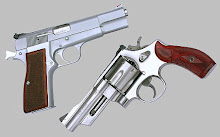
But does that mean that everyone has to be?
In my opinion, the answer is a resounding, “No.” align="justify">
If the Hi Power just isn’t your “cup of tea” or you simply trust another design more and shoot it better, go with it, but do so for real reasons and not just what was read in a magazine article. That you just “want” to is good enough in my opinion…not that anyone’s decisions have to meet my OK. I only suggest that we make this decision based on other than what we read in a magazine article on pistol popularity.
Choosing a particular action-type, caliber or firearm make are choices all shooters have to make. None are usually cost-free! I suggest that we try and honestly evaluate what we want and why and be able to articulate it to ourselves. If we cannot be either honest with ourselves or put forth a convincing argument, we’re almost certain to suffer “buyer’s remorse”, a malady suffered by most of us…on a repeated basis!
I know that I’ve had a dose (or ten) of it and always for not thinking my decisions through.
I hope that you do better than I did.
Best.
Tuesday, June 02, 2009
"Portuguese Hi Powers"
The fact is that no FN or Browning Hi Power has ever been manufactured in Portugal.
For the last several years, Browning-marked Hi Powers usually have the familiar "Made in Belgium" on them along with "Assembled in Portugal" but so far absolutely none have been made in Portugal. (FWIW, since some may not be aware of it, FN makes the Browning Hi Power. Browning does not make it. Browning has never manufactured a Hi Power. FN (Fabrique Nationale in Belgium makes the Browning Hi Power. Browning is the US importer.)
Kurt Wickman, who was one of the early 'smiths at Novaks, told me that some of the very best Hi Powers he'd ever seen were early "Assembled in Portugal" guns. When I asked why, he advised that FN sent folks to Portugal to make sure that their tolerances were held. Since I own both early and later-run "Assembled in Portugual Hi Powers", I examined examples of each. I can find no major differences at all! It would appear to me that either the Portuguese assemblers take pride in their work or have their "feet held to the fire" by FN, but I find no consistently measurable differences; the work remains very nice indeed. (As I understand it, the original reason for having the guns assembled there was simply lower labor costs.)
I shoot a lot of 9mm Hi Powers and have for right at four decades now. In my observation, current guns do not usually have trigger pulls that are either as light or break quite as cleanly as the older guns from the '60's, '70's, and even '80's but they group just as well or better! They definitely feed a much wider variety of blunt-nosed ammunition, ie: JHP's.
This refinished Mk III has flawlessly fired many, many rounds. It was "Assembled in Portugal". It continues to serve well and function flawlessly. I would trust my life and those of my family to it.
This is fairly typical of what I expect Hi Power Mk III 9mm pistols to do at about 15 yards. For me, this is accurate enough. These pistols were never intended as Camp Perry match guns. That said, I think that they offer very excellent service accuracy. This gun used to shoot the group in this picture was also assembled in Portugal.Some of the T-series Hi Powers had a fine a polished blue as could ever be in my opinion but I am in no way convinced that they grouped any better or were any more reliable than current Hi Powers. I like both the "old classic" Hi Powers and the newer Mk II and Mk III pistols. I actually prefer the Mk III for a heavy-use Hi Power.
The older guns are getting harder to find to be sure and will only continue to do so. Find 'em while you can and buy them if you want examples of the earlier Hi Powers. I find them as gorgeous a pistol as has ever been made! Having said that, do not think that you have a "second-rate Hi Power" if you happen to have a "C" series, Mk II, Mk III or one of its variants.
You don't...and it wasn't "made in Portugal"!
Best.
Friday, April 24, 2009
Defensive Snubs: Conventional DA/SA or DAO?
1. Moves the hammer rearward and,
2. Releases it, firing the gun
The vast majority also have single-action capability. In other words, the hammer can be manually cocked so that a lighter and shorter trigger-pull discharges the weapon. It is generally believed that this allows for more precise shooting, perhaps at a greater-than-expected distance.
Do we need or even want both on a defensive revolver, particularly a compact snubnose?
Opinions vary on this question so let’s examine this area in more depth.
Folks wanting conventional DA/SA capability on their defensive revolver usually cite wanting to be more able to make a very precise (head) shot in the event of a hostage situation or if firing across a parking lot. They also like the idea of thumb-cocking in an emergency should a slightly high primer be causing the cylinder rotation to “drag”.
Shooters preferring double-action-only can argue that the longer, more deliberate trigger-pull necessary to discharge the revolver, makes is less likely that an unscrupulous attorney would try to claim that they cocked their deadly weapon and then “negligently” shot his criminal client. Older shooters as well as law enforcement officers trained on the wheel gun frequently prefer DAO. With proper training, double-action defensive revolver shooting can deliver very effective results.
Nothing in this world is for certain, but I’ll cast my lot for the DAO snub with a bobbed hammer if carried via a pocket holster and the same for the revolver that’s to be carried inside-the-waistband, regardless of barrel length. If it’s being carried in an outside-the-waistband holster, I still prefer DAO for self-protection but am ambivalent about the hammer spur being removed or not.
My choice does not necessarily have to be yours. If you already own or simply prefer a double-action revolver that also retains single-action capabilities, no problem here but I strongly suggest learning to shoot it double-action for defensive purposes.
Though nothing actually requires it, many DAO revolvers with exposed hammers have the spur removed or “bobbed”. The idea is that the spur is unnecessary as the revolver cannot be manually cocked so why leave it there to possibly snag on clothing if carried concealed?
Can revolvers still having single-action capability have their hammers bobbed? Sure, but I’d treat them as though they were DAO. That said, some folks have revolvers just that way, some having the tops of the bobbed hammers serrated for (somewhat) easier lowering from the cocked position. In the past, I have had such revolvers. Normally, I don’t get nearly so wrapped around the axel with lower cocked hammers over live rounds as do some. Yes, it requires one’s full attention and the potential for an accidental discharge is present, but it is just not as difficult as disarming say a live atomic bomb as in “Goldfinger” if the spur is present. Remove it and I do believe that the potential to inadvertently fire the revolver goes up considerably. Certainly, the reader should make his/her own decisions on this matter, but my bobbed hammers are on DAO revolvers.
Best.
Saturday, January 31, 2009
A "New" Old .38 Special Revolver...
I have been told by those more "tactical" than I that one cannot adequately defend home, hearth and heinie with a wheel gun. While I agree fully that the 6-shot revolver has to be reloaded more often than a comparable size autoloader, I also believe that we "solve our problem" in the first few shots and run out of time before ammunition. In other words, in most deadly force scenarios involving private citizens, I think that the revolver can hold its own if he can get the hits. This is true with any handgun and I've said before that "placement is power". In other words, I still believe that placement remains a primary component in "stopping power" and whether we survive or don't! (Do not make a mistake here and think that I support anything like "high-capacity magazine bans". I am firmly opposed to such anti-Second Amendment tripe and do all that I legally can to oppose it and I always will.)
Taking the revolver to the range, I was pleased but not surprised to find that the fixed sights were perfectly regulated for 158-gr. ammunition.
More "practical" defensive-type drills such as the common Failure to Stop drill were tried and a timer revealed them well within accepted standards.
In my opinion, the 4" .38 Special (quality) revolver with defensive ammunition is still a very viable defense gun and one that can be easily understood by shooters having less experience. That said, I definitely do not relegate this as a gun suitable only for a "beginner". I am aware of some very seasoned retired (and current) lawmen and shooters who stick with the DA revolver by choice and I assure you, they can get the hits and in a hurry.
These service-style Smith & Wessons turn up not infrequently for sale at pretty nice prices ($250 to $300, depending upon condition), but I fear that frequency will decrease with each passing year. I submit that these revolvers make a most useful addition to the owner's collection for both fun and more serious aspects of shooting. I think that at these or similar prices one gets more rather than less quality! These wheel guns are capable of extremely accurate grouping and if a person's willing to learn accurate double-action shooting, that person's probably going to be very surprised at what can be accomplished with the time-proven double-action revolver.
I am certainly not about to part with my 13-shot Hi Powers or other semiautomatic pistols but neither do I feel unarmed in the least with this retired old work horse. As this is written, it's loaded with Remington 158-gr. LHP +P less than a foot from my strong shooting hand.
If you get the opportunity, I strongly recommend one (or more) of these for your collection.
Best.
Friday, January 16, 2009
My Hi Power Fails to Eject on the Last Shot. Why?
Why?
I have a Hi Power in which this frequently occurs. It has not affected reliability at all but I can see how it could cause some concerns for those considering the pistol in a self-defense setting.
On all but the last shot, there is a cartridge in the magazine beneath the fired case being extracted as the gun fires. This keeps the hull from sliding downward on the breechface if the gun's extractor claw doesn't hold the case quite tightly enough to keep it from doing so. On marginal cases, the Hi Power might fail to eject the last hull with Brand X but never do it with Brand Y. The reason is slightly different rim thicknesses on the different makers' rounds.
The problem can usually be corrected by very lightly stoning the pad that bottoms against the slide in the groove in which the (external) extractor rides. Not much is necessary to eliminate the problem and this frequently takes care of it.
If the gun is failing to extract/eject on all shots, the problem is either a damaged extractor claw, a weak extractor spring, or both.
Best.
Sunday, December 28, 2008
Informal Tests: Hornady Critical Defense .380 & .38 Special
In recent years we have seen much improvement in ammunition intended for such serious purposes.
But a few decades past, one couldn't expect jacketed hollow points to expand reliabily (if at all in some cases) unless driven to very high speeds for caliber or reducing bullet weight in order to achieve the higher-than-normal speeds essential for expansion.
Eventually we did get ammunition with bullets that would expanded reliably a great deal of the time, but little thought was given to penetration. Expansion was the name of the game, the "be-all-end-all" in "stopping power".
We did hear of failures to be sure but there were also successes but the truth is that results could be quite varied. Some quit worrying about expanding ammunition and went strictly with solids so that penetration, at least, could be counted upon. Others remained sure that hyper-velocity rapid-expansion or fragmenting ammo was the sure cure for those pesky, violent felons.
"Back to the drawing board" must have been a repeated clarion call for serious handgun ammunition developers these past decades. Today's shooting community has a better and probably most varied ammunition selection than ever before. (Let us hope that the current crop of freedom-hating, anti-gun politicians are not able to change that!)
Hornady has been manufacturing very fine handgun and rifle bullets for decades. Their handgun bullets for reloading were pretty traditional until the introduction of the "XTP" line after the infamous 1986 FBI "Miami Shootout" in which several FBI agents lost their lives after one miscreant had been nicely popped with a 9mm 115-gr. Winchester Silvertip Hollow Point that punched through an arm before entering the upper torso from the side. The expanded bullet stopped just short of the heart. I will not get into the (vast) number of shots fired vs. the (small) number of hits but this incident did bring both bullet expansion and penetration requirements to the forefront of "stopping power" discussions.
The "XTP" (eXtreme Terminal Performance) handgun bullets from Hornady were designed to expand to about 1.5 times the original caliber rather than the previously-desired expanded "lead pancake". They did this nicely and XTP handgun bullets have been among the most accurate I've ever shot in either factory or handloaded handgun ammunition.
Here is typical performance for the XTP bullet. This one is a factory Hornady 90-gr. in .380 ACP. Results in "wet pack" or water were consistently about 1.5 calibers and accuracy was first-rate in several .380 pistols I tried it in. It would average about 920 ft/sec from a Bersa Thunder with a 3.5" barrel. This is usually very consistent ammo from my guns and would have very small extreme spreads. This one was from a lot having an extreme spread of 16 ft/sec!While the old claim that bullets traveling under 1000 ft/sec wouldn't expand had not been true for quite a few years, it was true that a majority of expanding bullets simply wouldn't if forced to pass through intermediate barriers before striking their intended "soft target". A bullet that might be a reliable expander in tissue would often times act like a solid if passing through leather (as in a coat), plywood, drywall, or other fabrics. Even penetration remained adequate, the wound channel was greatly reduced. This reduced the bullet's effectiveness and the fear of overpenetration reared its head again in handgun ammunition and self-protection.
Hornady was first to try and meet the FBI's 12" penetration minimum in 10% ballistic gelatin with their XTP line of bullets. They also sold these bullets in loaded ammunition as well. (It should be noted here that this 12" minimum includes such things as shooting through laminated automobile windshields, something not nearly so likely for the private citizen. The honest private citizen unlucky enough to be involved in a deadly force scenario is very likely to be face-to-face with his/her attacker and very close and we can probably get by just fine with ammunition penetrating a bit less than 12". Some ammunition that I've used on small to medium Texas game penetrates less than 12" but has repeatedly proven itself capable of human, rapid "stops". Likewise, visiting with folks who've used similar ammunition against human beings has shown that bullets penetrating less than 12" can be effective for head-on, unobstructed shots. At the same time, I cannot fault anyone who insists on ammunition doing no less than 12" in ballistic gelatin after passing through 4-layers of denim. (The denim barrier doesn't necessarily mean that one's attacker will be wrapped up like a tamale; it is described as a "worst case senario" and one that IF a bullet passes, it can be expected to almost always expand on the street.) The flagship loads from today's handgun ammunition manufacturers will usually pass this test and come with other desireable traits such as being sealed against moisture and having flash-retardant powders.
This Texas whitetail was cleanly and legally taken with a handloaded 45-caliber 200-gr. XTP. Penetration was complete and expansion evident. Overpenetration is not a worry under most hunting conditions. It is considered a serious potential problem by some concerned with having to shoot in an urban area. The XTP offered plenty of penetration but sometimes didn't expand satisfactorily if passing through intermediate barriers before striking gelatin...or tissue. Hornady's Critical Defense ammunition is reported to expand consistently, regardless of whether an intermediate target is struck or not.
Hornady's XTP appears to have been more appreciated by the handgun hunting community than those focusing on self-defense, and to that end, Hornady has come out with a new line of ammunition that reportedly passes through almost any barrier and still reliably expands. It is called "Critical Defense" and is currently (Dec. '08) available in .380 ACP and .38 Special. Hornady says up front that they didn't focus on its passing each and every FBI requirement and in at least one caliber, it doesn't make the 12" minium, but it gets darned close, as in 10 /12" or so when fired from the little Ruger .380 auto.
It utilizes a cannulured jacketed bullet and has a lead core as well as a hollow cavity at the nose. However, this cavity is filled with a red, flexible substance. Hornady calls this their FTX bullet.
Find out more about the FTX bullet here: http://www.hornady.com/story.php?s=786
It seems reasonable to assume that this ammunition is Hornady's competition for Speer's Gold Dot, Remington's Golden Saber, Winchester's Ranger (LE ammo), and Federal's Personal Defense ammunition.
While not inexpensive, there are other lines of self-protection ammunition from other makers that is more costly. Each box of Hornady's .380 ACP Critical Defense line of ammo cost me $17.95 or about $0.72/shot. The 110-gr. .38 Special costs $19.95 a box or $0.80/shot. While this is certainly not too much for premium ammunition to save one's life, it is enough to make one try and be conservative in informal "tests" like this one...at least on my retirement abilities.I was happy to see these standard pressure loads being first available in .380 ACP and .38 Special and here's why.
The .380, be it in one of today's really compact hideout pistols or the more traditional Walther PPK, SIG-Sauer P230/232, Bersa, etc, size has had to be a "compromise" caliber. What I mean by that is that if one used expanding ammunition that actually did, penetration was frequently very lacking. These lightweight bullets and the caliber's limited case capacity combined with the shooting platform's (almost always) straight blowback design prevented ammunition powerful enough to provide adequate penetration and reliable expansion. Thus, a goodly section of the .380 ACP toters opt to use FMJ ammunition. This will penetrate but with no expansion wound channels are small. The idea is that while expansion is desireable, penetration is essential. It is also usually mentioned that FMJ round nose is more reliable than blunter ogive JHP's. (It's been my observation that some guns are extremely reliable with most JHP's while others are not. I do not believe that FMJ is necessarily more reliable than expanding ammo in all 380-caliber pistols. I do not believe it has to be an absolute.)
Shooting: The handguns used in today's informal tests were my old Bersa Thunder 380, which has a 3.5" barrel and is in stock condition. It has had several thousand rounds through it with exactly zero malfunctions. For the .38 Special, I opted for my old BUG, an S&W Model 042. It is not rated for +P ammunition and sports the old J-frame rather than the Magnum J-frame common to current S&W J-frames.In any event, I was hopeful in finally getting to see a .380 ACP round that might offer its users both adequate penetration and reliable expansion
Likewise, I was hoping to see a .38 Special round loaded to standard pressures that could be used w/o concern in some of the lightweight revolvers not rated for +P loads. In the past, I've seen some light-for-caliber-standard-pressure rounds fired from snubs provide ballistic results similar to the .380. In other words, expansion but 6 1/2 to 7 1/2" penetration. (Speaking only for myself, this is too shallow to be trusted. I can go with 10" penetration and certainly prefer the FBI 12" minimum, but just am not confident with less than 10" penetration in 10% ballistic gelatin.)
One can certainly get adequate penetration coupled with reliable expansion from the snub .38, though it has to be "worked at" with more judicious load selection than for the longer barrel revolvers...but it has to be +P ammunition. Though I've personally experienced no problems with the occassional use of +P ammunition in quality .38 Special revolvers that are not so-rated, some folks really don't like the idea. Others cannot tolerate the increased felt recoil and some just settle on standard pressure solids, with results similar to those of the .380 ACP.
These handguns are essentially stock and both have proven reliable and accurate over the years. The snub sports Precision's black nylon "Hide Out" grips that I modified to work with an HKS speedloader.
These five shots were fired standing from an unsupported position and in single-action. No effort was made at speed. My goal was to see if this load would group satisfactorily within most self-defense shooting distances for private citizens. I believe that the ammunition is capable of one-hole groups at this distance; I simply am not.
This Bersa's POA has always matched 90 to 95-gr. .380 ACP POI out to about 15 or 20 yards and I was not surprised today to find that such remains the case with this 90-gr. Critical Defense load.
I did not achieve the listed 1000 ft/sec velocity with my Bersa.
Average velocity was a respectable 911 ft/sec with an extreme velocity spread of but 11 ft/sec and a tiny extreme spread of 5 ft/sec! This is based on 10 shots fired 10 feet from the chronograph screens! In my experience, this is about as consistent of ammunition as one can ever hope to get. Does this mean that the same will be true in all .380 pistols? No, but I'll bet it groups nicely and has pretty darned consistent properties when fired out of any quality 380.
The 110-gr. standard pressure Critical Defense .38 Special loads grouped nicely as well. The shot to the far right was my fault. I knew it when I fired it. It was not due to any inconsistency with the ammunition. Being a DAO revolver, all shots were DA. Like with the Bersa, POA was the center of the bullseye. These light-for-caliber bullets hit immediately below POA. At greater distances, the divergence of POA from POI might be an issue but not at ten yards and under.
Expansion Testing: Not having access to either caliberated 10% ballistic gelatin or a climate-controlled lab in which to achieve repeatable tests with it, I just used the old "wet pack" approach. I used plain old supersaturated news print. I soaked it for 24-hours and then drained it 30 minutes before shooting. Bullet penetration is definitely not the same as for the gelatin, but it seems roughly comparible in showing how a bullet expands. Through trial-and-error and comparing actual, repeated gelatin penetration tests with ammunition in wet pack, it seems that multiplying the penetration in wet pack by 3 and then dividing by 2 gives a pretty fair expectation of what the bullet would do in calibrated 10% gelatin.
Ten shots of each caliber was fired into wet pack from a distance of 5 feet. The depth of each "wound channel" was measured using a probe before retrieving the bullet. The measured height of each expanded bullet was added to each depth to give the true penetration distance from the wet pack surface to the front of the expanded bullet. I didn't have any denim but did fire five of each ten shots per caliber through 4 layers of the common cotton/polyester bathtowel.Cutting to the chase, expansion was extremely consistent. I could not tell which expanded bullets had punched the towel vs. which had not by looking at the results. Penetration was extremely consistent as well. With the .380, the greatest variation in penetration depths was a surprisingly small 1/10"!
Hornady .380 ACP 90-gr. Critical Defense averaged 6.75" in wet pack. This should be about 10.12" in 10% ballistic gelatin.
Fired from the S&W's 1 7/8" barrel, average penetration of the 110-gr. FTX bullet used in the Critical Defense line of ammo was 7.6". The greatest variation in penetration depths was 6/10". Based on what I saw today, I would expect this load to penetration approximately 11.4 to 12" or so in ballistic gelatin.
The .38 Special load was also very consistent and performed admirably in my opinion. In this picture, I also included the red, pliable material that fills the bullet's hollow point. Because the hollow point cannot be plugged up with debris from an intermediate target, expansion is almost certain to occur. The little red "fillers" were visible in the wet pack "wound tracks" of both the .380 ACP and .38 Special. Average expanded bullet diameter: 0.481 x 0.451 x 0.408" tall.
Conclusion: I believe that Hornady has come up with some pretty darned nice standard pressure ammunition for "serious use" in 380-caliber pistols as well as .38 revolvers. I have not seen any ammunition from any maker that is more consistent and any more likely to expand under varied conditions as this.
Even with its advanced FTX bullet and super-consistent Critical Defense ammunition, I just don't believe that we can transform the .380 or .38 snub into rhino-rolling handguns of nuclear destruction capabilities, i.e.: the FTX bullet isn't magic. That definitely does not mean that it isn't one of the best choices to maximize the ballistic potential of what a given handgun caliber has to offer.
I'll stick with the .38 snub over the .380 ACP but were I using a .380, I might very well go with this load from Hornady. In my opinion, it bests the very nice Corbon .380 DPX but only because Corbon had to use a lighter (80-gr.) bullet due to its being all copper alloy and longer than the lead core bullet used in the Critical Defense load. I am not at all convinced that this line will stand out above other premium ammunition makers' premium, best-quality defense loads.
In the .38 Special snub, for now I'll just stay with the "old technology" LHP +P from Remington. In my guns, it hits point of aim and the load has a pretty nice actual "street record" but if I were worried about the +P thing and was determined to carry an aluminum alloy slug, this would be a standard pressure load that I might very well use.
Best to all.
Monday, December 15, 2008
SIG-Sauer P232 vs. Beretta Model 85 F Cheetah...
I am not going to get into the "Why-get-a-380-when-there-are-small-9mm/40-caliber-pistols-available?", or the "stopping power" issue. The reason is simple: On the forums, folks asking about specific .380 pistols sometimes put in the request not to go into the 9mm/.40 options, stating that for whatever reasons, they are going with a 380-caliber handgun...and are routinely ignored with the usual Caliber A vs. Calber B arguments which sometimes results in the threads' never getting around to answering the original questions! The thread gets "hijacked" by well-meaning posters arguing over caliber rather than answering the questions originally asked!
With that caveat, let's see what we might see...
SIG-Sauer P232:
LOA: 6.6"
Height: 5.7"
Width: 1.3"
Bbl: 3.6" w/1:10" twist
Weight: (aluminum frame) 18.5 ounces (all stainless) 23.6 ounces. (Both of these weights do not include magazines.)
Magazine Capacity: 7
Magazine Weight (empty): 1.4-oz blued and 1.6 oz-stainless
Internal Firing Pin Safety: Yes
Magazine Disconnect: No
Sights: Fixed
Grips: Black synthetic
Trigger Pull: 10-lbs.(DA) 4.4-lbs (SA)
Decocking Lever: Yes
External Thumb Safety: No
In addition, the gun is available in blue, stainless and two-tone finishes.
The Beretta 85F has proven itself reliable as were its predecessors. The F-Series have the hooked "combat trigger guard. I prefer the more traditional rounded ones.
I much prefer the rounded, "non-combat" trigger guard on the older Beretta Model 85 BB version and the SIG-Sauer P232 to that on the Beretta Model 85 F. The reason is simple; I do not hook a finger on the trigger guard. If you do, your preferences might be just the opposite. LOA: 6.77"
Height: 4.8"
Width: 1.37"
Bbl: 3.81" w/1:10" twist (actually 9.84 but 10" is close enough)
Weight: 21.9-oz
Magazine Capacity: 8 shots
Sights: Fixed
Grips: Black, synthetic
Decocking Lever: Yes
External Thumb Safety: Yes, ambidextrous (Pushing these upward with the pistol cocked will safely decock the hammer and then the pistol cannot be fired until they are pushed downward (ala 1911) to disengage.
Some of the discontinued "B" and "BB" models were offered in either blue or nickle finishes. The current "F" models are available in the dark Brunitron finish which protects against corrosion.
Both the SIG-Sauer and the Beretta can be had with wooden stocks if desired. Both the front and rear grip straps on the Model 85 are serrated. These are smooth on the P232.
The SIG-Sauer P232 can be had in the lightweight aluminum frame/blue slide version or the heavier all-stainless "SL" version. The Beretta is offered only with the lighter aluminum alloy frame.
I do not have information on the DA/SA trigger pulls on the Beretta Model 85F, but to me it is similar to the SIG-Sauer. I do not find enough difference to be of any consequence. If it is of any importance, the P232's trigger face is smooth while the Beretta's is grooved and has a trigger stop. (I find neither trigger face or pull superior to the other in actual use on these pistols.)
The Beretta with its smaller serrated flats seems to generate more complaints about difficulties in racking the slide than the SIG-Sauer's if that is an issue. I find the SIG-Sauer easier to rack, but don't find either a problem. This might not be the case with some of our older folks or those with weaker hands or arms.
While both are "straight blowback" designs, the SIG-Sauer's bbl is fixed to the frame. The Beretta's is not; it is removable during the field-stripping process. That said, I have not been able to determine any accuracy degredation in the Beretta due to its "non-fixed" barrel. It is simply not an issue in my view. Neither is the slight difference in barrel length between the two. Average velocites with factory ammunition have proven very similar between these two little autos.
I've never shot a Beretta Model 84 or 85 that didn't mimick the Walther PP series in that shots hit about 1 1/2 to 2" high for me at ranges of 15 yards or more. (Most folks will not be interested in shooting these "pocket guns" at great distances and at closer ranges, the sights are "on" close enough in my experience.) Unlike shooting the Walthers, I do not suffer either slide or hammer bite with the Beretta or the SIG-Sauer.
For me, the SIG-Sauer P232's in .380 hit "dead on" for me at ranges from arm's length to about 25 yards or so. I much prefer the P232's sight picture to the Beretta's, but that might not be an issue for a pistol intended for close-in use and that was never intended as a formal match pistol.
The following is based on a relatively small number of handguns but I find either the 232 or the Cheetah to be very reliable with ball and JHP ammunition. (Most of the earlier P230's I shot were fine with ball and some were alright with JHP's but not all. I have not shot any Beretta Model 84 or 85 in any version that wasn't reliable with any and all ammunition. I think SIG-Sauer was aware of this issue because while I only own one P232, it's been 100% reliable with all FMJ and JHP ammo as have those owned by other shooters I know.)
If I shoot over about 200 rounds of standard-power .380 in a session with the P232, I do notice a couple of little "wear" areas where the edges of the tang rub my hand. None of this occurs for me with the Berettas in either the M84 or 85 versions.
Which is best? I flat do not know. Both are quality firearms. Between the two, I think I prefer the SIG-Sauer P232 but I don't intend to sell my Beretta 85F either!
I find either easy to shoot accurately in double-action mode and both are a piece-of-cake in single-action. I do not notice any difference in felt recoil between the two.
Sweeping "off" the thumb safety is easily done and comfortable for the Beretta, but it is perfectly safe to carry with the thumb safety disengaged as it has an internal firing pin safety like the P232. Some will opt for the gun having the external safety as it not only offers perhaps another level of safety but might prevent an attacker or unauthorized user from immediately grabbing and firing the pistol. If this is a major concern for you, the Beretta is the way to go as the P232 offers no such external safety; it is a "point-and-pull" design.
Both offer an external slide release.
The Beretta has the magazine release at the rear of the trigger guard like the 1911-pattern pistols, Hi Powers, etc. The SIG-Sauer's is a bottom-release design ala the Makarov and other European designs. (The Model 85F's push-button magazine release is not ambidextrous.)
While the Beretta's is probably quicker in the event of a speed magazine change, the SIG-Sauer's is considered less like to inadvertently release the magazine as might happen were the pistol sat on or carried tightly against the body. Again, what is actually "important" will be up to the individual buyer's perceptions.
I seldom carry pistols of this genre but were I depending upon a .380 for "serious purposes", I would absolutely not doubt the mechanical ability of either of these, though between the two, I would probably go with the P232, simply because I much prefer its sight picture and that POA matches POI for me better than the Beretta. (It is possible that this will not hold true for all or that it just won't be an issue for many.)
Again, speaking only for myself, I doubt that I'd pick the heavier all-stainless P232 and in my admittedly subjective observations, I don't find either the aluminum-framed P232 or Model 85 difficult to carry nor do I find one to have a "real world" advantage over the other in this regard. (Were I concerned with rust and corrosion, I'd go with the Brunitron finish on the Beretta.)
Hand-cycling ammunition through both guns seems to result in more positive ejection of the cartridges with the Beretta than the SIG-Sauer but in actual firing, both fling the fired cases well away from the shooter. Both use external, pivoting extractors and I've not noted one being better or tougher than the other.
Unlike the 1911, there is not a literal cottage industry of aftermarket parts for either of these well-made pistols, but both remain in production and OEM parts as well as aftermarket grips and recoil springs are available, as are extra single-stack magazines.
As mentioned earlier, I think that the choice between one or the other of these two pistols is not a choice between quality but between the guns' individual features as well as the buyer's subjective preferences. Either of these guns are well-made and quality firearms in my opinion.
Best.
Monday, November 17, 2008
FAQ on Self-Defense Handguns & "Stopping Power"
I thought that it might be interesting to compile the most commonly asked questions I receive and answer them in an article, but let me hasten to add that I am not an expert and have never claimed otherwise. I am a retired police officer, police firearm instructor, tactical team leader, and have been seriously interested in what handgun bullets actually do to human aggressors for decades. I have seen felons shot and in each instance was seriously unimpressed with the actual incapacitation times required to truly render the bad guy harmless, be that through unconsciousness or death. Calibers involved ranged from .38 Special, 9mm, and .357 magnum through .45 ACP. Of those incidents, only two involved nonexpanding ammunition. The rest were with hollow points.
Over the years, it has been my privilege to visit with law enforcement/military personnel who had been forced to use handguns to "stop" another human being. More officers than soldiers actually had this experience since most soldiers are not issued pistols. I have not and will not disclose the names of those persons. Some of these contacts are recent while others are decades old. One faction of the "stopping power community" will declare any such information as "anecdotal" and useless because it is not documented. I honestly could not care less. It is not my goal, aim, or intention to be published in the scientific literature surrounding this topic. I truly respect the scientific method and understand its precepts from my college days as a double major in physics and mathematics, but have enough common sense to listen to those who have actually been in the urine stench atmosphere of life-and-death shootouts and close quarter combat. The laboratory approach to terminal ballistics is a fine thing and that I have great respect for. At the same time, results from the street are hard to just discount. Discussions with coroners have also occurred but on a less frequent basis. I find it interesting that when our military's scientific personnel engineer a new weapon, all that can be done in the lab to assure its reliability, etc, is no doubt done. Still, the weapon finds its way to a proving ground. Might not the street's real life conflicts be a direct parallel to the military proving ground?
I also hunt with a handgun and have since the early '70's. The largest animals I've repeatedly killed cleanly with one shot have been Texas whitetail deer. Most critters I've killed have ranged in size from the cagey and sly coyote to the tough-as-nails javelina, raccoon and fox. On these, I have been singularly unimpressed with solids used in any caliber from .38 Special to .45 ACP. (With .45 Colt using the large 255-gr. CSWC having a very wide meplat, things are much better. The .41 and .44 magnums with their smaller CSWC meplats apparently have the speed to make up for their slightly smaller flat compared to the .45 Colt.)
Fired from a Browning Mk III at about 12 yards, I hit this Texas whitetail deer's heart with a Winchester 127-gr. Ranger JHP +P+. The animal was instantly decked, unable to get up but weakly kicking for about 15 seconds. This was done under handgun hunting conditions and the shot taken only with absolutely perfect conditions. The life-or-death scenario we might find ourselves having to use deadly force in will allow for neither perfect conditions or much time for steady and sure aim. A hit like this against a dangerous felon would surely be a good hit, but not necessarily an instantaneous stop. Always expect the unexpected and don't just assume that because you're using premium ammunition that your hits will do what you want as quickly as you want.While the shooting of animals versus felons emphatically is not the same thing, I think that there are similarities involved in "stopping" or the mechanism of collapse. How pertinent these are will always be open to debate.
With regard to "proper" defensive handguns, I personally will not go lighter than a .38 snub using expanding +P ammunition for a hideout or backup gun. The belt gun should be 9mm, .38 Super, .40 S&W, .357 SIG, or .45 ACP in my opinion. Those opting for revolvers should not go lighter than .38 Special +P.
I have little tolerance or use for the dogma so often associated with either of these related topics. I have yet to see and much less understand how some people seem to believe that such discussion is license for rudeness and all around boorish behavior.
Hopefully, you see where I'm coming from and that I leave it entirely to the reader to decide how much of this is worthwhile, on the money, or just dead wrong. It is not my aim to try and sway a single soul to my beliefs, only to provide what I believe to be true and offer them more "food for thought" in making up their own minds on these topics.
With this in mind, let's proceed to the questions.
1. What is your preferred number one defensive handgun?
For pocket, hideout, or BUG use, my preference remains the S&W J-frame snub in .38 Special and with +P expanding ammunition. Right now, the top choice for me is the Airweight S&W Model 642 or 442. I prefer it to the all-steel snubs and only carry "pre-lock" revolvers. I also choose the aluminum gun over the newer lighter scandium/titanium revolvers because I am not limited to jacketed ammo. Those revolvers lighter than the "Airweight" series cannot be used with lead bullets; they unseat themselves in recoil and lock up the gun. I have personally tried this and such has been the case in caliber .38, .357, and .44 Special. If the snub is to be worn on the belt, I'd go with a steel revolver with at least a 3" bbl, if there is a choice. With regard to semiautomatic handguns, I have no real desire for those lighter than 9x19mm nor having less than a 3" barrel…and much prefer longer barrels. My favorite all around 9mm pistol remains the lightly modified Browning Hi Power Mk III. From a strictly defensive viewpoint, I do favor the .45 ACP from a 5" 1911 pattern pistol. Using a two-hand hold, I note no real difference in handling ability, but when using one hand, I do slightly better with the Hi Power.
2. Why are you against the .380 and 9x18mm Makarov for self-defense?
This little Bersa Series 95 is a favorite of mine. I really like the gun's handling and concealment capabilities. I am not fond of the cartridge for self-protection but understand that more than a few folks find themselves able to more accurately shoot a .380 auto than a hot-loaded-but-lightweight-38-snub. Under some conditions, I have toted a .380 or 9mm Makarov for "serious purposes" but though I remained truly a staunch admirer of the guns, I never changed my belief that better defensive calibers can be had in similar size packages. I had rather face a poor shot, lousy tactician and undecided adversary who was armed with a .44 Magnum than a skilled shot, determined to survive and having but a .22! If you prefer the .380 or 9x18mm Makarov, use them; be competent, accurate and quick in their safe handling, but this is true for any caliber/gun combination to be used in the self-defense arena.3. But if you HAD to go with a 380 or 9mm Mak, what would your choices be?
I would chose the traditional size pistol in these calibers. They offer enough sight radius to get the hit or hits and enough velocity to get bullet expansion using many JHP rounds. For carry guns, I would go with smaller than the Beretta double-stacks or the CZ-83. Right now, my first choice would be the Bersa Thunder, but only after testing it for reliability as well as POA vs. POI. If going with the Mak round, I would go with the Makarov handgun over all others in t his caliber. In the .380, my ammo choices would be Corbon DPX (Later runs of this ammo have reportedly had the Barnes X-bullet tweaked for slightly deeper penetration.), or Hornady XTP. With the 9mm Makarov, I'd go with either Hornady XTP or the Brown Bear 115-gr. JHP. The latter round can cause problems in some Makarov pistols as it has a slightly longer LOA than most JHP's in this caliber but it is my top pick. After I made a small correction at the bottom of my guns' feed ramps, it runs as slick as a gut in my three Mak pistols.
These expanded 115-gr. Brown Bear JHP's in 9x18mm expanded consistently for me when fired from a Makarov pistol into either super-saturated newsprint or water. Actual expansion/penetration tests when fired into calibrated 10% ballistic gelatin also show impressive expansion and penetration in the 11 to 12" range. Whether from Brown or Silver Bear, these loads are hard to find. Be sure that your pistol feeds them reliably before depending on them.4. Which is more important, velocity or bullet weight?
It depends on the particular caliber being discussed in my view. For example, in my own informal testing I remain convinced that from the 4 to 5" barrels, the .45 ACP continues to do best with the traditional 230-gr. bullet. They usually strike at or very near POA compared to lighter, faster bullets and many JHP's are available. FWIW, my choices are Winchester Ranger JHP, Remington Golden Saber, followed by Federal Classic JHP. The Speer Gold Dot is favored by many and if it runs reliably in your pistol, it is a very good choice as well. It feeds nicely in some of my .45's but not all. The others run slick as a gut in all of them and with all magazines. In .38 Special I cling to the Remington 158-gr. LSWCHP +P. It expands more reliably than the Winchester counterpart from the 1 7/8" bbl in my experience, but either work fine from 3 or 4" tubes. Unless the bad guy is wrapped up like a 4-layer-of-denim tamale, the bullet expands. The two that I've seen recovered from felons expanded nicely, though not as evenly as when fired into homogeneous test media. FWIW, two new loads offer decent penetration and expansion. These are the Corbon 110-gr. DPX +P and Speer's "Short Barrel" 135-gr. Gold Dot +P. Though I am extremely fond of the DPX line of ammo, in this caliber, my second choice would be the Speer. In .357 magnum, I prefer bullets weighing 140-gr. upward if being used in service type revolvers. In the J-frame snubs, I currently use Corbon 125-gr. DPX followed by Remington 125-gr. Golden Saber. Both of these are mid-range loads offering more "whammy" than .38 Special +P, but less than the full power magnums. In the smaller guns it has been my experience that these lighter loads are distinctly easier to handle at speed and for repeat shots. I have verified this for myself using a timer. In the K-frames and up, the heavier loads work fine in practiced hands. In 9mm, my personal choices remain Corbon 115-gr. DPX +P and Winchester 127-gr. Ranger +P+. Going to standard pressure, I am pretty impressed with Speer 124-gr. Gold Dot and Remington's Golden Saber in the same weight. In the 147-gr. weight, I like the Speer Gold Dot, Remington Golden Saber, and Winchester's Ranger. Unlike the 1911 pattern pistol, most of the 9mm's I've tried run quite reliably with the Gold Dot. I guess you could say that I usually want as much velocity as I can get so long as bullet weight and penetration are not negatively affected. In small case/high pressure calibers like the 9mm, I do favor the 115-gr. DXP and several 124-127-gr bullets over the 147-gr. The .38 Special has more case capacity to be sure, but its lower maximum cartridge pressure seems best suited to bullets from 135 or 140 grains to the 158-gr. standard.
5. Do you prefer single or double-action automatics?
I personally prefer the Browning Hi Power and 1911 pattern pistols to all others for personal protection. They are simply what I am most used to and their "feel" and operation are permanently imbedded in my brain. I also prefer their consistent and light trigger pulls for each shot, first to last. Internally, they are less complex than the DA/SA automatic and more easily lend themselves to detail stripping. If their cocked-and-locked appearance frightens some, others find their easy to disengage manual safeties comforting should a firearm-ignorant felon manage to wrest the gun from them. A point-and-pull pistol such as the Glock, SIG-Sauer, etc can be fired by anyone. Having said this, I am not nearly so adamantly opposed to the DA/SA automatic or DAO, as are some other folks. In fact, I am becoming quite a fan of SIG-Sauer's super-light DAK system and have it on two forty-five's.6. If you had to choose a traditional double-action auto, what would it be?
I get this one a lot and the reason is simple. Some shooters simply are not comfortable (yet) with Condition One Carry and others are not allowed to carrying other than a DA/SA or DAO autopistol for police duty. They may have some latitude in brands and calibers, but single-action is not one of them. I definitely do not see them as "the badge of the incompetent" as has been said by some. In .45 ACP, I'd go with the SIG-Sauer P-220. I have shot these quite a bit and found them to almost always be reliable and surprisingly accurate out of the box. While they do exhibit a bit more muzzle flip than the Commander-size 1911's, a timer has repeatedly proven to me that very nice "work" can be done with them in both slow and rapid-fire. For carry I prefer the standard version of the gun, which has the aluminum alloy frame. In 9mm, my choice is the CZ-75. This gun offers both DA/SA as well as cocked-and-locked capability. The gun points well for me and has proven reliable and accurate. I did not list the excellent SIG-Sauer P-226 simply because the gun does not "feel" that great to me, but it has proven an excellent weapon in my observation of many being used by officers over the years.
7. I shoot a 9mm better than a .45, but am afraid that it's not powerful enough for protection. What do you think?
In my book, "Defensive Handguns", I cover this and "stopping power" (as I see it & pretty extensively), but here are my thoughts, which are based on both personal observation and "anecdotal" accounts of shootings by the shooters. Though I do not believe that .45 ball is quite so grand a stopper as others, I do believe that it is better than 9mm FMJ. I have shot jackrabbits with both and neither stopped the stringy things unless hit in the forward third of the body and then death was several seconds in coming. When struck in the mid-section or guts and they ran several yards before collapsing…even with the legendary 45 FMJ. With its better loads, I believe that the .45 ACP offers an edge over the best 9mm loads, but I remain unconvinced that the differences are so day-and-night different as espoused by some. The deer I've shot with expanding bullets in 9mm, .38 Super, .357 magnum, .44 Special, and .45 ACP, exhibited no major differences in terminal effect. All dropped immediately and kicked a few seconds or jumped and ran a few yards before collapsing. (FWIW, I've seen the very same thing when using the moderately loaded .45 Colt and full-power .44 magnum. The main advantage I've seen with the heavy magnums is extended practical range over the calibers commonly associated with self-protection.) Using the better .45 ACP loads, I do believe that there is a ballistic advantage, but that does not mean that I think the 9mm with the better loads is ineffective. I use a 9mm as a primary house gun and often as my primary carry gun. I would not do this if I did not trust the capability of the 9mm loads already mentioned.
8. I've heard that a jacket hollow point going less than a thousand-feet-per second will not expand. Is this true or not?
It depends upon the bullet design and the velocity envelope it was designed to "work" within. A couple of decades ago, the 1000 ft/sec thing was generally true, but there are more than a few JHP bullets around today that emphatically do expand at less velocity. Examples include Speer Gold Dots in .45 ACP, .38 Special, as well as 147-gr. 9mm. Ditto Winchester Ranger and Remington Golden Sabers. Let's assume that a JHP weighs 125-grains and is intended for a full-power .357 Magnum commercial cartridge traveling at 1350 ft/sec from the muzzle. That same bullet may not expand if it impacts at say 800 ft/sec; the velocity may be below its minimal threshold velocity to begin expansion. A bullet designed to expand at 800 ft/sec will certainly expand at 1350 ft/sec, but may not hold together, but the old saw that a bullet must be traveling at least a thousand-feet-per-second is simply not true as a general statement with today's better expanding handgun bullets. If you hear this from someone, they are just not up to date on the realities of current expanding handgun ammunition.
9. I want a stainless steel pistol but am afraid of galling. Should I be?
In my experience, no. This "problem" stems from early stainless steel pistols introduced decades ago. With guns from quality manufacturers, today's stainless pistols use different alloys in the frame and slide to eliminate the problem…and have for years. I truly believe it to be a non-issue.
10. Does it hurt to leave pistol magazines fully loaded? Do I need to let them "rest"?
In my experience, the answer is no… so long as they are not compressed to a shorter length than they were engineered for. Mr. Wolff of the gun spring company bearing his name advises that it is the repeated compressing and decompressing of springs that causes them to weaken. In other words, a magazine that is loaded and unloaded many times will weaken before one that is simply loaded to capacity. I have experimented with this over the years leaving a couple of magazines from different make handguns fully loaded. These included the Browning Hi Power, the Glock 26/17, various 1911 magazines, as well as the CZ-75 and Walther PP in both 380 and .32 ACP. Ditto all Beretta handguns from .25 ACP to 9mm. In all of these cases the magazines being used were from the maker or were made by quality manufacturers such as MecGar, Wilson, McCormick, etc. I definitely have seen spring weakening to the point of unreliability with some aftermarket magazine makers. Most of these were with the nameless "high capacity" magazines that flooded the market before the "high capacity feeding device" ban enacted in the dark days of 1994. The only quality magazines I've ever seen weaken when left fully loaded for approximately two years were one for the HK MP5 submachine gun and one Colt-marked 30-shot magazine for the AR/15-M16 type rifles. Others from the same makers left loaded for the same time-period worked fine.
11. I do not trust automatics and prefer a revolver for a house gun. What would you choose?
I do use revolvers for such purposes and am happy with .38 Special, .357 magnum, .44 Special, and .45 Colt. The magnum is loaded with the mid-power Corbon 125-gr. DPX. My mid-size .44 Special Taurus Model 431 is loaded with CCI/Speer 200-gr. Gold Dots while I would choose Corbon's DPX load for an N-frame S&W.
I honestly believe that the 3 or 4" 38 Special remains a very viable choice for both new as well as seasoned shooters. I am not ashamed in the least to admit that one of my most trusted defense revolvers remains a 4" .38 Special loaded with Remington 158-gr. LHP +P.
12. I know that you use the lightweight 38 snub as a carry gun. My wife wants a simple handgun for home protection when I am away. Would this be a good choice?
In my opinion, no. The very characteristics that work for the snub as a carry gun work against its being comfortable to shoot or relatively easy to shoot accurately. Despite some gun store salesmen saying otherwise, I truly believe that the relatively inexperienced shooter (male or female) is better served by a mid-size, all-steel handgun for home defense. It does not need to be super small for this purpose and will reduce felt recoil and offer better practical accuracy as well. My wife is not a shooter. What works best for her is an S&W 3" K-frame loaded with Remington 38 Special 158-gr. LSWCHP +P. By the same token, a 5" all-steel 1911 will have less felt recoil and should at least point better for many than the super compact, lightweight pistols of that breed.
13. I want a match barrel for my defense gun. Which do you recommend?
Unless the existing barrel is defective, I have very seldom seen a quality handgun that was inaccurate enough not to be used for self-defense in the private-citizen-versus-the-bad-guy type scenario. For us, distances involved are usually going to be marked by single digits with the unit of measurement being feet, not yards, but to answer the question, in the 1911 I'd go with Kart. In the Hi Power and others, BarSto.
14. What do you think is the very most important characteristic of the defensive handgun?
Reliability is first by a wide margin in my book followed by caliber/load and practical accuracy. (This refers to how easy it is for the individual user to competently shoot a particular handgun.)
15. Which defense caliber do you trust the most and why don't you just use weapons in that caliber?
I don't "trust" any of them. Compared to most rifle rounds and shotgun loads (at close range), handguns offer a ballistically weak payload in my observation. I do not trust any commonly accepted defensive handgun caliber to deliver the all elusive "one shot stop" against a human aggressor unless it destroys the brain or cuts the spinal column above the heart. It is true that many folks drop to a single shot but keep in mind that people fall down for a couple of reasons: They have to due to physical damage or because they want to for psychological reasons. The choice of the "right" defense handgun should be based on several factors in my opinion. These include the gun's "shootability" for the individual for one. Caliber and load are but one part of the equation. In whatever caliber I use, it is my view that we're better served by picking an effective load and then practicing rather than worry so much about the ne plus ultra stopping power caliber. (I begin to believe that a cartridge has sufficient "stopping power" with .223 and certain expanding rounds and am happy as a clam with .308 using expanding ammo…but understand that even these can fail to deck the bad guy…just less often it seems. I carry a defensive handgun or handguns because they are portable and with me 24/7 for the unexpected.
16. What do you consider the minimal acceptable penetration depth for a protection handgun round?
I pretty well believe the often-quoted 12" is fine. Some prefer more penetration, but I think that this depth should work on most full-grown men from about any angle. That said, it should be noted that I've received several reports of aggressive-expanding ammunition that repeatedly makes the bad guys drop with decent hits. Most of these penetrate around 9 to 10" in calibrated 10% ballistic gelatin. Two examples are Corbon's 9mm 115-gr. JHP +P and the same company's .45 ACP 185-gr. JHP +P. Go figure. One of my best friends used this load against a human aggressor with very dramatic and instantaneous results.
17. I have seen the 148-grain .38 Special wadcutter recommended as a top standard pressure load for the .38 snub. Do you agree?
I do not. Most of the commercially loaded rounds I've chronographed have been well under 600 ft/sec when fired from a snub! As I understand it, the recommendation comes because most of the .38 +P loads fired from a snub do not reliably expand in gelatin after passing through intermediate barriers such as denim. So, why put up with the extra recoil and wear on the gun? As others have said, there is no free lunch with handgun calibers. What if the target is not wearing denim? The expanding bullet will probably be more effective than the slow wadcutter, assuming equal hits. Even when the often-used LSWCHP +P doesn’t expand, it frequently flattens or deforms to mimic the wadcutter and smacks at 800 ft/sec or so. As I've mentioned in the past, I spoke with a man who had been shot through the heart with a .38 wadcutter. He was sitting on a curb and didn't feel very good to be sure, but he could talk and could've used a gun. That he died 4 minutes later is not the point; the load was simply not effective in that statistically insignificant incident. Unless a person has physical limitations or simply cannot handle recoil, I would not go with the .38 wadcutter at target velocities. Were I personally faced with having to do so, I'd prefer a .380 or 9mm Makarov with ball in this power range; I have more shots in an easier to shoot handgun. If using the .38 snub, it is my belief that the top loads are required and these simply have more recoil than the much more lightly loaded wadcutter. When I opted to go with the snub 38 as an "always" gun for the pocket, I did so understanding that this breed of revolver required frequent practice. I still believe that. With its limited 5-shot capacity (in most cases) and what I believe to be minimal power for protection, being able to get the hit(s) requires some dedication and serious practice.
18. I want a small automatic for carry and prefer 9mm. What would you choose?
The super compact 9mm's don't interest me all that much so as a result, I've tried only three extensively. These were the Kahr K9, the Kahr P9, and the Glock 26. The K9 was reliable and accurate. I had trouble with the P9. If using +P 9mm ammo, the slide would frequently lock to the rear with ammo still in the magazine. In all fairness I must admit that mine was an early production P9 and the problem may have been solved by now. Both of the Kahr pistols gnawed holes at the base of my shooting hand thumb. This was due to the way my hand fit the gun and may not be a problem for others. For me, the Glock 26 has worked reliably, is easy to shoot, and continues to prove itself durable. I continue to be surprised with how easy it is to get good defense-type hits at speed with the thing considering that I do not find it particularly comfortable. At this moment, I'd cast my lot with the Glock 26, but remind you that I've not tried this genre of compact 9mm's very much. It is the only one I can recommend based on personal observation.
19. I've been told to use ball ammo only in my self-protection pistols because it is more reliable. Is this true?
Maybe, but I've seen autos that would feed certain JHP's and not ball! In my opinion, unless one lives where round nose FMJ is mandated by law or personal choice, the defensive handgun should be reliable with most JHP's. If I have a handgun that is only reliable with ball, it usually goes the way of the goose or is not used for self-protection, usually the former.
20. If choosing a gun for the all-important task of self-survival, shouldn't I go with the best or most expensive?
This can be argued from either viewpoint, but in my experience a decent quality handgun, not necessarily the most expensive, offers about all of the qualities one can ask for in a protection handgun. It doesn't have to be the particular company's flagship model; it does have to be reliable.
21. I think I want a 1911 in .45, but it seems that this design is not reliable. Are they?
In my experience, the design is reliable, but its cutthroat competition production rate sometimes is not. The result is a sound design that is poorly executed in the finished product. The 1911 pattern pistol remains a most popular gun today and everybody and their dog seem to cranking them out to meet demand. I've seen some "entry level" 1911's that worked great and others that choked repeatedly. Sadly, I've seen this not only at the lower end of the price range, but at the middle and top as well. Based on my own experiences, if the gun is in spec, it will run reliably. Many times, if you know what to do, correcting problem guns is a snap and they become examples of reliability in the extreme. Though this is a very favored type of handgun for me and countless others, the rapid production pace and methods seen today can result in a less than stellar 1911. That said, I believe that the reliable 1911 can be found without spending thousands as some claim. I've "built" two from the ground up and they are reliable and accurate, but I paid extremely close attention to detail and dimension. If a layman such as myself can do this, I'd think the major manufacturers could too.
22. I much prefer the revolver in .357 Magnum for protection but am concerned with its only holding six shots. Should I go with the high-capacity automatic?
In the man vs. bad guy or two or three, I think the revolver can hold its own IF and ONLY IF the shooter can. There is no ammo to waste and if the dudes are determined not to stop unless forced to, every single shot is important. In general, I believe that we run out of time before ammunition and that our first shots are probably the most important ones. It's my view that the revolver shooter should really practice reloading as well as the use of cover, concealment, etc…which we all should. If one has reason to fear dedicated gang assaults, but still doesn't feel comfortable with the automatic, I'd carry at least one more revolver, ideally one chambered for the same cartridge as the primary and one that would use the same speed loaders.
23. I've been told that a .22 makes a good defense round because the little bullet bounces around within the body and does a lot of damage. Is this true?
I don't know. It could happen I suppose but most of the people I have seen shot with .22lr handguns were not stopped; they were injured and some seriously, but they didn't have to stop from immediate physical damage. The majority did opt to leave the scene rather quickly but one didn't and severely injured the man who shot him by beating him nearly to death with his own revolver. I personally do not consider the .22 a viable defense caliber. That it has been used successfully as a quiet killer in suppressed firearms doesn't translate to effective stopper. Its use in assassinations by certain military personnel or criminal contract killers is done with stealth surprise and head shots. Any handgun caliber can kill with a torso shot, but it simply may not stop the individual for several minutes vs. seconds with a more appropriate caliber.
24. What about Glocks? Are they safe? I've heard that they can explode.
The Glock pistols, particularly those in their original 9mm seem to be about as reliable as a pistol can be in my experience. I find them reasonably accurate in the G17, 19, and 26 out to about twenty or twenty-five yards. I do admit to not being able to shoot these pistols as well at extended distances, but for most of us, extended distances are not a significant concern in self-defense scenarios. I have seen 3 Glocks in which cases from factory ammo let go and the often-discussed "kaboom" occurred. These were in the Glock 22 40-caliber in each instance that I saw. It should also be noted that this was shortly after the forty hit the market. Such incidents seem to have declined and I'm not convinced that it is an issue anymore. Still, I personally prefer the 9mm Glocks to the rest. My Glock 17 sees "duty" as a house gun and is sometimes carried concealed as a belt gun. Glocks have near fanatical devotees and equally adamant detractors. I fall in the middle; to me they are decent pistols that have a well-deserved reputation for reliability right out of the (plastic) box in most instances. For me, the grip angle is not the greatest, but I've learned it and the gun should serve well as a protection piece if I do my part. Mine is loaded with Winchester 127-gr. +P+. Because of their polygonal rifling, Glock warns against the use of lead or cast bullets. Leading can build up and pressures can be increased it seems. I've shot lead reloads in my Glocks, but no more than 200 before I thoroughly cleaned the barrel. For folks interested in shooting lead, match grade barrels with conventional rifling are available from more than one manufacturer. The Glock can serve well in my view, but it is very unforgiving of poor gun handling: Especially with the Glock, keep the trigger finger off of the trigger until ready to shoot. Also make sure that if the holster has a retaining strap or device that it cannot inadvertently get into the trigger guard. If it can or does, the pistol can fire when being reholstered.
This Glock 17 has proven to be both reliable as homemade sin and plenty accurate enough for any self-defense role one is likely to envision. These guns, like single-action autos are not very tolerant of improper handling. In competent hands, these things are capable of surprisingly good performances.25. Some say that we should use only one type of handgun if we carry a handgun for defense. Do you think this is right?
I do not think it is wrong, but neither do I think it is universally right, either. Let me explain. When firing under calm "range conditions" we are under no stress. Firing in competition adds some, but nothing like what can and does occur in an in-your-face-do-or-die-right-now situation where some dude is determined to kill you. This is when a person can completely forget about accuracy or disengaging a thumb safety, etc. For this reason some advise using a single type action so that with repeated use, its operation is second nature and can be done instantly without having to consciously think about it. If a person shoots only for self-protection and is not really into shooting all that much, this is probably a pretty good idea. In my own case, I am a certifiable firearm enthusiast and shoot all types of handguns, but the ones I shoot most are single-action automatics. This has been true over 3 decades and manipulating the thumb safety just "happens" and has never been an issue on the street. Often times when shooting at speed but using a revolver or a Glock, etc, I still find myself disengaging a thumb safety that is not there! It hurts nothing, but the reverse might very well not be true. In other words, let's say that my primary handgun used for years is a point-and-pull handgun like a revolver, Glock, SIG-Sauer, etc and I decided to start toting a Browning Hi Power after but a few weeks familiarization. If the balloon went up, it might very well be that I'd revert to just point-and-pull rather than disengaging the thumb safety on the way to the target and such an error could be fatal. I cannot speak for everyone on this issue, but this is the way I see it. I do think that if one opts to use two different types of automatics having external safeties they should both operate the same way. In other words I wouldn't suggest carrying a 1911 with which "off safety" requires a downward push one day and an S&W 9mm requiring an upward push to disengage the safety, the next.
26. Do you use 7 or 8-round .45 magazines in your 1911's?
I prefer the 7-shot magazines. The reason is simple. They are reliable all of the time in all of my 1911 pattern guns. The 8-round magazines I've used are reliable most of the time in some of my pistols, but not all. For me, the problem usually occurs with the last shot failing to feed or holding the slide back. That said, I've had the best luck with McCormick and Wilson 8-shot magazines, but am in the process of converting all of my magazines to seven-shooters using the Tripp CobraMag upgrade kit. In 8-shot magazines other than Tripp's, capacity goes to 7 shots. If used in any 7-shot magazine, capacity remains seven. This inexpensive upgrade has made even problem magazines paragons of virtue in several different makes of 1911 pattern pistols.
Hopefully, the preceding has been of some interest and use to the reader. Some will agree with all or some of it while others will not. As I mentioned at the beginning, it is not my aim to sway anyone's point of view. Each of us bases reality on what some call individual "life filters" but what I've written here is the truth as I see it.
Believe it or not, my primary interest in handguns doesn't focus on self-defense. I see them as interesting works of art and am drawn to shooting them like the proverbial moth to a flame. At the same time, I realized long ago that the handgun can be a lifesaver and that self-protection aspects should be considered by those willing to take on the responsibility for their own well being. It is an unfortunate reality that in today's world, it is necessary (in my opinion) to be able to defend one's self and loved ones against unprovoked criminal attack both at home and elsewhere. For that reason I remain armed 24/7 whenever possible and am distinctly uncomfortable when I am not.
Best.
Thursday, October 16, 2008
Is There Such a Thing as a "Mk I Hi Power"?
I guess it is a normal logical jump, but it is not uncommon to FN or Browning-marked Hi Power pistols predating the Mk II Hi Power called "Mk I" Hi Powers. These pistols are the "classic" style Hi Power as typified by the T or C-series pistols. They have either a factory ring or spur hammer, a small, single-side thumb safety, checkered walnut stocks and usually have blue finishes. Fixed sight versions will have smallish sights. The rear is dovetailed into the slide while the front (semicicular) one is staked on. Adjustable sights will frequently have the "beer can" type rear and the serrated ramp front sight and base are silver soldered to the slide. These sights are tall compared to many others.
The fixed sight versions were sometimes called "Vigilant" models while the adjustables were sometimes referred to as the "Sport"...but neither were ever called "Mk I" by anyone.
This does not mean that no Hi Power-pattern pistol had such nomenclature. It is my understanding that there was indeed a Mk I Inglis Hi Power and it may be that the Indian Hi Power clones recently produced have such a model.
If I owned a Pre-Mk II Hi Power, I wouldn't call it a "Mk I". I'd call it a "72 C" if that's what it was or similarly, a "68 T" were that the case. My own approach has been to refer to the Pre-Mk II pistols as the "classic" style Hi Power.
Best.
Saturday, September 27, 2008
What Hi Power Parts for Emergency Spare Parts Kit?
For over three decades I've been shooting 9mm Hi Powers quite a bit. Parts breakage has been limited but can occur to be sure. Based on what I've seen break, here is what I suggest having spares of the following:
Firing Pin Retaining Plates: (If these crack, it is usually at the 7 o' clock position when looking at the plate from the rear.)
Extractors and extractor springs: (The Hi Power requires a strong extractor spring. Usually when I've seen one with extraction problems, simply replacing the spring has solved the problem. I prefer the extra-strength extractor springs from Wolff.)
Firing Pins: (I've not had these break but do have a couple on hand should that occur.)
Recoil Springs: Changing these out is essential in Hi Powers that are shot very much. I change mine about every 2K to 2500 shots. The Hi Powers I've seen that had damaged, rounded lugs always had extremely weak recoil springs.
Ejector: (I have not seen any of these break, but if one should, it would be nice to have a spare.)
Grip Screws: These can be lost or damaged.
Spare Roll Pins: for extractor and sear lever (If you have a Hi Power having the factory extended ambidextrous thumb safety, you might want a spare roll pin or two for it, too.)
In my opinion, one cannot have too many magazines and springs as well. (I try and have plenty for any semiautomatic I own. I consider 5 or 6 the barest of minimums. Having said that, I suggest strongly obtaining only quality magazines. My first choice remains Mec-Gar 13-shot 9mm magazines, be they marked "Browning" or their real maker's name.
Though breakage has been pretty darned rare, these are the parts I'd have on hand. Once these are acquired, it doesn't hurt a thing to pick up other parts just in case of the very rare possibility that something not stressed gives up the ghost, so to speak.
Best.
Mk III or Practical: What's the Difference?
Here we go...
The Mk III and the Practical share many basic features. I sort of consider the Mk III to be the "base gun" for this newest version of the Hi Power.
The majority of Mk III pistols have the internal firing pin safety. I am not aware of any Practicals that do not. The Practical and the Mk III use the same factory barrels and both have the magazine disconnect. Both have been manufactured in 9x19mm and .40 S&W but I have not seen the Mk III offered with adjustable sights. The Practical has been.
The Mk III usually comes with black, checkered nylon grips having thumb rests. The Practical's I've seen and shot came with checkered, rubber Pachmayr wrap-around grips and backstraps. Most of the Mk III pistols I've seen had the traditional FN ring hammer but not all; I've seen a couple with spur hammers like the Mk III. I have not yet seen a ring hammer on either a Mk III or the Standard from the factory. (The Standard is a Mk III sporting a bright blue finish and checkered walnut stocks. I have seen this model in both fixed and ajustable sight versions.)
Neither model has proven itself more accurate model nor can one be expected to always have a better trigger pull, at least not in my experiences with these guns. In other words, I do not see more handfitting, accurizing, etc. in one over the other. Both have the straight feed ramp and almost always handle about any JHP the shooter might use. Such could not always be said for the Pre-Mk II "classic" style Hi Power.
This shooter's Hi Power came with the ring hammer and everything but the slide, barrel and extractor have been hard chromed. It has the internal firing pin safety along with the magazine disconnect. Though not visible, this one sports the usual Pachmayr grips. Obviously, the hard chromed frame is the most visible difference between the Practical and the Mk III. This one is factory stock with no changes.
Some runs of Mk III 9mm pistols have been with lanyard rings. I have not seen any Practicals with them.
Both the Mk III and the Practical have the "matte finish" on the slide. (This is a baked-on, black epoxy over parkerized steel.) The Practical has a hard chromed frame. The Mk III's frame has the previously described matte finish. I have seen some Practicals having the usual ambidextrous thumb safety levers hard chromed while they are not on other runs. Ditto, the triggers and slide releases.
I do not see either as having an advantage over the other in terms of reliability or mechanical accuracy. I think that the primary determinant for most shooters is which he finds more appealing be that due to looks or hammer style. The ring hammer is more visually appealing to many it seems, but it can also be more prone to bite a shooter's hand than the spur version, though both certainly can.
Checking around at both FN and Browning's sites, I do not see the Practical listed and have heard that this version is no longer being produced. I do not know if that's true or not. If it is true, I have no idea if it is permanent or not.
This 9mm Mk III has been lightly modified. Sights remain unaltered. Note the gun's semi-post front sight compared to the more sloping one on the Practical. I bobbed and recontoured the spur hammer on this one and had the gun blued and also removed the right-side thumb safety lever as they get in my way. It is wearing Spegel checkered delrin grips. Though slightly altered, one can see the differences between this lightly-modified Mk III and the Practical.Speaking only for myself, my preference remains the Mk III. The reason is that the ring hammer definitely bites me more. I prefer the semi-post front sight on this version of the gun and can find it for less money. Other folks may feel just the opposite.
Best.
Saturday, September 06, 2008
Can Less be More? A Look at .357 Mid-range Magnums
Initially, most are probably happy with their decision…until they get to the range!
After the initial first full-power shot, many think "God Almighty! Did it explode?"and gone is the rationale of the "inherently reliable revolver" or compactness combined with a relatively potent round being a good thing.
Let's take a closer look at some mid-power loads offered in the .357 Magnum, see what they offer and what they do not, and understand why they came to exist. Let's take a look at what they are actually meant to do.
The first .357 Magnum revolvers were from S&W. The "357 Magnum" N-frame became the Model 27, a "Cadillac" of the company's line. Later, plainer versions of the revolver were made for law enforcement or citizens wanting the power of the magnum round but in a less costly handgun. Shown is a Model 28 "Highway Patrolman". These served the Texas Department of Public Safety and others well for decades. Like the Model 27, the Model 28 is built on the S&W large & heavy N-frame. Back in the 1930's, some of the old literature actually says that gloves are necessary to protect from the heavy recoil! Full-power loads from the N-frames, particularly in years past, were noticeable but not unmanageable. In today's super compact and lightweight revolvers, those same loads might seem like holding an exploding hand grenade with regard to felt recoil.
Fast-forward a couple of decades and we find the .357 Magnum being chambered in the medium-size S&W K-frame such as this Model 19 Combat Magnum. Recoil goes up as the weight and size of the revolver goes down, but the gun was much easier to carry and became immensely popular among lawmen of the era. These revolvers are still very popular with shooters today. Before long, the Model 19 was offered in the common 2 1/2" bbl for concealed carry by detectives and others wanting a more compact magnum revolver.Much more recently, S&W has come to offer revolvers chambered for this magnum cartridge in their small J-frame revolvers. Once the province of the .32, .38 S&W and others, and the .38 Special, the J-frame in .357 Magnum has become a most popular choice among serious concealed carry revolver toters. Improvement in metallurgy and alloy combinations have allowed the gun to be made in relatively heavy for size steel guns as well as very, very light ones.
Ruger (and others) also began offering compact .357 Magnum revolvers. Shown is Ruger's 3 1/16" bbl SP101 stainless steel revolver. This compact but relatively heavy revolver is also offered in a 2 1/4" bbl. For a small belt gun, the use of a good belt and holster negate its weight "disadvantage" to me and I appreciate its recoil dampening when shooting the little thing. There was only one thing wrong with the small three-fifty-sevens: the ammo. One could either shoot the full-power magnums suffering the consequences of stout recoil, extreme muzzle blast and flash, or go to the .38 Special, usually in +P form. This seems particularly true with the really lightweight magnum revolvers.Finally, the ammunition makers came to the rescue. They began offering ammunition specifically intended for the compact guns.
There is only one problem…
None of these are full-power loads so these magnum rounds are "magnums" in name only.
But, is that necessarily bad?
Let's take a close look at this aspect of defensive .357 Magnum ammunition. Will it do the job? What does it offer and what does it take off the table for the defensive shooter?
Thirty years ago the clarion call was for ammunition that actually expanded. The "adequate penetration" concern was mentioned now and again, but my recollection was not so often as today. Foot-pounds of kinetic energy was almost always discussed while today it is considered moot by many of the serious researchers and a round's KE is discussed less frequently…if at all.
The gun scribes usually touted King of the Hill in 357 as any maker's "125-grain jacketed hollow point". Usually the Remington 125-gr. SJHP or Federal's 125-gr. JHP was recommended as potent medicine for bad guys. Incidents I'm personally aware of as well as others I've only read about indicated that this full-power load usually had what it took to deck a felonious opponent.
At that time, these loads were normally rated at about 1450 ft/sec. When shooting an N-frame, you knew that you'd fired a gun, but I never found full-power 357 loads punishing at all in the large frame magnum. In the medium K-frame, recoil was still manageable but sharper. The L-frame 357's I've shot feel about like the N-frames to me…but felt recoil is subjective.
Put any of these full-power loads in a J-frame S&W, small-frame Taurus, or Ruger SP101 and most of will agree that felt recoil is more substantial than in the larger frame revolvers. This is hardly surprising but should a fellow suffer the harder-kicking rounds and slower recovery times or go all the way "down" to the hotter loads in 38 Special?
Currently, Remington, Corbon and Speer offer newer technology bullets loaded to lower velocities than the true magnums. I've seen some refer to it as "357 Minimum" but think a better term might be "357 Medium". To counter these loads' lower velocities, the bullets are engineered for optimum performance at these speeds.
In decades past, ammo makers used the same traditional JHP bullets in both their .38 Special and .357 Magnum loads. That usually meant that if a bullet expanded and held together in the 357 version, it would probably offer marginal expansion at 38 velocities. Likewise, a bullet that expanded rapidly in .38 Special might very well offer very little bullet integrity at higher magnum speeds.
While Corbon uses not only different DPX bullet designs in their 38 and 357 loads, the bullet weights differ as well. The 38 weighs in at 110-grains while the 357 DPX weighs 15 grains more. Remington's 125-gr. Golden Saber bullet appears to be used in both the 357 and its parent cartridge. Ditto Speer's excellent 135-gr. Gold Dot.
The difference is that the bullet's operating envelope has been tailored for maximum performance at lower than throttle-to-the-firewall velocities. They work at both mid-range magnum speeds as well as those for the .38 Special. These newer bullet designs usually penetrate deeper than older conventional JHP's in the same weight.
Expanding bullets have an operating velocity envelope; below it expansion doesn't occur but get too much above it and expansion characteristics can be quite different than expected. The homogeneous copper alloy DPX bullet is tough to get to fragment and a higher impact velocity usually means more penetration. The same thing is true of the Gold Dot. Its jacket is chemically bonded to the lead core and separation is very rare with this round. I have seen expanded bullets cranked up in handloads that resulted in the bullet nearly turning inside out, but the jacket remained with the core and their was very little weight loss. The Golden Saber's harder gilding metal jacket can separate from the lead core, but I've seen this more with expansion testing in water than on animals I've shot with the Golden Saber in various calibers. It has happened but in the few cases I've seen it, the jacket was within a couple of inches of the expanded lead bullet. I don't consider it a major issue though I'll concede that others definitely do.
In my opinion, the mid-power magnums serve a useful purpose in the small revolvers. For those limited to the use of one-hand or who are very sensitive to recoil, they might very well be a good choice in larger guns as well. For the shooter concerned with split times using full-power loads, these might be just the cat's meow. They are going to be loud inside a structure but so is any handgun cartridge. To my subjective ear, the mid-power magnums are similar to 9mm's on the range and definitely not so loud as the full-power magnums.
The three mid-power loads mentioned all use flash-retardant powders, something that is considered de rigor for modern defense loads and they use excellent bullets. Powders are optimized for substantial velocity in shorter barrels. Bullets are designed to penetrate at least 12" of 10% ballistic gelatin when firing from the compact revolvers. In the past a man wanting maximum performance from the 357 usually went with the longest barrel compatible to his needs. Today, some express concerns over using Speer's 135-gr. 38 +P and 357 in other than shorter barrels! (This is something I intend to look into further.)
The ammunition manufacturers have done yeoman's service with the R&D performed to come up with the mid-range magnum.
But are they "as good" as the full-power .357 Magnum? Are they as "powerful"?
I have generally found them to be plenty accurate, sometimes surprisingly so. I have not yet found these to be shallow penetrators. I have found them to expand reliably in "soft targets" and considerably easier to shoot in the small 357 revolver. To me, all of these things are "good". Penetration is deep enough that most defense-oriented shooters would find it acceptable.
But, I do not believe that they are as "powerful" as full-velocity .357's.
For example, from a 3 1/16" Ruger SP101, Remington's 125-gr. Golden Saber averages 1189 ft/sec while Corbon's 125-gr. DPX gets 1176 ft/sec. The full-power Winchester 145-gr. Silvertip averaged 1207 ft/sec but with 20-gr. more bullet weight (albeit an "old technology" slug). The velocities of these three are in the same ballistic ballpark, but to me "felt recoil" was significantly greater with the Silvertip. When I used a timer to measure split times (time between shots), I was as much as a half-second slower with the full-power STHP than either of the other two. This means little if hunting critters but could mean lots if facing multiple attackers or even a single determined one in a fight. The full-power Remington 125-gr. SJHP usually touted at 1450 ft/sec averaged 1293 ft/sec from the SP101, but to me its recoil is very sharp. Federal 125-gr. JHP got an average velocity of 1301 ft/sec and the trade off for it was sharp felt recoil as with the Remington and Winchester loads.
Shown is a 15-yard group from an S&W 2 1/2" Model 19. It was fired with Corbon's 125-gr. 357 DPX load and is certainly plenty accurate for most purposes. Likewise, I have found the Remington Golden Saber and Speer Gold Dot capable of tight groups as well. (The expanded bullet was fired into water from the Model 19 snub.)The mid-power loads offer very good expansion that seems reliable. They offer penetration in line with the much touted FBI ballistic protocols and dependable accuracy in my experience.
Speaking only for myself, I believe that the mid-power magnums are the rounds of choice in the small or light 357 revolver.
Technology and hard work from the ammo designers has provided us with some loads that perform as close to perfect as anything in this power range. They have tried to give us maximum performance for considerably less recoil, but there's only so much that can be done. Newton's laws of physics are still valid and for more powerful loads, there is a price to be paid: recoil. Part of this is also due to the heavier powder charges required for these. This adds to felt recoil as well but is seldom mentioned.
The mid-power loads offer adequate penetration and expansion for self-protection in my view. It is unlikely that they offer as large a temporary cavity as full-load magnums but many researchers consider this a non-issue, a non-contributor to "stopping power." For me, the jury is still out on that one but I do believe that it contributes something. I just don't know how much and neither does anyone else from what I can find.
I believe that the mid-range magnums serve a very useful role. At the same time I do not believe that they are as potent as full-power loads like Winchester's 145-gr. STHP, but in my mind there is something more to a "good defense load" than just power. I am sure those most have read the advice to "Choose the most powerful caliber that you can handle." This is not bad information and many can handle the .357 Magnum…in the larger revolvers, but may not handle it so well in the little ones. Some say that this doesn't really matter at "self-defense ranges", the assumption being that we're speaking of distances of but a few feet or even arm's length. True enough I guess if the first shot does the trick and there is but one assailant, but maybe not if facing a dude on PCP or a couple of armed hyped-up freaks assaulting you. I believe this to be even more possible if we're being forced to fire with but one hand.
Mid-power 357 loads may offer less power than full-throttle loads but more "shootability" for many shooters while still delivering respectable incapacitation capability. Less recoil might translate into more accuracy and I still believe that placement is power. With the first round from the small revolver, be it a hard-kicking full-power 357 or less-recoiling mid-range magnum, the shooter may very well "stop" his target but he gains little if a second aggressor receives a less accurate hit requiring longer to deliver.
Though not as important as surviving a deadly encounter, there is another reason that I like the mid-power magnums from any of the three companies previously mentioned. They're not as hard on the guns as are the full-charge loads. The K-frame S&W Model 19 is a most favored revolver amongst many wheelgun fanciers, but new replacement barrels from the company are no longer available. Though I find them easy enough to use with full-power loads, I find myself shooting them with reduced power handloads or the mid-range factory loads if other than range work or hunting is the goal. Admittedly, it is not likely that a fellow will damage his K-frame with full-power 357's. I've only seen a couple of cracked forcing cones in heavily-shot K-frame 357's in three decades, but wouldn't it be the pits if it happened to your gun?
In the larger L and N-frames, cracked forcing cones are not an issue with any sane loads. The same is holding true for Ruger's line of GP revolvers. In my opinion, full-power loads can be nicely handled in these guns and I will not argue one wit with folks opting to use them for defense. At the same time, I'll wager that they can do quicker accurate shooting with the mid-power loads in these heavy steel revolvers.
Here are three of the contenders for 357 mid-power carry loads. Left to right: Speer 135-gr. Gold Dot "Short Barrel", Corbon 125-gr. DPX, and Remington 125-gr. Golden Saber. In the short-barreled 357, the mid-power load offers very good bullet performance and controllability. While these loads may not be the most "powerful" for caliber, their performance is optimized by design for use in these guns.If a person is determined that the best 357 snub load for them remains a full-power one, I'll not argue too loudly. The choice of "best" self-protection ammunition will always remain that of the individual, at least to me. I have found that while I do appreciate all the power that can be had in this round, my performance against the clock is better with the mid-power loads.
With the smaller 357 revolvers I find that for me, less can indeed be more in terms of overall performance.
If you carry a smaller .357 Magnum revolver for self-protection, the mid-range loads might very well be worth a look.
Best.
Wednesday, September 03, 2008
What is the difference between the Mk II and Mk III Hi Powers?
Introduced in 1982, the Mk II was offered in but one caliber that I'm aware of, 9mm. It sported ambidextrous, extended thumb safeties and the classic Hi Power's checkered Walnut stocks were replaced with black, checkered nylon stocks with thumb rests. The magazine safety came along unchanged. The gun had a spur hammer and some were offered with lanyard rings. Frames were forged and at least in early runs of the gun, there was no internal firing pin safety. Some of the Mk II Hi Powers eventually did get the device as I've seen and shot Mk II's so equipped. The mainspring was the same 32-lbs that it is in current Mk III pistols and the recoil spring remained at 17-lbs, the factory standard. There is a small hole in the front of the slide, under the barrel and about where the center of the end of the recoil spring would be. Presumably this is to allow water to drain from a previously submerged pistol, something not uncommon to military handguns. The non-removable bushing extends out slightly more than on Mk III pistols. Classic Hi Powers made from the mid-70's until the Mk II was introduced did as well.
Perhaps the most noticeable change was the full-length rib on top of the slide. It is narrow and integral to the slide. The front sight is part of the rib and not removable. The rear sight is dovetailed in place and has a relatively wide notch for sight pictures in less than ideal light. These sights are usable at speed and most opine that they're an improvement over the classic Hi Power's fixed sights.
Until the introduction of the Mk II Hi Powers, the gun had been known to be picky in feeding some JHP rounds. The humped feed ramp was gone and replaced with a "throated" one similarly to what gunsmiths were doing here in the US to make Hi Powers feed reliable with other than ball. It's been my experience with several Mk II Hi Powers that they'll feed about any JHP of standard overall length or even close to it.
I am aware of no adjustable sighted versions of the Mk II nor any caliber other than 9x19mm.
FN manufactured the Mk II through 1987 are sometime near that. FN's records are more like "suggestions" rather than being as "exact" as other makers. It is possible that some variations of the Mk II exist, as its maker has been known to offer non-cataloged items to buyers having the interest and buying volume.
The Mk III Hi Power made its debut in 1988. It retained the extended, ambidextrous thumb safeties seen on the Mk II, but the barrel bushing was nearly flush with the front of the slide. Though it makes no practical difference, I like the looks of that better than the extended one. Gone was the full-length rib on the slide and both the front and rear sights are dovetailed to the slide. The hammer was the same spur type as on the '70's vintage Hi Powers as well as the Mk II. Oh, yes, we got to keep the damned magazine "safety" as well. Stocks were identical to the Mk II's. Mainsprings and recoil springs remained unchanged, but the hole in the front of the slide was not there on the Mk III. The lower rear of the ejection port is beefed up while the entire port is somewhat more "squared off" and similar to that of the 1911. Personally, I like not only the increased strength at the rear of the ejection port, but also think the Mk III pistol's ejection port change makes the gun look better.
Some Mk III pistols come with the lanyard ring, but most that I've seen do not. Finish will be either bright, polished blue covering the entire gun and is referred to as the "Standard." It costs more than the most often seen "Matte" finish, which is a baked-on epoxy finish over parkerizing and is corrosion proof. However, only the slide, sights, and frame have this finish. All other external parts do not.
Early production Mk III Hi Power's were produced with the traditional forged frame. It's my understanding that when FN tested the forty-caliber version of the Mk III the frame rails would warp or break at around 2500 rounds. For this reason, FN began manufacturing quality cast frames, which are harder. This solved the problem and allowed for the forged slides to be heat-treated a bit harder as well. The frames on the 9mm and .40 Hi Power's are the same and soon all Hi Powers were produced with the cast frame, probably to reduce manufacturing costs.
For those interested, how to easily spot a cast or forged frame pistol is here:
http://hipowers-handguns.blogspot.com/2008/07/does-my-hi-power-have-forged-or-cast.html
Though not commonly seen in the US, some Mk III pistols do not have the internal firing pin safety. However, the odds are that if you see or buy one, it will. While I don't think the device is necessary, I've encountered no problems because of it. There have been some reports of the slide cracking between the cutout in the slide for the firing pin safety's "paddle" to go through and block the pin, but this appears to be extremely isolated. Never the less, I'd prefer it if this device were not in the pistol.
More information on the internal firing pin safety and how to tell if your pistol has it, is here:
http://hipowers-handguns.blogspot.com/2008/07/does-my-hi-power-have-internal-firing.html
The Mk III is available in 9mm and .40 S&W. The frames are the same but the slide is slightly thicker on the forty-caliber version and it uses a 20-lb recoil spring rather than the 9mm's 17-lb. The mainsprings are the same. Mk III pistols in either caliber come with spur hammers.
There are other versions of the Mk III pistol beside the Standard. They are the Practical and the tangent-sighted Capitan.
It's my observation that the biggest controversy over the Mk III is the cast frame. Some detractors refer to this as "pot metal" or "cast iron" and roll their eyes while wringing shaking hands while saying that "quality" is gone from the Hi Power.
I shoot the Hi Power quite a lot and have done so long-term, as in 3 decades. I do believe that the earlier forged frame pistols had a "look" that is not matched, but I also believe that the cast frame pistols do hold up better for those shooting large amounts of hot-loaded 9mm in either handloaded form or +P. There is no choice for those choosing the forty-caliber. The forged frame pistols I own have not proven fragile by any means and I continue to shoot them, but prefer to pretty much stick with standard pressure loads.
Best.
Monday, August 25, 2008
Is the Single-Action Automatic Obsolete?
Are they right?
Springfield Armory's XD 9 is an example of "new technology" handguns with its lightweight polymer frame, rust resistant finish on steel parts and manner of barrel lockup. Glock pistols are now several years "old," but continue to sell very well. Like the Glock, they command a large section of the American police market today. They are extremely reliable pistols and simple to use. The SIG-Sauer P-Series handguns are newer designs than the single-action autos and some can be had in double-action-only. In that regard, they do match the single-action in having but one trigger-pull to master. The DA/SA auto has been around for decades now, but is still newer than the single-action. Is it really superior?
In some ways, I do believe that some of the newer designs are better, but by how much can be more theoretical than real. One area might be reliability.
Most of the time, the newer pistols can be counted upon to feed about any available JHP ammunition on the market right out of the box. In the past, pistols like the Browning Hi Power was not unknown to choke on certain types of hollow points. Current Hi Powers no longer use the old classic humped feed ramp and in many examples I've shot long term, they feed and function fine with about any ammunition one cares to use. Likewise, the 1911's of year's past would frequently fail to feed much besides "ball" ammunition. These days, they come "throated" and most will feed most JHP ammunition, particularly if it has a rounded ogive. We do see complaints concerning some guns not reliably feeding some rounds and about as many about the slide not locking open on the last shot or locking open too soon. There are many reasons for this and most can be fixed pretty easily. I think one reason for these problems with the 1911 pistols in particular is that a myriad of makers produce them and there are many, many companies being used to make small parts. In this there will be dimensional variations and the 1911 design doesn't seem to tolerate that too well. However, with those that work reliably, they can be extremely effective pistols as they have been from nearly the time of the US Indian Wars to the days of the personal computer!
In a time when fewer folks shoot and where administrators are concerned with lawsuits anytime a service handgun is fired, the newer designs have found a home. This is understandable. One's perception of what is "safe" or "dangerous" is that person's reality, at least for that moment. If they opt never to investigate or delve a bit deeper, they can easily make wrong assumptions as to fact. Some opine that the cocked and locked automatic looks "too aggressive." One cannot argue with emotion though those familiar with "Condition One" frequently tend to favor it for fast and accurate shooting.
The 1911 pattern pistol remains a favorite to this day. Designed in a very different era, it can still deliver when called upon, be that in a hard-fought match or dark, danger alley.
It's been my experience that the single-action automatic carried cocked-and-locked is not unsafe. It is less tolerant of unsafe gun handling than a pistol with a longer, heavier double-action, but with proper handling, the mechanically sound single-action automatic will not fire until intended. (It's interesting to note that there's a rather large contingent of shooters who consider the Glock unsafe and cite numerous negligent discharges to back up this view. I think the Glock is "safe," but like the single-action it is not forgiving of unsafe handling.)
With regard to manufacturing methods, the older, single-action designs might be considered obsolete or at least not as "cost effective" compared to the newer guns.
I've proven to myself at least that the easiest pistol with which to get quick and accurate hits remains the single-action automatic. I've noticed on many occasions in tactical training that when some pretty fast shooting, particularly involving distance was required, the officers using DA/SA automatics preferred to start with their pistol cocked, if possible. The single-action auto is designed to start off cocked and allows the use of a safety up until it is being brought to bear on the target. The Glock does offer a fairly short trigger-pull compared to other newer pistols, but even it does not have the short reset of the 1911. I have never been able to shoot any semiautomatic at distances of 50 yards and farther better than an accurate single-action.
While some really don't like the double-action first shot and single-action transition thereafter, I've not found it to be as "bad" as some. However, it is not as "easy" as with the single-action.
It is interesting to note that here in the earliest years of the 21st century, some of the "high speed - low drag" police and military units having a choice go with the "ancient" 1911, albeit with features not available on the original guns and this is sometimes an overlooked point. You see, the single-actions have not just been frozen in time. Their actions and manuals of arms may have remained the same, but features have been added and refined to make them very capable of dealing with about anything a handgun might be called upon to "handle." Colt, Kimber, Springfield Armory, STI, and others continue to refine the 1911 single-action as it approaches 100 years of age.
Not as popular in the US as the 1911, the Browning Hi Power is now available in several configurations having extended, ambidextrous thumb safeties and easy to see high-visibility fixed sights. These pistols shoot very well and are extremely reliable. I'd prefer to use one of these or a 1911 in a fight if required to use but a semiauto handgun.
Please don't get me wrong. I have nothing against many of the newer designs, but I emphatically do not believe that the single-action auto is obsolete; not if getting bullets where you want them in a short period of time is the goal. Training with them is essential, but in skilled hands, the single-action automatic can do miraculous things.
If you prefer the DA/SA, Glock, P-7, or other handgun type to the single-action, I have no problem with it at all. People sometimes simply prefer other than single-actions and some are given no choice by mandates from bosses to agencies, but I do think that simply bypassing the single-action because it's "obsolete" is a mistake.
It's not.
Not by a long shot.
Best.
Lightweight 1911 Pattern Pistols
Before the really small compacts or the full-size lightweight 5" guns, the Colt Commander filled as the "lightweight forty-five". These remain popular today and for good reason. They can be concealed without major effort, carry the usual 7 or 8 +1 capacity and can be extremely reliable pistols.
This piece will explore why these pistols have a following, shooting observations, as well as special "problems" that may crop up with the aluminum-frame pistols. (Polymer-frame guns are not discussed.) I will also give my own subjective views on both their strong and weak points.
It is a fair statement that Mr. Browning's 1911 remains a popular gun after many handguns designed after its birthday have faded from the shooting scene. I strongly suspect that more 1911 pattern pistols are produced domestically than any other American-made handgun. This might not be true worldwide, but I'll bet a sizeable percentage of non-US handgun owners have them…or would if they could.
Not surprisingly there are several variations on the 1911 theme and lightweight versions with aluminum frames are but one.
This Springfield Armory 5" Lightweight has an aluminum alloy frame. This one was fitted with a Ed Brown grip safety several years ago. Since that time dimensional changes call for a 0.220" radius rather than the 0.25" required for most. It has a Brown sear and hammer and an STI trigger. Anti-skid tape covers the front strap. Being an older version it also has the more squared off front grip strap. Of my lightweight 1911's, this one sees the most use. The 1911 pattern pistol in lightweight form can be a pretty useful item. Are they essential? Probably not, but they are nice for some purposes or circumstances.Why a Lightweight? This is a good question and I'll give my observations and best guesses. It seems that the more popular handgun models eventually do come out in a lighter version. If a handgun is popular, it seems that many manufacturers will offer it in several variations to get as much of that market share as possible. Advertising always stresses a particular gun's strong points but never the weak. (We'll look into some of the problem areas a bit later.) Advertising can be geared to helping a potential buyer "believe" that they really do "need" this version of the gun in question. Many of the newer handgun models stress lightweight. Look at the ultra-light S&W revolvers, the scads of lightweight polymer-frame pistols, as well as the continuation of aluminum frame standards like the Colt Commander, SIG-Sauer service handguns, as well as Glocks. All of these use frame materials lighter than traditional steel.
So am I saying that gun makers are creating a false need to increase sales? Not necessarily, although the main focus of any company rests at the bottom line. They want to stay in business and need sales to do this. If essentially the same gun as an all-steel one can be made by simply substituting aluminum alloy for steel, they can offer at least one other variation on a successful theme with relatively little R&D or start up costs.
The more compact lightweights include the Colt Defender and the mainstay Commander. Many do not consider 1911 pattern pistols smaller than the Commander to be true 1911's and reliability issues are frequently cited. While it's no secret that I personally own no 1911 pistols smaller than the Commander, more than a few folks tote such diminutive forty-fives as the Defender. For this article the important factors concerning its special "needs" compared to all-steel guns are the same.
I will offer my opinions as a shooter and former police officer on the role of the lightweight handgun in general and the 1911 pattern pistol in particular.
We frequently hear that the only thing the lightweight 1911 does is to carry easier. While it is true that they are lighter, for myself they seem to be quicker from the holster to the first shot! It seems that they just get "on target" quicker for me…for the first shot which very well might be the most important in self-defense scenarios.
There's not much way around there being more felt recoil in a lighter pistol of the same type. (The LW 5" SA weighs about a half-pound less than its steel frame counterparts.) The interesting thing is that it makes no difference in speed if firing one shot on one target and moving to another. The gun doesn't have to be down in from recoil before moving to another target. I verified this with a timer using myself and a friend as guinea pigs. There is a slight increase in the time between individual shots on a single target. This proved true for both myself and my friend, who is extremely quick. So, if in a shoot-out situation and you engaging multiple targets, we probably won't see a difference in time between a single hit on each. If one requires a second or third shot, the split goes up (slightly) and translates to a tiny bit slower response time for secondary targets. I do not remember the exact times but it seems that there were but a few hundredths of a second difference. How much of a factor this might or might not be in real life I leave for each of us to decide based on our own experiences and perceptions.
Problems with Lightweight 1911's: The aluminum frame 1911's are nice to carry despite a bit more actual felt recoil when firing, but to have this we also inherit a few problems. Some are easily overcome and one might be impossible to totally eliminate. Let's talk about it first.
Longevity: This is usually the reason cited for not owning a LW rather than all steel 1911…and there is some truth to it. The aluminum frame guns probably do not hold up to as many rounds as the steel frame ones. The question is how many is "many"? If you shoot perhaps 100 full-power rounds per month through your LW, that would be about 1200 per year. I've heard estimates suggesting that the LW is good for 15 to twenty thousand rounds before the frame will crack. I have no idea if this is true or not, but assuming that both are "good numbers" and pick one in the middle at 17,500 rounds. Doing the math indicates that our pistol should be good to go for over 14 years at 100 full-power shots per month. This assumes that the recoil spring is changed when needed. I honestly believe that using a bit stronger recoil spring and a shock buffer can significantly extend the useful life of the LW aluminum frame. This would cushion the impact transferred from the steel slide to the aluminum frame via the flange on the recoil spring guide. The factory standard recoil spring for the full size 45-caliber 1911 is 16 pounds. I use an 18.5-lb spring with no problems and I also use a shock buff. If you are concerned with either or both causing malfunctions, why not just use them at the range and then revert to the factory standard recoil spring and no buffer when carrying for serious purposes? Mine stays set up with the slightly heavier spring as well as the buffer as this combination has caused me absolutely zero problems in my guns. The same might or might not be true in others.
I believe that using the polymer buffer along with the slightly stronger 18.5-lb recoil spring extends the life of the aluminum alloy frame. Others disagree. I suggest that if you have reliability concerns, use the slightly heavier spring…or at least the buffer for practice and remove when you clean the pistol before carrying.
I do not subscribe to the theory that the 18.5-lb spring damages the gun when it "slams" the slide forward. The 5" Delta Elite fires the 10mm and uses even heavier springs. If you do, just use the 16-lb. spring and a buffer when practicing.
The relatively few lightweight frames I've seen cracked have been on Colt Commanders and most eminate from the hole through which the slide stop passes…or are in that immediate area. Frequently drilling a small hole at the end of the crack can stop its continued growth. Of course this looks like hell.
I don't think the LW 1911 pattern pistol is best served with +P ammunition in .45 ACP. Assuming equal bullet weight, the +P round should translate into that bullet being pushed faster than the standard velocity one. That translates into the slide being driven rearward harder when the gun is fired. It also means more felt recoil. For the lightweight pistols I suggest standard velocity ammunition. If a person is bound and determined to use +P, I suggest using it only for ocassional practice (with a buffer) and then as a carry load if that is intended. My own lightweight 1911's use standard pressure ammunition for carry and the handloaded equivalents for practice.
The LW 1911 might not have the longevity of its all-steel brethren, but neither is it waiting to just crumble, either. A little prevention and common sense should allow a shooter to do quite a bit of shooting with one with no problems.
Feed Ramps: On many of the lightweight 1911 pattern pistols the feed ramp will be the traditional setup in which the frame provides the lower portion of the system. Aluminum is softer than steel. It will dent and gouge easier and is usually covered with a hard finish called anodizing. This protects the aluminum alloy and should not be removed. Bare aluminum can be damaged fairly easily if bullets with sharp edges are used and particularly so if the magazines used don't angle the bullet upward. If the cartridge "dips" or hits the ramp straight on as it is stripped from the magazine, even an anodized ramp area can eventually get pretty dinged up.
In my experience, ammunition having rounded edges around the bullet's meplat or hollow point is not harmful to the aluminum lightweight 1911 frame portion of the feed ramp.
Magazine followers can wreak havoc on an aluminum frame gun's feed system. If the follower is free to move forward past the front of the magazine tube as the last round is stripped and chambered, it can cause dings in the ramp. Fortunately these are usually below where the bullet initially contacts it but the problem can be avoided altogether. I suggest using only magazines in which the follower design does not allow it to possibly move out of the magazine body and contact the ramp. Examples would include some of the old Randall magazines as well as Wilson and Tripp magazines.
Plunger Tube: Aluminum is simply softer than steel and a vital part of the 1911 is staked to the frame. Of course this is the plunger tube. It simply holds the spring-loaded plungers that tension both the slide stop and the thumb safety. If too much up/down pressure is applied to the plunger tube it can become loose. Its legs are steel and extend through the aluminum frame where they're flared on the inside. Too much force can let these legs wallow out the holes they're in and the tube no longer is stationary. Depending upon how loose it becomes, it can allow differing amounts of pressure to be applied to the slide stop and/or the thumb safety. The main cause I've seen for this malady is apply too much force to the slide stop plunger when reinserting the slide stop when reassembling the pistol.
The spring-loaded plungers tensioning both the slide stop and the thumb safety can be seen protruding from the plunger tube, which is staked to the aluminum frame. If the front plunger extends outward too much to somewhat easily allow the slide stop to seat that you retract it a bit. Don't just force the slide stop into place. That is guaranteed to eventually loosen the plunger tube and has the potential for severely degrading reliability.
Conclusion & Observations: I like lightweight 1911 type handguns. I lean toward the 5" gun but have no arguments against the 4 to 4 1/4" Commander size versions. They allow for very comfortable concealed carry of a relatively potent full size defensive arm. They can stand considerable shooting but will not handle the extreme amounts that the steel frame guns can in all likelihood.
Were I only going to own one 1911, it would not be a lightweight. I am a shooter and folks reading this probably are too. Were I going to own a couple of 1911 forty-five's, one very well might be a lightweight.
I see these as filling a specific niche for the handgunner as either an exceptionally easy gun to carry concealed or even as a backup that is the same as his primary except for its weight.
This SA Lightweight 5" is a favorite .45 ACP 1911, but it would not be my choice were I going to own but one 1911.
They do bring special concerns for maintenance but it is not difficult to meet these specific needs. I believe that they are great guns for specific purposes.
Best.
Saturday, August 09, 2008
Why the 9mm Hi Power Remains a Favorite of Mine...
The Hi Power, P-35 or by whatever name it is known is definitely a classic of proven, tested design. Some do consider it "obsolete" and "outdated". I consider it a favorite and expect to for years to come.The choice is there in action types, too! We can still find purely single-action autos from a number of makers including FN, CZ, and a number of 1911 makers who chamber it in 9mm. Traditional DA/SA automatics can be found from S&W, HK, SIG-Sauer, CZ, and more. Want a "plastic pistol"? You can sure find in from Glock, SA with their XD9, S&W, and others. Some such as CZ and HK offer selective single-action, meaning that their DA/SA pistols can be carried cocked-and-locked.
For me, the Hi Power continues to remain my favorite overall.
Part of this is admittedly subjective but some valid arguments for the "mature" Hi Power design can be made. So let's take a gander at why this classic design continues to be popular with folks interested in something to take to the range to those most assured that they will go in harm's way.
Simplicity & Reliability: The Hi Power consists of very few internal parts compared to many of today's handguns, but it is not alone. Others include the aging Makarov, the 1911, and the considerably younger Glock. All of these pistols share a common trait and one that is frequently espoused by their devotees: reliability. Each of these guns has proven itself capable of functioning under adverse conditions. The ultra-fine sand of Iraq may affect one more than another, but that pistol may do better in arctic climates. The Hi Power has been doing this decade after bloodletting decade. I am not saying that more internally complex handguns are doomed to be unreliable; I am saying that the potential is there.
With older classic Hi Powers pre-dating the Mk II which arrived in the '80's, the Hi Power's legendary reliability was primarily with FMJ or ball ammunition. It is very true that many of these guns simply would not run reliably with other than jacketed round nose ammunition. Their humped feed ramps worked great with military-style ammunition but could be very selective about which JHP ammo they would feed. With some work on the feed ramp this could be changed and I've done that very thing with a couple of my older Hi Powers. They handle any JHP I've put in them since. With the Mk II and it progeny, the Mk III, there is no such problem. FN finally went with a feed ramp capable of slickly feeding about any JHP.
Today it seems that the few reliability complaints with the Mk II or Mk III pistols are not feeding, but extraction. With enough ammunition fired, it is possible for crud to build up under the extractor to the point that the claw does not move inward enough to get a complete "bite" on the cartridge rim. A failure to extract can be the result. Simply removing the extractor and cleaning out the mess usually solves the problem and it is not chronic; it occurs after many rounds have been fired, assuming that parts are in spec…and they usually are.
The other "problem" with the Hi Power is that the extractor spring must be a strong one. Pushing inward at the rear of the extractor should require pretty good effort to move the extractor. If it doesn't, the spring needs to be replaced. (I've had really good luck with Wolff extra strength extractor springs.)
That's about it. Clean under the extractor every case or two of ammunition and you should be good to go and check the extractor spring. If you unexpectedly begin experiencing failures to extract and the extractor claw is in good shape; I'll bet the problems either crud under the extractor or a weak spring.
Reliability is desirable at the range. It is essential for self-defense whether fending off felonious assault as a private citizen, shooting it out with a criminal as a peace officer, or dishing out defeat to enemies in war.
The Hi Power will reliably pop any primer I've tried. This includes the very hard-primed Greek ammunition sold in droves here a few years ago. Glock 9mm's simply did not get 100% detonation. Neither did S&W 9mm pistols. The reason is that the Hi Power has a hell for stout mainspring. I am not aware of another handgun mainspring rated at 32-lbs. The striker on the Glock and the S&W with it's lighter mainspring simply couldn't overcome each and every single one of the hard Greek primers. A few months after its debut, ads for the Greek surplus stated, "Not For Use in Glock Pistols". At this point I should mention that this stuff was probably excessively hard primed, possibly for use in open bolt submachine guns. (Glocks and most other quality 9mm automatics have reliably fired most every other military round I've tried or seen shot. I know they've been reliable with any and all US-manufactured ammo I've tried.) Still, this speaks well of the Hi Power. The change to the heavier mainspring took place in the '70's with the "C-series" Hi Powers. I was told at the time that this was not necessarily to increase reliable primer detonation but to help the pistols withstand some hot-loaded SMG ammunition being used in the unending unpleasantness in the Middle East. The heavier mainspring works similar to a heavier recoil spring in delaying the slide's rearward movement and slows slide velocity to avoid rounding locking lugs on the barrel. Still, it is a good thing to know that the pistol is capable of reliably firing most any 9mm cartridge made in the world. (The only primers I've seen fail to fire in the Hi Power 9mm and .45 1911 have been in factory Sellier & Bellot ammunition. In these cases I believe that the primers were defective. Both pistols had full-strength mainsprings and the same rounds failed in other pistols as well. I have not seen this repeated in several years but still have a hard time trusting S&B for anything other than the range.)
Accuracy: This is a relative term. To a formal match pistol shooter, the Hi Power is an inaccurate handgun. To the less-than-stellar shot, that the gun will keep its shots on a piece of typing paper at 10 yards might mean that it is very accurate in his estimation. To me the Hi Power is a very accurate handgun considering that its original intent was not to wallow out a single hole at 25 meters. Having shot lots of Hi Powers over the decades, I submit that most will put 10 shots inside about 2 to 2 1/2" with ammunition that groups in that gun. I've seen it consistently group better than what some gun scribes euphemistically call "acceptable combat accuracy." A Hi Power capable of but 3" @ 25 yards would be dropping any shot no farther than 1 1/2" from the POA, assuming zero error on the shooter's part…which is rare.
For those wanting greater intrinsic accuracy in their Hi Power, a fitted BarSto barrel will usually reduce group size by 15 to 20% with most jacketed rounds and more with cast bullet loads, at least in my experience. The 1:10" twist of the factory barrel works with some cast loads, but the 1:16" does better in my experience and with a wider variety of cast/plated bullets. The majority of my Hi Powers use their standard factory barrel, as they're plenty accurate enough for my purposes. For a general-purpose sidearm, if I can hit a target the size of an orange at about 25 yards that's all I require. This does not mean that the Hi Power platform is incapable of better accuracy. The target version of the gun, the FN Competition, is capable of very small groups, but the gun is no longer produced; no demand. It appears that fans of the Hi Power find it accurate enough in standard trim for their intended needs.
Here we see two 15-yard, slow-fire groups fired with a Mk III Hi Power using the standard barrel w/o any "accurizing" other than a good trigger-pull. These were fired from a seated position with my wrists braced and bagged. No effort was made at speed. For me, this is plenty accurate enough since I cannot match these groups off-hand. Thus, I cannot shoot beyond the intrinsic accuracy level "built" into the gun. Others might but I cannot.The thing that really contributes to the Hi Power's accuracy for me is its practical accuracy. In other words, I find it extremely easy to shoot well in both slow and rapid-fire. This is akin to how "good" a gun feels and is subjective but it would appear that from the gun's long service history and relative popularity among 9mm shooters, a great many folks feel the same way.
No other 9mm pistol feels quite as "right" to me as the Hi Power. For me, this pistol groups plenty tight enough for my purposes and is easy to shoot accurately at speed as well as in slow-fire.
It has been reported that some 9mm pistols suffer reliability problems when using 147-gr. JHP ammunition. While I admit not being a user of this weight bullet in 9mm, I have had no problems with the limited amounts that I've tried in a couple of Mk III pistols. Ammunition used was Speer Gold Dot, Remington Golden Sabers, Winchester Silvertip, and Winchester Ranger. These loads ran smoothly and w/o malfunction using either the standard factory 17-lb. recoil spring or the Wolff 18.5-lb. All of this ammunition grouped well with ejection being positive. People considering the Hi Power but preferring the "heavy bullet" approach should have no reliability problems based on what I've seen. (This does not mean that the ammo to be used shouldn't be tested in the individual pistol.)
Spare & Aftermarket Parts: Parts remain plentiful for the Hi Power from the manufacturer as well as from Cylinder & Slide and a few other places. There will probably never be as many aftermarket parts and choices as exist for the Hi Power and Glock pistols, but spare parts are available and should be for years to come even if FN does eventually cease production of the Hi Power.
9mm Cartridge: I like it and consider it the "perfect" cartridge for the sleek Hi Power. There are other articles on this site focusing on various standard velocity and +P rated 9mm loads for the Hi Power so I won't dwell deeply on it here other than to say that the choice is wide for people interested in high-performance loads in this caliber. With the advent of some of today's bullet designs I think the "gap" between standard velocity performance and that from some +P has considerably narrowed. I do not consider the 9mm wanting in terms of performance when loaded with such ammunition as Winchester's 127-gr. +P+, Corbon DPX 115-gr. +P, Remington's 124-gr. Golden Sabers in either standard velocity or +P or Speer's 124-gr. Gold Dots in either pressure range. The old Federal 115-gr. JHP isn't bad, either! While I do believe that in its better loadings .45 ACP edges higher performance-wise than 9mm, I am not convinced that the difference is significant. I am sure that it is not if the larger caliber cannot be shot as accurately as the 9mm. In short, I'm quite happy if armed with a 9mm Hi Power and what I consider good defensive ammunition.
Conclusion: The FN Hi Power, GP, P-35, or by whatever name it is known has served people going into dangerous situations very well for many decades. Though its popularity is declining in current times, the pistol remains a favorite of many handgun enthusiasts and will for decades to come. I think I might have written many of the reasons why. Born in a different era, some consider it a relic. Others simply see it as continuing to do what a pistol should: function reliably and allow the shooter to put the holes where he wants them. I see it as something a little different. To me it is a reliable design but one that is also a work of art, combining function with graceful lines and deadly beauty.
For those desiring to do so the Hi Power lends itself to custom touches and a number of famous gunsmiths specialize in Hi Power customization.
I have no quarrels with those opting for a different 9mm. Each of us must "work out our own salvation" so to speak, but for myself, no other 9mm satisfies so completely as the Hi Power.
Best.
Tuesday, July 29, 2008
Favored Back-Up Guns I have Known
This S&W Model 042 rode with me on many "routine" police calls and was my usual BUG for my duty Hi Power. It also served as an "off duty" gun and is sometimes carried now.During my years "on the street", the duty gun was almost always accompanied by the hidden back-up gun. Contrary to what the opposition might say, the BUG is not a "throw-down" gun to be placed in the dead hand of a shot-too-fast-and-without-legal-justification "victim". It is simply what the name implies, back-up and in some cases, perhaps an alternate primary duty arm for a very short time-frame or when extreme discretion is desired.While the back-up's intended primary role is to be a quick substitute if the duty sidearm goes down or is taken or lost by the officer in a fight, it can be used to discreetly cover potentially dangerous suspects without causing a scene. An example might be that a law enforcement agencies is on the lookout for "a blue Chevrolet pickup (no other description) occupied by two white males with long blond hair and having at least one handgun" because it is the getaway vehicle for two rape suspects. One might be surprised how many such vehicles and people there actually are if you are looking specifically for them! Though the felony vehicle stop can certainly be used if the agency is willing to fend off the inevitable complaints and has enough manpower to do them, one might be surprised at how many times potentially dangerous suspects have been met by uniformed officers having their duty sidearms holstered...but a (usually the off-hand) paw on a handgun, especially if in a cooler season or climate.The scenario above is true and is one in which I approached a suspect vehicle alone (because there was no back-up available) and with my left hand wrapped around the butt of an S&W Model 36 Chief's Special being toted in the left pocket of my police "tuffy jacket". It was winter and cold and the two blond-headed potential suspects were never aware that they'd initially had a revolver pointed at their heads when I made initial contact. They were not the rapists and the interview ended on a friendly note with no complaints filed.These days, my usual orbits are vanilla as can be and relatively tame. At the same time, I do carry (legally) concealed simply because I choose to be responsible for my own safety, knowing that the police cannot be expected to be every place at once and that there are vicious souls present who have not the slightest compunction in killing or maiming others to get what they want when they want it. Unlike when "in harness", I frequently carry but one concealed sidearm, but now and again I will carry a BUG. Just as the discreetly pocketed S&W snub allowed me to approach two potentially dangerous suspects without anyone being the wiser, pocket carry today allows me to nonchalantly walk across dark parking lots when necessary with my hand already on my snub revolver. This cuts potential response time way down but does not look the least offensive and shouldn't disturb the delicate sensibilities of today's "gentler & kinder" people.
Is it better or necessary that the BUG for both the officer and legally-armed citizen share exactly the same characteristics? Should they be the same caliber or even the same make and model handgun? This article will cover these questions and present my opinion on them. Opinions, including mine are not always equivalent to facts. That said, my opinion is based on year's of actual use, observation and experimentation. None of this is "written in stone" and certainly not just because I "say so." I believe that one almost always has to offer some latitude simply because no two people are ever exactly alike. That deemed insignificant by one might be major to another regardless of what is actually "real", i.e.: a person's personal perceptions can be their reality. For example, let's say that a lawful carrier wants to tote a BUG but absolutely does not trust 9mm as an adequate defense caliber, regardless of load. It is not real likely that he will voluntarily choose a 9mm, much less a 380 ACP or 32 as a BUG unless he can absolutely not find what he considers a viable substitute in a larger caliber. Do we think this guy would be happier with a Bersa Thunder 380 or a Colt Defender 45? You get the idea; what's "right" for one is not necessarily "right" for another. On the other hand, the person who is content with more compact 380 might tend to have it with him more often than the thicker Defender .45 ACP.
What is the main purpose of the BUG? My view is "to be there," but what does that suggest? To me, it means that this genre of handgun needs to be relatively easy to conceal year round. This almost always means a compact or mid-size gun. I find those with short butts and rust-resistant finishes to offer advantages over handguns not having these characteristics. I also prefer BUG's that are relatively lightweight. In the smaller-sized handguns frequently considered for self-protection, I generally prefer the double-action revolver...but not absolutely.
I prefer "dark" guns myself but the extra measure of corrosion-resistance provided by the stainless steel on this Model 642 won me over to its practical utility in often sweaty pocket carry.What characteristics should the BUG have? Besides being compact, lightweight, relatively easy to conceal and perhaps corrosion-resistant, it must be reliable. If the BUG is being used, things are already in a terrible shape and the gun's not functioning might just be the user's ticket to eternity, or the ER, a colostomy bag or wheelchair, none of which sound particularly inviting at the present time. Those handguns meeting your requirements in size and action must be reliable as is mechanically possible.I believe that the BUG should possess at least "adequate power", but we all understand that there are many divergent opinions on what is "adequate". I have frequently said, "Power is placement". I still believe that. Thus, to me, "adequate power" also infers a handgun that I can shoot well. It doesn't matter if the handgun meets my own size/weight/caliber requirements if I cannot shoot it competently. Does this mean that "adequate power" and the BUG that the user can shoot well always coincide with each other and if not, which is more important? Try as I may, I cannot find any better answer than "Shoot the biggest caliber you can handle." Though one might substitute "potent" for "biggest" (often one-in-the-same in my opinion), I believe that this applies as much for BUG's as for the primary handgun.Sometimes overlooked in BUG discussions is that the "shootability" of one potential BUG might be noticeably better than for another, the reason being size and weight. Most realize that the same caliber fired from a lighter, smaller handgun is going to generate more felt recoil than from a larger, heavier one. Thus, the larger might very well be more easy to get the hits with but harder to conceal. The primary concern for potential buyers/users in this area of concern might be whether or not the larger gun is that much harder to conceal or if the smaller one is that much harder to shoot well. The respective answers would determine which was "right" for the individual shooter and the right one might not be the same for both! I personally suggest going with the one I shot best if it could be easily enough concealed as a BUG over one that was a peach to hide but difficult to shoot with accurately, particularly at speed. Instead of "A hit with a .22 is better than a miss with a .45", we might hear, "A center hit with a 380 Bersa is better than 1 peripheral hit and 1 miss with a (insert your choice of tiny 380 pistol)."
Minimum Acceptable Power? Any handgun has sufficient power to kill anyone shot with it...over time. The idea of "stopping power" is that our caliber have as close to instantaneous stopping potential as is possible while fully realizing that the desired "one-shot stop" is illusive and just may not be in the cards most of the time. Multiple, solid hits are more likely to be required if "stopping" a determined adversary only willing to stop because he physically has to rather than because he decides to. He is the zombie-like villain that concerns many concerned with self-defense and deadly force.For me, the lower somewhat comfortable limit is .38 Special +P with the absolute minimum being .380 ACP or 9x18mm Makarov. "Anecdotal" reports given to me over the years combined with results personally observed in shootings with these calibers have lead me to this decision. While I find more traditional size .380 easier to shoot than the Airweight .38 snub, my own situation required me to practice with the latter until I could shoot it as accurately as the former. For me, the extra "power" was worth the tariff in time and practice.These calibers often generate very similar amounts of kinetic energy, a physical term frequently associated with moving objects but one out of favor with many who seriously analyze "stopping power", it seems. Whether or not this measureable quantity is relevant to the discussion frequently generates much heated debate.
My decision was based on the following:
1. Observed reliability of a wide number of compact revolvers vs. compact automatics coupled with that firearm's longevity if used regularly.
2. Actual "street histories" of certain calibers and loads as related from folks who were there whenever possible combined with the findings of serious researchers.
3. How hard the potential BUG is to maintain or get spare parts for.
4. How many shots can be fired before the gun is empty and a reload is necessary.
5. Both how comfortable the gun is to actually carry hidden along with how comforting it is.
It is my understanding that Mr. Clint Smith of Thunder Ranch fame opines firearms should be comforting rather than comfortable. What he says makes sense and I guess one could say that minimal caliber choices are related to this "comforting" aspect as well as the gun's size and I'll add, how competently we shoot the gun well.In the early 1970's, I moved from the bobbed spur S&W Model 36 (all-steel J-frame "Chief Special") to the aluminum alloy version designated as the Model 37. The little revolver's aluminum frame was shiny black anodized with other components being blue steel. Stocks were the smallish checkered wooden service stocks. Like many other Model 37's toted by officers back then, the hammer spurs were either bobbed at home or by a gunsmith. These were carried in pockets, via ankle holsters or just stuck in the waist band if a jacket or coat was worn, sometimes with a rubber band or two wrapped around the grip to help prevent the gun from sliding free and down the inside of the pant leg. The plethora of pocket holsters and especially IWB holsters just weren't nearly so common then. I have little doubt that the J-frames like the Model 38 and Centennial would have been very popular but I simply didn't see them as much back then. One saw Model 36's and 37's. When the Model 60 came along, dealers could hardly keep them in stock and I did my part, too, in this regard. I bought several and while they're certainly very good J-frame revolvers, I eventually came back to the Airweight versions and always in the dark version. I would venture away from the Airweight J-frame as a BUG for a number of years but eventually came back and have been extremely satisfied with them over the long run. Loaded with Remington 158-gr. LHP +P, Corbon 110-gr. DPX +P or Speer 135-gr. Gold Dot +P, I believe that they still offer good protection in practiced and willing hands.
Like others, I tried the .380 ACP for a few years. After all, Skeeter Skelton liked them and felt-recoil was nicer out of the all-steel Walther PP-series than the Airweight snubs loaded with maximum-effort 158-gr. loads. The little automatics held more shots and were flatter, too. (While the "mid-size" autoloader as is typified by the Walthers, Beretta Model 85's, et al are not large, they are now considerably bigger than some arms in the same calibers like the Keltec, Ruger LCP, etc. Does this affect their "shootability"? For me the answer is yes, not to mention that their shorter barrels reduce bullet muzzle speed. Others may disagree and this is fine, but I suggest that if you go the super compact route, that you actually be able to shoot the gun well and know that it is utterly reliable.)
The problem was that the little autos were not always as reliable as their full-size counterparts, at least not in my experience. I owned a number of the Walther PP's, PPK's and PPK/s pistols when they were still made in and imported from their European maker. Most were trustworthy with ball and some were with JHP's as well...but not all. When the dust settled, I wound up carrying a blue steel Walther PP .380 ACP loaded with hot handloaded Sierra JHP's for a number of years way back when. Felt-recoil was quite manageable but "slide bite" was consistently a pain in the paw for me.
I also tried the all-steel Star Model 43 Firestar 9mm when they hit the scene and found it too heavy for a pocket gun. Cocked-and-locked, it rode primarily in an ankle holster with part of its weight being supported by the top of my duty boot hitting about midway up the front grip strap.My gun was reliable but I saw some that simply couldn't make 50 shots without some sort of stoppage. Most seemed capable of pretty nice groups. One of the tuckable IWB holsters so common now, would have been a real joy back then. This little single-action's needing to be carried in Condition One (Cocked-and-Locked) didn't bother me, but other officers just didn't trust it in an ankle holster where the thing was probably pointing at the small bones in the ankle.
Kahr's K9, like the Firestar, proved a little heavy for pocket carry and a bit large as well. Still, it could be carried in an ankle holster or in something rigged up that attached to the side of the body armor that more and more of us were wearing. I didn't mind its DAO action and despite its being a little larger than the Star, came to favor it. It proved reliable (once I'd fired about 100 shots through it) and possessed more than enough mechanical accuracy for defensive scenarios.
Then came the Glock 26, and while it was both accurate, reliable and more corrosion-resistant than other BUG's I'd tried over the years, its width was just enough to make pocket carry difficult and not quite as concealed as I wanted. Though it worked just fine, I just never could warm up to that gun. To some, these words represent sacrilege as the little G26 is very well regarded by many serious shooters. As a belt gun, it is easy to carry and conceal and I have used mine in that manner; the pistol's short butt makes it extremely hard to spot as it just doesn't seem to "print" if in a holster that turns the butt inward toward the body.
Eventually, 25 years passed and when I accepted my retirement plaque on my last night of service, an S&W Model 042 loaded with Remington 158-gr. LHP +P's was in a pocket holster backing up my 9mm Hi Power which rode Cocked-and-Locked in my strong-side duty holster.
Retiring from policing did not mean that I retired from carrying. As this is written, an S&W Model 642 loaded with Remington 158-gr. LHP +P is on my person via a Galco pocket holster. Though I tried to resist, eventually the easier maintainance of the stainless Airweight won out over looks. I much prefer "dark guns" but must admit being pretty well sold on the stainless ones for next-to-the-body-concealed-carry-in-hotter-than-hell climates like Texas in the summer! (My 042's bbl and cylinder would begin trying to rust in just a few hours in sweaty pockets. The stainless versions darned sure do resist this noticeably better in my observation and experience.) These days when carrying more than my BUG (which is now usually my primary weapon), it is likely to be a 3 1/16" Ruger SP101. The reason is simple. The heavier Ruger is carried concealed as a belt gun and the Model 642 continues to ride in the pocket holster. The very same speedloaders work fine in either revolver, but must be loaded with .38 Special to do so. Sometimes, my "real" gun is an autoloader but more and more I find myself carrying one or two revolvers; I am honestly not sure why.
Now and again I have tried to be happy with mid-size .380 ACP's such as the Beretta Model 85, Bersa Thunder or SIG-Sauer P230/232 or the Glock 26 and other compact 9x19mm pistols, but I keep coming back to the S&W J-frame, specifically the Model 642. Some will prefer the 442, 637 or 638 and I don't find enough difference between them in actual long-term carrying (other than corrosion-resistance) to matter, much less get into heated discussions over! Speaking for myself (and more than a few others on this topic, I think), the Model 642 remains my top choice for the general BUG as well as for a primary concealed carry piece around the house or neighborhood. There are many styles of holsters crafted for them by various makers and in all price ranges. Usually, these guns run w/o problems but if one doesn't, S&W's customer service remains very good according to what I hear; I've never used them!
But what about the lock? This always comes up and I can only report what I have personally seen. I will not use revolvers so equipped for anything serious and right now will not own one. I am sure that the odds are against me seeing it happen again or having it happen in a fight are small indeed but after seeing two S&W revolvers with the locks "self-engage" while firing, hopelessly locking them up, I do not trust them. One was a very lightweight 357 magnum snub (don't remember the model number) and the other was a Model 642 using standard pressure .38 Special ammunition. From what I have read, when sort of thing happens it is usually with the lightest-weight-for-magnum-caliber models but it evidently can happen with the very common aluminum-frame 38's, too. What I've actually seen is statistically meaningless as "two" is an extremely miniscule number compared to the total number of lock-equipped revolvers being used. That said, my personal preference is not to use the S&W revolver having "the lock". I am lucky enough to own several sans this device. If you prefer to do the same, keep an eye out for clean, pre-owned (but not abused) S&W's made before the lock was used or buy some of the limited runs of new S&W's not having the lock. Long ago, I learned not to use the word "never". That said, it is highly unlikely that I will ever carry any handgun having a lock for self-protection. None of my other sideguns have them; I intend to keep things as they are in this area of concern. To other shooters, it is not an "area of concern" and they couldn't care less.
Though I just cannot remain all that confident with the .380 ACP cartridge I am especially fond of some of the pistols chambered for it. In face-to-face deadly force confrontations, it might prove adequate with well-placed shots but I'll just continue practicing more with the harder-recoiling Airweight .38 Special. To me, it is worth the effort. I cannot say that the .380 or 9x18mm Makarov are automatically doomed to failure because they are generally considered less powerful. Here is why: Most private citizens having to employ deadly force are facing their attacker(s) face-to-face. It is therefore possible that a bit less penetration is acceptable.
The same is not necessarily true for law enforcement officers. It may very well be that intermediate barriers such as laminated vehicle windshields have to be punched before the officer's bullet(s) can do their work. Officers providing back-up to an incident's primary officer frequently (roughly 30% of the time in the 10-year old literature I seem to remember) would have to take initial shots from the aggressor's sides if shooting becomes necessary. This means that an arm might also have to be penetrated before the bullet can pass into the torso. Thus, either of these situations suggests that more powerful expanding bullets are more likely needed than for the face-to-face private citizen encounter. Where the officer's situation might call for 12 to 14" penetration for success, the citizen's might be nicely handled at 10". 158-gr. LHP +P from the 2" snub will usually penetrate in the 12" range in ballistic gelatin and it has a decent track record "on the street". Go below .38 Special and one is almost certainly required to use FMJ or non-expanding bullets to achieve/exceed the minimal 12" deemed necessary by many today. In the case of the .380, 9mm Makarov or .32 ACP, no expanding bullets reliably "pass" this FBI protocol for duty handgun requirements. If non-expanding ammunition is used, the penetration is present but these calibers don't have so inenviable a "stopping history" when FMJ is used.
Even if not physically incapacitated, a felon just shot by a private citizen might choose to abandon the encounter and flee. He might believe that his would-be victim won't pursue while the felon vs. law enforcement officer can rest assured that his will.
For these reasons, I think that the private citizen might be adequately served by something less than .38 Special +P (though I don't enthusiastically recommend it) while the law enforcement officer should not go below this caliber and load's level of performance.
In the end, choices will be made that include compromises. Some of us will have more leeway than others. This decision, if even allowed for some will be made by departmental policy or only specific handgun makes/models will be allowed.
My suggestions are:
1. At least a quality snub revolver in no less than .38 Special +P but no bigger unless you know that you can truly handle it
2. Lightweight but not ultra-light such that only jacketed ammunition can be used unless being able to use non-jacketed ammunition is not an issue
3. Corrosion-resistant and having a readily available supply of spare parts
4. A handgun that is exceedingly reliable and long-lasting for frequent practice sessions
5. A handgun that the potential owner finds "comfortable" enough to actually not avoid routine practice sessions
6. A handgun that the owner actually trusts and will actually carry as much as possible
Good luck and best.Friday, July 18, 2008
Why Should I Buy a Hi Power Pistol?
Whether or not you buy a Hi Power is really up to you and what you like. There are more modern designs, but if you still prefer the single-action automatic for use at the range, small game hunting, or personal protection, there's really very little competition and most still rate the Hi Power as the single-action 9mm.
For some us, the initial attraction remains looks, feel, or both. Speaking only for myself, I don't think any other semiautomatic pistol feels as good in the hand as the Browning Hi Power and I think it's one of the best looking pistols around. It is not perfect out of the box and most serious users buy them expecting to do a trigger job and some remove the magazine disconnect. Some have fairly extensive customization done and wind up with very elegant pistols.
This is a Mk III 9mm that has been very lightly customized, mostly by me. I bobbed and reshaped the hammer spur and blued it. The Spegel checkered delrin stocks replaced the factory nylon thumb rest stocks and I did a trigger job on the gun. When the factory matte finish eventually became pretty dinged up, I had the frame matte blued while the slide is bright blue. It has the factory barrel and has not been accurized. This Hi Power hits spot on at 15 yards and will normally group well under 3" with most ammunition and considerably less than that with particular loads. The eagle-eyed will have noticed that the right side factory extended thumb safety lever is gone and that the shaft has been rounded on the end. I had the gunsmith do that as the ambidextrous thumb safety gets in my way. Most folks do prefer them. This is a lightly customized pistol that's equally at home for informal target work, self-protection, or on my person when hunting. It is fitted with a Wolff conventional 18.5 lb. recoil spring and has a buffer as well. Other pistols can shoot tighter groups, but being able to hit a tennis ball size target at around 25 yards or a bowling pin at 100 yards (not every shot, though) is plenty good enough for my needs.In recent years, the trigger pulls are not usually as good as those on other pistols like the CZ-75 and the 1911. Part of this is due to the way the magazine disconnect operates and trigger pull on the Hi Power can actually vary depending upon which magazine you happen to be using at the time. The exact dimensions of the magazine as well as the smoothness on the front of the magazine in the gun at the time all play a part in this. For this reason and others, I routinely remove the magazine "safety." Others counsel against it. You do what you want. For what it's worth, there are a number of Hi Power gunsmiths who can do a darned good trigger job with or without the magazine disconnect in place.
Hi Powers in the past usually did have better trigger pulls. I think that some reasons this might have gone downhill might include the liability issue here in the sue-happy United States as well as the fact that the Hi Power's just not as big a seller for FN as in decades past. While there still are military forces that use the Hi Power, it's probably not the 65 or so nations that were 20 years ago. Though many, including me, still believe that the single-action automatic is the most efficient fighting handgun extant, it's day is probably passing. That does not mean that among its fans, the Hi Power won't remain a popular, viable tool and it will still be used by many if they have a choice. Still, production is down, liability issues up, and with the bottom line being profit, FN most likely does not spend the time and attention to trigger pulls it once did. I suspect that military contracts for the gun specify a trigger pull of not more than so much or less than a certain amount. FN cranks out the pistols knowing that most will fall within that range and if some don't and complaints made, they'll take care of it. Otherwise, the guns are sold and profits made without the extra expense of a pristine trigger out of the box.
At one time, both Browning Arms Company and FN-USA were importing Hi Powers. For the most part, the imported pistols are in 9mm and are the Mk III with the internal firing pin safety. This model is sometimes listed as the Mk III S. In the US, the most popular single-action automatic remains the 1911 as is witnessed by the numerous makers of the gun and the multitude of models and the caliber of choice, .45 ACP. Browning and FN were suffering in this market and this is why future importation of the pistol was in doubt. Currently, Browning imports a relatively small number of guns and when they're sold, imports more. FN is no longer importing Hi Powers into the US under its name though Browning Arms Co. does indeed do so.
Even if production stopped tomorrow, spare parts would remain available for decades and it wouldn't surprise me at all to see more aftermarket parts makers begin cranking out parts for the gun. What I'm getting at is that if you're holding off on one as you think it may cease to be made, don't. The gun's everywhere in its original form and even the supply of Pre-Ban 13 round magazines has not dried up yet.
I think I've seen a ray of hope in three NIB Browning Hi Powers of late; all had surprisingly good trigger pulls and none allowed any sear movement when the safety was engaged. Can it be that FN is finally getting enough complaints to try and improve the trigger to more acceptable levels? I sure hope so.
If you actually do like the feel of the Hi Power after comparing it to other guns, it might be a very fine choice for you. If you don't mind single-action-only in a handgun, the Hi Power is a viable possibility.
If having a design that has been used all over the globe with proven performance in less friendly environments is important the Hi Power qualifies. If you don't require competition grade match accuracy, the Hi Power could be on your short list and might just surprise you in what it can do.
In recent times, I've been hearing from a few folks that their Hi Power groups OK, but then will throw a flyer for no apparent reason. Some report this happening about 1 time out of 5 and are adamant that it is the gun and not them. If this is the case, it's a pretty sure bet that the Hi Power's factory barrel is just not locking up properly for each and every shot. As one gentleman's noted on a gun board, the problem could probably be remedied with a gunsmith's welding up the barrel and refitting. This might be a good option, but I think it might be better in the long run to have a Bar-Sto oversized match barrel fitted to the pistol. If the gunsmith's competent, there's plenty of material in these barrels to provide for a perfect fit. I strongly believe that this will eliminate the flyer problem. The problem is that it does cost money. What you have to keep in mind is that with the exception of the FN Competition Model, the Hi Power has never been intended to be anything other than a military combat arm. Better than "combat accuracy" has never really been a major concern for either FN or most of its customers. That it is often capable of better intrinsic accuracy is a good thing, but not necessarily one originally given as high of a priority as many US shooters might have preferred. While there's not a big chance that this will happen to you if you buy a Hi Power, there's always the possibility. (Of course, the chance of getting a "lemon" exists with any and all makers.)
The Mk III Hi Power that fired these groups had no accuracy work done. I suggest that these groups, fired from a seated position with wrists braced at 15 yards, are accurate enough for 99.99% of most of our needs, be they real or imagined.If you want a gun with as light a trigger pull as can be had on a tuned 1911, the Hi Power is not for you. The best trigger pull I've ever seen measured right at 3.5 lbs. and the gun worked fine, long term. What you can expect is that a gunsmith who knows Hi Powers can get you a crisp, clean trigger pull of about 4 to 4.5 lbs. The Hi Power reset will never be as short as that of the 1911; it's mechanically not "in the chips."
Should you want match accuracy and are actually capable of shooting well enough to take advantage of it, there are better choices than an out of the box Hi Power. (I'd personally go with the STI Trojan in that case.)
The Hi Power hammer, spur or factory ring, very often bites the shooter's hand. It does me. I simply bob the factory hammer spur if I have a good trigger already and the problem goes away. I've also had good luck with Cylinder & Slide's abbreviated Type I ring hammer, but be advised that changing the hammer means a trigger job in most cases and I recommend going ahead and buying the same company's sear to use with their hammer. That means more expense so this might be an important part of your decision in buying a Hi Power or not.
Frankly, I think that they are worth the extra money and time invested to get a relatively compact single-action pistol that fits like a glove, is extremely reliable, and more accurate that I can shoot under most conditions.
American shooters demand much from their handguns and the Hi Power can meet most of those needs, but sadly, not out of the box. For those who can and do enjoy the Hi Power out of the box, it is a good thing, but frequently, the gun does need a little help in being the best it can be.
Best.
Thursday, July 17, 2008
Does My Hi Power Have a Forged or Cast Frame?
Here's the easiest way to tell.
Look at the bottom of the pistol frame at the magazine well. If the surface appears smooth (left), the frame is probably forged. (Since this was written, I have been told that some early cast frames did not have the ripples. This may very well be so but I have not seen one.) If it has the longitudenal grooves or "ripples" (right), it is cast.
Purists will opt for the forged frame every time...and in my view, there's nothing wrong with that.
If my intention was to shoot thousands of hot-loaded 9mm rounds, I'd personally go with the cast frame. I do believe that they handle the warmish ammunition a little better in the long run. With standard pressure, it doesn't make me any difference.
Best.
Does My Hi Power Have the Internal Firing Pin Safety

Best.
Monday, July 14, 2008
Shooting the Beretta Model 85F .380 ACP
At the same time, some shooters cannot or will not "dress around the gun" as is sometimes suggested and/or find the recoil of the Airweight (and lighter) ilk of snubs to simply recoil too sharply. Thus, some gravitate toward the compact "service caliber" automatics, some to light- loaded 38 Special snubs and others to the .380 ACP genre of pistols.
Caliber preference aside, I personally think that there are some pretty neat .380 ACP pistols and decided to wring one out for those folks who might be interested in a handgun of this type.
(This article's focus will not be on "stopping power" concerns but on how the particular pistol handled as well as what I liked and disliked. There are plenty of sites on which endless debate and pontification on "stopping power" can be found. In some instances, the discussions get rude, something I've never quite understood. Anyway, here I will focus on the pistol and offer observations. The individual reader can decide what does or doesn't equate to adequate "stopping power" for them.)
I recently obtained a like-new Beretta Model 85F .380 ACP pistol at a reasonable price. It is certainly not the most miniscule handgun in this caliber and probably not a current favorite, but it is a relatively compact shooter that offers an 8-round single-stack magazine for a total max capacity of 9 shots before the pistol is emptied.
This is a factory stock Model 85F Beretta. It is a DA/SA pistol having fixed sights, a magazine "safety", a grooved trigger dull black, checkered synthetic stocks. Both the front and rear grip straps are grooved for improved purchase with sweaty, wet or perhaps bloody hands. Finish is a combination of matte blue and "Bruniton". It has convenient ambidextrous thumb safety levers but unlike earlier versions of the pistol, Condition One Carry is not possible. When the safety lever is pushed all the way upward, it acts as a decocker, dropping the hammer to sort of a "half-cock" position. The pistol can be carried hammer down with the safety engaged or not. There is an internal firing pin safety such that the pin is not free to move unless the trigger is in the rearward position. Barrel length is 3.81". The gun weighs just under 22-ounces, empty. Barrel pitch is approximately 1:10".
At this point, some will suggest that this is just too large-for-caliber pistol. I suggest that this actually depends upon just the how-easily-concealed vs. how-easy-to-get-hits factor plays into things, something that will likely be different for different shooters. As is the case in many aspects of life, there trades and compromises to be frequently made. For some, this pistol might just be nearly perfect while others wouldn't own one on a bet!
Shooting: I shot 220 95-gr. FMJ rounds from Georgia Arms in today's test. I'd previously tested the pistol for reliability with other than ball ammo and it worked flawless with 3 magazines each of Federal 90-gr. JHP, Federal 90-gr. HydraShok, Corbon 90-gr. JHP, along with Winchester's flat point FMJ and Silvertip hollow points. The pistol functioned flawlessly in today's shooting along with the previous test-firings of the above-listed rounds.
Today's shooting was done at 5, 7, and 15 yards. The two overlapping groups here were fired in slow-fire and using single-action only. No effort was made at speed and I fired from a sitting position with wrists braced. Note that at 7 yards and closer, a dead-on hold appears satisfactory but at 15-yards, a six o' clock hold was needed to avoid being a bit high on POI. Single marks indicate those shots fired at 7-yards while those bullet holes that are circled indicate firing at the longer distance.
Next on the agenda was Jim Higginbotham's standard "controllability drill" for defensive hanguns. Essentially, it is 5 shots at 5 yards in under 2 seconds from a low-ready position. His suggested target is a piece of folded notebook paper measuring about 4 1/4" x 11", with the latter being the vertical measurement. I fired 5 shots but at a dotted circle measuring roughly 6" or so in diameter. This was repeated 6 times for a total of 30 rounds being fired.
Average time for 5-shots was 1.71 seconds. That is not particularly quick. There are plenty of folks who can beat that but I do think it shows that the double-action first-shot is not necessarily the oh-so-hard-to-master feat described by some...at least at this distance. I am not convinced that the average shooter gives up much if anything at close range with the DA/SA autopistol so long as the double-action is smooth and the reach is not too long for his hand size.
Next up was the classic "Failure to Stop" drill. In today's session, I started from a low-ready at 7-yards and fired two to the center chest area of the target and then one to the nose/eye area of the head.
The FTS drill was repeated 10 times. Average time was 2.54 seconds. I attribute the longer times for fewer shots fired on the Higginbotham exercise to having to obtain two sight pictures and taking slightly longer for the more precise head shot. First rounds in the "controlled pair" to the chest were fired double-action. I did get one round outside the target area. I flat don't know if I did it firing double or single-action. I didn't fire "double taps" or "hammers", ie: two shots with one sight picture. I fired "controlled pairs". Col. Jeff Cooper's "flash sight picture" was obtained for each shot.
The slide locked rearward after firing the last shot and there were no instances of its either failing to do so or locking open with rounds still in the magazine.
Like the vast majority of .380 ACP pistols, this one is of straight blowback design. Unlike many, the barrel is not fixed. It is removeable for cleaning and comes off with the slide and recoil spring assembly during routine field-stripping and cleaning.
The pistol's magazine well is not beveled but there was no problem inserting magazines. I suspect that this will not be an issue with most owners of this type pistol.
Though I detest magazine safeties, the 85F has one. It caused no problems today and contributed to positive ejection of the magazine when released.
While the .380 ACP will probably never be a favorite of mine, I do enjoy this pistol. It appears to be of very fine quality and from what I've seen over the years personally and gleaned from others, they're usually reliable as homemade sin.
I may just hang on to this one.
Best.
Thursday, July 10, 2008
The "Perfect" 9mm Hi Power
It might also help to understand that my frame of reference is that of the shooter. I am neither a collector nor a historian on FN Hi Power pistols. I like to shoot Hi Powers and like to shoot them lots. For this reason, you'll probably figure that my suggestions will concern themselves with long term durability in a big way. I also really like 9mm and am not so fond of .40 S&W. My "perfect" Hi Power will be a 9mm.
Those of us wedded to the Hi Power or P-35 are primarily most pleased with both the gun's "feel" and its looks. My ideas are meant to alter this as little as possible, but will probably preclude many existing Hi Power parts from working in this imaginary pistol. One sure exception would be the magazine. My perfect Hi Power would be 100% compatible with current 9mm Hi Power magazines so private citizens could use the Pre-Ban original and high capacity ones.
Barrel: The barrel would retain the one-piece feed ramp and I would want the chamber as fully supported as possible. The barrel would have 3 locking lugs rather than 2, imitating the current .40 Hi Power barrel. A current potential problem area in heavily used Hi Powers can be the locking lugs. With a steady diet of hot loads, a standard recoil spring, and frequently a reduced mainspring, these can round with use. This will result in premature unlocking of the barrel and slide. Having the extra lug's surface and engagement would probably alleviate this completely in 9mm.
Though a goodly number of us do shoot lead bullets through our 9mm Hi Powers, I suspect strongly that most use jacketed ammunition. For that reason, I'd leave the pitch at 1:10." In my experience, this has proven to be very good with both 115 and 124-grain bullets. It has also proven very good with the 147-grain slugs. The internal diameter would remain unchanged, but I would opt for a barrel that is made of stainless steel, but finished in an extremely fine matte as per the STI Trojan barrels. The last half-inch of the barrel going toward the muzzle would be approx. 0.05" larger diameter to help insure a tight lock up as the gun goes into battery. Hopefully, with today's computer assisted machining, barrel to slide fit could be very, very precise. The crown would be polished and recessed and would extend very, very little past the front of the bushing. The same open slot arrangement would be used, as would the recoil spring guide's relationship to the barrel and slide stop lever. Internally the barrel would be extremely smooth for minimized fouling whether shooting lead or jacketed bullets. In short, my perfect Hi Power's barrel would be a precisely fitted match grade one capable of extreme use. For reasons to be more fully explained later, the cam slot might need to be a bit larger. It would not matter to me if the barrel were constructed from one piece or two, as current ones are so long as quality and durability are equivalent.
Slide: Other than the extra cut for the third lug, the slide on "my" Hi Power would be about the same as the existing one on current pistols, but there would be no internal firing pin safety. In my opinion, it is unnecessary and while the current one is much less complex than those found on other designs, it does require a cut in the bottom of the slide that might weaken the slide. There have been a couple of reports of current Hi Power slides cracking at the rear of this cut, but from what I've been able to learn, this is not widespread. While the problem might be more theoretical than likely, I'd just as soon eliminate the possibility altogether.
The lateral hole in the slide through which the roll pin that the sear lever pivots on would be set up as per the Competition model for a better trigger pull. (The necessary corresponding changes in the lifter and trigger would be made as well. In short, the gun would have the trigger "chain" of the Competition model.)
The slide serrations, ejection port, lightening cuts at the front would all remain the same. The permanent bushing would be "flat" as per existing Mk III pistols, not "protruding" quite as much as some of the mid to late '70's C guns nor the Mk II.
The slot for the retaining plate would be a couple of hundredths wider to allow for a slightly thicker retaining plate to avoid cracking as sometimes occurs at the 7 O' Clock position on existing Hi Power retaining plates.
The slides would continue to forged.
Extractor: It would continue to be of the same dimensions, etc as it is now. The spring would be extra strength as sold currently by Wolff.
Sights: I'd look long and hard at Novak's new adjustable sight that looks very much like his existing fixed rear sight. This appears to be a compact and hopefully durable enough sight and is small enough that should changes be deemed necessary down the road, they could be done. An example might be changing the rear sight to something like a Heine or Bomar. The front sight would be dovetailed in and a semi post, much like what exists today. I'd prefer my sights plain black-on-black with a serrated front.
Hammer: I'd have no problem at all with using the existing Cylinder & Slide Type I ring hammer or a spur hammer similar to the current factory one, but it would need to have an abbreviated spur to avoid biting. The hammer (and sear) would be made of the strongest possible steel, but the hammer and sear from C & S would probably be fine. I don't require the thinning of the hammer shank to avoid pinching so my "perfect" Hi Power wouldn't have it. I would like the edges of the hammer to be discreetly beveled.
Magazine Disconnect: None.
Thumb Safety: I find the existing thumb safety to be very comfortable and would opt for one of the same general design. Like the "perfect" hammer/sear, it would be of the finest steel. As they get in my way, "my" gun's thumb safety would be single-sided and for a right handed shooter. The plunger would be more pointed like the C & S version with appropriate detents in the slide for more positive positioning.
Magazine Release: I have no issues with the existing magazine release so it would be fine on this pistol.
Trigger: As mentioned earlier, any necessary changes for the trigger to work with a sear lever and lifter designed for the Competition linkage would be made. There would be no provision for a magazine "safety" and for me, the existing width of the trigger is fine.
Slide Release: I have no problem with the current slide release lever.
Frame: For my "perfect" Hi Power, I would want the frame as near existing dimensions as possible and don't care if it's forged, milled from a billet of steel, or cast. I want the one that will last the longest, and take the greatest amount of shooting. From what I am seeing, this probably means cast frame. When discussing the barrel, I mentioned that the cam slot might need to be a bit larger. Another weak point on the Hi Power seems to be the cam that the barrel sits on. If at all possible, this would be made a bit larger and of the strongest possible steel. The trade-off must not be weakening the barrel around the cam slot, but if possible, I'd like to see the cam possibly beefed up.
The Hi Power has a pretty short tang. Some like the extended tang and I'd be willing to have one extended a quarter inch or so if it can be done without major changes to the hammer. Another person's "perfect" Hi Power might need a drastically altered hammer for a very extended tang.
The front strap would be kept at the same contours as much as possible, but I would make it about 0.03" thicker so that checkering could be done without unduly weakening this area. This might also allow for at least a slight bevel of the magazine well. Whether anything was done, I'd like to see this area strengthened a bit. "My" Hi Power would probably be stippled on the front grip strap from the bottom of the grip to the bottom of the rear of the trigger guard. If the front was stippled, the rear would be done the same way, but only up to about the height of the grip screws. Above that would be smooth. The gun's serial number would be on the bottom of the dust cover in front of the trigger guard.
Finish: I'd be happy with a matte blue for the frame. The slide would have polished bright blue slide flats with the top a matte blue, as would be the rear of the slide. The trigger, safety, grip screws, hammer, slide release lever would all be finished in the dull gray NP3, as would all pins in the gun. (There would be no roll pins used, only solid steel ones, but I fully admit never having had a problem with roll pins breaking on any Hi Power.)
Stocks: Black, checkered Spegel delrin grips.
I would expect the gun to have a crisp 4-lb trigger. I understand that the reset will never match that of the 1911, but do think the trigger could easily meet that goal with the Competition-type trigger set-up. To that end and with the extra locking lug, I'd be willing to see the mainspring reduced from 32-lbs to 29 or 30 if that would help. The recoil spring would be conventional and 18.5-lbs. In my experience, this weight spring works fine with both standard and +P ammunition as well as warm handloads.
Building my version of the "perfect " Hi Power would be expensive, but for one built like this, I'd be willing to save and spend for it.
Best.
The Effective Defense Gun
Effectiveness!
But have we really gained anything?
I think that the answer is a qualified "yes". Unlike the ammunition of years gone by, bullets now actually do expand at less than a thousand feet per second and do so more reliably. Consistency shot-to-shot is remarkably uniform with the better stuff and so is accuracy. Most of today's ammunition can be expected to feed reliably and in several calibers, we have a choice as to how powerful a load to choose. For example, a person with a .357 magnum can have anything from the light target .38 Special 148-gr. wadcutter cruising along at around 700 ft/sec from a 4" gun to a full-house magnum kicking out hot JHP's at nearly twice that velocity. The choices don't end there. If the magnum's too much a +P .38 load that pleases is bound to be available and there are some attenuated magnum loads that ballistically rank just a bit higher. With the automatics we find standard velocity and +P loads and a myriad of designer ammunition intended to meet the majority of perceived needs.
So while I think we can say, "Yes, there have been improvements in defensive handgun capabilities," I also think that these improvements will never be realized by many.
Today's expanding bullet designs do work more reliably than those from years past. These can increase the effectiveness of a given handgun, but are they going to? Are they the most critical part of the handgun effectiveness equation?
We now have a plethora of downsized automatics in more potent calibers ranging from 9mm to .45 ACP and newer rounds like the .357 SIG and .40 S&W have their devotees by the thousands. Revolver fans can now purchase more compact magnums than ever before, but does increasing numbers of guns, calibers, and loads significantly increase our individual chances should we ever be in the "dark place"?
The effective defense gun may or may not be of the latest design or newest caliber. Its effectiveness depends upon its shooter, something that is woefully overlooked in my experience as a firearm instructor to both police and private citizens. It has been said that the mind is the weapon and the gun but the tool and I tend to agree…strongly.
So how does one get an effective defense handgun?
I humbly submit that going with what works for the individual and being competent with it attains this more surely than simply owning the latest gun or newest ammunition for it.
The CZ-75 is considered a top choice by a great many shooters. Is it necessarily going to be effective in the hands of someone who does not trust automatics or who has never shot other than a revolver? If the gun cannot be made to accurately fire in an instant, magazine capacity and ammunition simply do not matter.Owning a defense handgun is the first step, but being competent with it is a more important one. I believe that the caliber and action-type should be that which the shooter is most comfortable with and trusts, but think it should be at least a .38 Special. Solid, sure hits with a properly loaded .38 will have more effectiveness than misses and peripheral hits with a .45 or .357 magnum in my observations.
In the trained hands, a 1911 .45 makes a very fine defensive arm as could this custom-built one, but for someone used to neither the action nor how to operate it under stress it could be a liability.Thus, the effective defense gun is one with which the owner is willing to practice and become extremely familiar. He or she absolutely must be able to operate without having to remember how it works. It should be of at least sufficient power to do what's required but must not have recoil so intimidating as to make practice unpleasant. If this happens, practice is forsaken and we're back to less than effective. I believe an overlooked fact of life is that some people do perceive the need for a defense gun but are not shooting enthusiasts. This must be kept in mind as shooting enthusiasts have already made their choices or can do so independently or with but minimal suggestions. Very often I fear that we overlook this aspect of recommending an appropriate defensive handgun for others.
This S&W Model 10 represents what might be a very good choice for the non-enthusiasts. It's simple to operate, has modest recoil, is capable of extreme accuracy, and possesses very, very good reliability. For those not really into shooting, it might be a very fine defense gun. The gun chosen by an IPSC competitor, IDPA martial artist, SWAT team member, or Special Operations soldier would probably be something quite different.So let us assume that our new owner has purchased the "right" defense gun and has put forth at least minimal effort toward understanding his weapon. He has practiced and is at least able to repeatedly hit his target pretty quickly at close range. He's bought "effective" ammunition of one type or the other and knows that his gun works fine with it.
Does he have an effective defense gun?
Maybe, but maybe not.
It is my opinion that unless the individual is actually willing to use the gun against another living being if no reasonable alternative exists, the gun is not effective. In fact it becomes a threat to its owner. It can be loaded with "nuclear" expanding ammo, but that will matter not one wit if he cannot use the weapon to save his own life and do so quickly.
The effective defense gun that's right for me may not be the best choice for another. Caliber, make of weapon, action type, etc. may vary quite a bit between serious users, but the following will be present:
· Understanding of the gun chosen
· Competence in its use
· Willingness to use it if there's no other way
When all of these are combined with a weapon of at least adequate power and proven reliability, we find someone with an effective defense gun.
Best.
Handloads for Defense: Yea or Nay?
In my opinion there was a time when this was a more reasonable option, but in today's ammo market there are so many really good factory loads that I don't suggest using handloaded ammunition for defense. My reasons are primarily because not all reloaders are created equal so to speak and in a self-protection scenario, there is no room for ammo-related problems.
Then there is the old bugaboo about being "convicted" if you use handloads and death results. Two prosecutors that I've discussed the matter with advise that so long as the ammunition had not been "poisoned" or used "exploding bullets" or something like that, it really has nothing to do with whether or not the shooting was lawful or not. It should be noted that I'm in Texas and it's a more gun friendly state than some others are. I cannot say that some rogue, anti-gun prosecutor might not try and use it against a person, but for the most part I believe that it would have no bearing on the criminal portion of the aftermath.
The inevitable civil suit is a different matter. I do believe that the use of handloads would be brought up and that the plaintiff's attorney would portray the shooter in the worst possible way. The burden of proof is less in a tort case and the use of handloads might result in defendant not prevailing or having to pay more in damages if he that particular jury was going to find for the plaintiff anyway. While a good attorney can find experts to shoot down the lies that would be spewed, the whole matter could be avoided by not using handloads specifically for self-protection.
In other words, there could be a problem if you loaded up some 9mm JHP rounds and kept the house or carry gun loaded with them when the gun was being used specifically for self-defense. However, let's say that a shooter was at the range shooting targets with a pet small game load or in the hunting field and some crazy person put him into a life-or-death deadly force scenario and winds up shot full of holes with his handloads. In this case, I don't think the ammunition would play nearly as big a part in portraying the shooter as a heartless, bloodthirsty monster. At the same time, it seems to me that ammunition type shouldn't even be an issue. (The legal question should be whether or not the shooting was justified and if so, that should be the end of it from both the criminal and civil aspects. A sure way not to be shot with either handloaded or factory ammunition is simply not to rape, rob, assault, murder and so forth.)
I can easily remember when there were very few choices in JHP ammunition for both 9mm and .45 ACP. Most of those did not expand reliably. Today things are much better and defensive ammunition choices in some calibers are so wide that few if any shops would have all that is available. In those calibers not so often used for self-protection, there are usually at least some choices. I think a person can find a load in the more popular defensive calibers that would meet his perceived needs and ammo requirements. Without sacrificing anything but a few extra dollars, the whole issue can be avoided.
This does not mean that opposing counsel won't try and make an issue of the "dum-dum" bullets used. This is pretty readily discredited when the shooter's firearms expert testifies that the vast majority of police in the US use expanding bullets and goes on to discuss overpenetration issues and safety to others. These topics may be "old hat" to most of us, but will very likely be a "brave new world" for non-shooters on the jury.
In my view, it is unfortunate and a travesty of justice that a person lawfully using deadly force should even have to worry with civil suits following a "righteous shooting." (In Texas, there have been some anti-suit legislation passed for those defending themselves with deadly force, but I am not yet aware of any test cases.) I think they should be immune from civil litigation, but it is what it is and we can avoid some of the headaches by using our handloads just for targets, recreational shooting, and hunting. Having said that, I wouldn't hesitate to use a handload if needed for protection at that instant and it was what was in the gun.
Best.
Hi Power Pistols: 9mm vs. 40
Here we'll look at the following questions:
1. Which is more accurate?
2. Which has the better long-term durability?
3. Is there any difference in reliability?
4. How is recoil?
The basic differences in the two pistols is in the width of the slide and the forty-caliber version of the Hi Power is the reason that we now have cast frames on all Hi Powers made by FN. Prior to the release of the forty, all Hi Power frames were forged, but the frame rails reportedly warped or cracked after approximately 2500 rounds. I tend to believe this explanation as Hi Power guru, Wayne Novak, converted some of the FBI HRT 9mm Hi Powers to forty several years ago, but problems in durability were experienced as these had forged frames and the standard weight 9mm slide. Some folks simply hate the cast frames. I have noted zero problems in using them heavily although one downside is that there appear to be some slight dimensional differences from the forged frame upon which aftermarket grips were designed. As the result, some grips don't fit quite as well on the cast frames as on the forged. This may be worse with some production runs of the Hi Power than others. More than one gunsmith I've spoken with has said that both the slides and frames are harder on the cast-frame pistols than the forged. Contrary to what some are saying, the Hi Power slides are not cast. Also, the 32-lb. mainspring did not come as a result of the forty Hi Powers. I don't remember the exact year, but this occurred in the mid to late '70's. Originally, the word was that this was to make sure the pistol reliably fired some makes of foreign ammunition having hard primers. I believe that the change was due to ammunition considerations, but not hard primers as the firing pin springs were made heavier in conjunction with the mainspring power change. During this time, there was much unpleasantness in the Middle East and some 9mm ammo intended for use only in submachine guns was being used in Hi Powers on both sides. Reportedly, the result was rounded locking lugs and cracked barrel cams. The heavier mainspring slows the unlocking process and helps prevent these problems. On today's .40 Hi Power, the barrel has not two, but three locking lugs as opposed to the nine's two in addition to its heavier 20-lb. recoil spring as opposed to the nine's factory standard 17-lb. The additional weight of the forty's slide also slows unlocking and the rearward velocity of the slide.
Most parts are interchangeable, but the most obvious one that is not is the slide release lever. As you know, there is a circular "plate" at the front of the 9mm Hi Power's slide release. The top of this is removed on the forty to allow passage of the thicker slide and there is a relieved area in the slide so that the altered part does not come in contact with the moving slide. A slide stop from a forty Hi Power can be used in a nine millimeter Hi Power, but the reverse is not true unless the top-half of the slide stop "plate" is removed. It also appears that the ejectors are a little thicker on the forty than the nine, at least in earlier guns. I'm not sure if FN has simply started using the same ejector on both pistols or not. While I think either extractor will work in either gun, I could be wrong and have noted that the extractor for the forty has a flat milled on it where the nine's is rounded. Again, I've not tried switching to see for sure if they can be interchanged.
Recoil spring guides, hammers, sears, triggers, and grips are the same for both pistols.
Accuracy: When the .40 S&W was first released and various makers began filling the market with pistols for it numerous complaints concerning a lack of accuracy surfaced. I noted that some of the pistol/load combinations did give less than stellar groups and did so consistently. I no longer see this as an issue. Ammunition makers have had enough time that they've improved and tweaked their products such that the forty is capable of very good accuracy and to levels that most of us cannot shoot to. One major ammunition maker had a premium line of ammunition that did blow cases, but this was limited to a few lot numbers and has long since been corrected. I did personally witness two "kabooms" with their ammo in unaltered handguns, though none were Brownings. Those of you who purchased early forty Hi Powers might remember Browning wanting you to send your gun in for a new barrel. The reason was the ammunition mentioned above. FWIW, the load in question was Federal 180-grain Hydrashok, but this is no longer a problem and hasn't been in years.
In my personal forty, I found that it would group moderately well with some loads, but very well with others. Mine seemed to prefer 180-grain bullets, but an exception was Remington's 165-grain Golden Saber as well as Winchester 155-grain Silvertips. With most 180-grain loads, my forty Hi Power was capable of extremely tight groups. I suspect that this situation has improved as mine was an early gun and the ammo makers had not yet refined their loads to today's levels.
With factory load or handloads that my particular Hi Power liked, it was every bit as accurate as my nine millimeter Hi Powers. From a rest, two-and-one-half inch groups at 25 yards were not uncommon when I did my part shooting from a rest.
Today, I think there is no accuracy issue with either caliber.
Durability: I do not care for forty caliber and wound up selling both my forty Hi Power and a CZ-75B in the same caliber. For that reason I cannot give you first-hand observations on the forty Hi Power's long term durability. I can tell you what I've observed in other folks' forties and what I've been told as well as what I believe.
I estimate that I fired around 3,000 full-power rounds through my Hi Power. Most were handloads, but probably 30% were factory. I noted neither small parts breakage nor undue wear. There was no rounding of the locking lugs.
The Hi Power in forty does appear to be holding up well with continued use as there are few reports of either small parts giving up or catastrophic slide or frame failure. Folks I know who use them report no problems in this regard.
Unlike some gun manufacturers, FN did not just rechamber the 9mm Hi Power and stick in a stronger recoil spring in their forty caliber pistols. They made significant changes in the pistol so that it would withstand the more powerful caliber's use in their gun without beating itself to death.
So long as the forty Hi Power is used with at least a twenty-pound recoil spring and the factory mainspring, I think it will hold up fine for long-term users. I believe that the forty Hi Power will hold up at least as well as the 9mm Hi Power. What I think FN has done in their changes is to make the stresses received to the frame, slide, etc, the equivalent to those found in the nine-millimeter version, which has withstood the test of decades.
Reliability: As most know, Mec-Gar is the maker of the "Browning magazines." This has been the case for quite a few years and has always been so for the forty Hi Power. With my 9mm Hi Powers, either the factory magazine or the Mec-Gar has worked perfectly in quite a few pistols. With my particular forty Hi Power, such was not the case. It showed a strong preference for the factory magazine. Other folks' Hi Powers worked fine with either.
Even though Mec-Gar makes the magazines that come with the Browning guns, the followers are not the same. At least this was the case when I owned my .40 Hi Power. The Browning magazine follower had a "skirt" type arrangement around the bottom of the follower while the Mec-Gar used the traditional "two fingers" protruding or a single oblong post in the middle that the recoil spring attached to. As best as I could observe, the latter two allowed for some tipping forward of the cartridge when the slide hit it from the rear. My pistol would frequently fail to feed on the first shot with a full magazine when using the Mec-Gar magazine, but worked fine with the Browning. I changed the followers in the two magazines and the Browning magazine would cause problems while the Mec-Gar worked perfectly. I've not seen any current Mec-Gar forty caliber followers, so I do not know if this has been changed or not. It should be noted that the Mec-Gar magazines causing me problems in my forty worked perfectly in two other forty Hi Powers with the same ammunition.
Other than that, I've noted no reliability issues with the .40 Hi Power. Extraction and ejection have never been a problem in any .40 Hi Power I've seen or shot personally.
While it may have changed and my main observations are based on but one .40 Hi Power, I did find that the 9mm was more reliable with Mec-Gar magazines. From the Browning-marked ones, there was zero problem with either.
Recoil: As I've stated on more than one occasion, felt recoil is very subjective. What "kicks" to me might not to you! While the forty caliber Hi Power does have more felt recoil than the 9mm, it is not "bad." To me, it is very similar to a nine using hot +P or +P+ ammo, but with more muzzle flip. The rearward "push" seems about like a 230-grain .45 ACP round from a steel 5" gun, but "sharper." If you can handle the great .45 ACP 1911, I don't believe you'll have any problem at all with the Hi Power in .40 S&W.
I'm also asked why I'm not a fan of the forty Hi Power. The reason is that I don't care for the feel of the forty-caliber version. That is subjective and others may very well feel just the opposite. Do not let my feelings on this influence yours; this is a decision you must make, as there is no "right" or "wrong" answer in my opinion.
Were I going to get back into shooting forty-caliber pistols, my first choice would be a Browning.
Best.
Tuesday, July 08, 2008
JSP or JHP in Handgun Ammunition?
No, it appears that it is not.
Here we see an expanded .44 Special solid copper alloy DPX bullet from Corbon. It was fired into water. Note that none of the "new technology" handgun bullets are soft points but continue to be based on the jacketed hollow point.
While JSP rounds expand or deform in some mediums like ductseal or clay, when fired into animals I've personally shot or seen shot with them, it appears that they act just like ball. Apparently, most handgun velocities in the 800 to 1200 ft/sec range just are not enough to cause reliable deformation of jacketed soft points. (This most definitely is not the case with the myriad of "tweaked" jacketed hollow points now on the market; they normally work both well and consistently at realistic velocities for caliber.)
I've not seen a human that has been hit with jacketed soft points that I can recall. The folks who study terminal ballistics and "stopping power" seem to pretty well agree that the JSP ammo does NOT expand reliably in tissue. Oddly enough, there are some soft points in rifle cartridges that seem to expand better than the hollow point designs, but such does not appear to be the case in most handgun cartridges.It appears then that if we want maximum tissue damage and penetration we need to go with a quality JHP. If we seek deeper penetration, some sort of solid is called for. That may wind up being a SWC, WC or simply FMJ round nose. Unless reliability is an issue, I'd go with either SWC, WC or a flat-nosed bullet having a large meplat before going with the old round nose. While some opine that the shape of non-expanding bullets plays no role in "stopping" that which is shot, I've just not seen it. Round-nosed bullets have generally performed at the bottom of the pile in my experience. Those hunting larger animals with handguns almost always use a hardcast SWC or flatnose with a very healthy "flat" or meplat.
If a JSP is to help any at all in this regard, I suspect it might be because of its flatnose shape rather than its expansion characteristics...which are probably nil.
Best.
Thursday, July 03, 2008
The Hi Power and Hammer Bite
This affliction usually occurs when the tip of the hammer spur hits the shooting hand behind the pistol's abbreviated tang. Folks who are bitten by the spur hammer will usually get the same if using the factory ring hammer which is the hammer almost always seen on the Practical out of the box.
Looking carefully, you can see that this Hi Power sports an unaltered spur hammer. This combination bites many folks during shooting, including me.
This Mk III hammer has been bobbed at the second later serration as described later on in the text.1.Those who get hit by the rear of the hammer spur or the lower rear of the factory ring hammer.
2.Those who get the web of the hand pinched by the rear of the hammer shank and tang.
3.Those who get bit for the reasons cited in both #1 and #2!
I fall in with the first group and have found that the easiest way to rid myself of this problem is to bob the hammer spur off at about the second lateral serration from the rear of the spur. This is a small amount, but it makes a huge difference for me.
I use a cutting wheel to carefully cut the spur at the second lateral serration. Smooth and contour the edges to your own liking and then cold blue. Actually, I put a small amount of the cold blue into the plastic lid and then microwave for a very few seconds (3 to 6, depending upon the microwave) to get it hot. I immediately apply with a Q-tip. FWIW, it seems to "take" better that way. Be sure to apply oil as soon as the color from the "hot" blue is where you like it. This will stop the chemical action and prevent rusting.
Usually taking the steps mentioned above will solve hammer bite from the Hi Power for most people. Another option is to use a C&S Type I rowell (ring) hammer. This hammer is very similar to the old "Commander" hammer seen on 1911 pistols with the ring being more circular than the FN factory ring hammer. The C&S hammer does not extend as far rearward as the factory hammer. You can see pictures of it here:
http://www.cylinder-slide.com/
Look under "Parts".
I use the CS198 Type I hammer but their relieved CS197 might be a better choice for folks getting the webs of their shooting hand pinched. The hammer shank has been relieved and is less likely to pinch the web of the hand between it and the pistol tang. I do not recommend the Type II hammer if hammer bite is a problem. Stick with the Type I.
This Hi Power served with me in police service for years. It has the Type I ring hammer from C&S.If you pistol has a spur hammer and a good trigger pull, I'd simply bob it. If you go with the C&S ring hammer, you really need to go with their sear as well. It's harder than the factory sear and using their hammer with the factory sear does not result in a stable trigger pull for more than about 2K rounds in my experience. If you get the hammer and the sear, you will probably have to have a trigger job as well. This is considerably more expensive than just bobbing the spur or bobbing and having a trigger job done.
Taking one of the approaches described above usually solves hammer bite problems for folks in groups 1 & 2. A gunsmith can also remove the lower portion of the factory ring hammer should this be desired. This is harder than it looks, especially in reshaping, and I suggest one hire a gunsmith for it. Some gunsmiths can make your existing spur or ring hammer into a "no bite" hammer like the C&S. If your pistol already has a great trigger pull, but you get pinched all of the time, this is an option that will save you the cost of a trigger job and C&S parts. The relief cut on the shank of a factory spur hammer as well as bobbing it should solve the problem for almost all the folks bitten by their Hi Powers. Ditto using the C&S parts.
FWIW, replacing the factory spur hammer with the older factory FN ring hammer usually does not help. Most folks find that the factory ring hammer is more prone to hammer bite than the spur hammer.
If you are "lucky" enough to be one who finds no relief, several of the name Hi Power gunsmiths like Novak's, Bill Laughridge, Ted Yost, or Gartwaite (and others) can weld an extended tang onto your Hi Power. This is expensive and requires that the frame be refinished, but this will solve the problem.
Best.
Wednesday, July 02, 2008
Federal 115-gr. JHP 9mm Ammunition
At the same time, we have some folks who simply cannot or will not pay the ever-increasing tariffs on such ammo or no outlet in their area carries it.
Some will argue that the new technology choices are the only way to fly. After all, "How much is your life worth?" Sound familiar?
Countering, others will suggest, "If it worked satisfactorily in the past, it can still work today. Human beings are no different now than then, are they?"
While there is merit in both arguments as I see it, such discussions seem to inevitably degenerate into the proverbial "shouting match", something that bores me nearly to death.
I thought it might be interesting to provide the results of some informal ammunition "testing" on this Federal "Classic Hi Shok" round. It will not meet any sort of "scientific method scrutiny" and was never intended to do so. At the same time, when I can relate how a particular bullet performed in actual tissue, I will do so.
I leave it to the reader to make their own choices concerning this load. After all, that's really what we all do in the end, isn't it?
"Average velocity" is based on a 10-shot average fired 10' from the chronograph screens and the firearm used will be noted. This seems to be the norm for obtaining the velocities (I know that it is actually "speed" since no direction is specified, but I use the term "velocity" simply out of habit when discussing projectiles. If it bothers you, please try and bear with me. If not, there are other sites to read, I'm sure.)
Informal bullet expansion/penetration "testing" is done either in water or in "wet pack" in my tests. This article focuses only on wet pack results.
The reason is simple: Money!
I have to pay for my ammunition and simply cannot afford 10% ballistic gelatin. Neither do I have access to a laboratory with constant temperature settings optimized for use with this stuff!
Since it takes so long to get any volume of expanded bullets from actual living tissue (animals), some substitute for gelatin was necessary. I wound up using super-saturated newsprint. Jeff Cooper coined the term "wet pack" for it, if memory serves.
I soak plain old newspaper for 24 hours and drain 30 minutes before shooting. This offers an easy-to-obtain sort of consistency in the media and it doesn't seem affected by temperature at all so long as it is above freezing. (Below freezing is fine too so long as the test media is not allowed to freeze.)
Penetration and expansion results are not equivalent in wet pack (or water) to 10% ballistic gelatin, but then neither does gelatin consistently predict actual penetration depths and expansion characteristics in human targets. The reason is simple in my opinion. The human body is not homogeneous as is gelatin. It has organs of differing density and tissues may have different limits of elastisity and there is quite a bit of bone to be dealt with in the real world. That said, most serious researchers do agree that 10% ballistic gelatin is the gold standard for such work. FWIW I agree, but I do not accept that anything else is worthless as some say, often times at the tops of their lungs! I have never understood this emotionalism that is so often involved in any sort of layman ballistic discussion.
So now the reader knows my frame of reference and "where I'm coming from".
Federal 115-gr. JHP (standard pressure):
In decades past, I've seen critters up to about the size of Texas coyotes hit with this load, usually from Browning Hi Powers. It was more effective than might initially be expected, particularly by folks not trusting the 9mm cartridge. Keep in mind that these animals were hit very nicely in the lung/heart region of the body by folks capable of making "good" shots and passing on the shot if a humane one couldn't be made.
Some law enforcement folks I've visited with over the years have used this very load in deadly force scenarios. They were pleased with their individual outcomes but the number of people I could actually speak with is "statistically invalid". Though I have no doubt that such is true, that I have repeatedly heard of the round being satifactory is not something I am going to just discount for that reason.
While it may not be the most accurate load in all of my Hi Powers, it is almost always one of them! In some guns, it will be the most accurate, at least in this bullet weight.
Federal 115-gr. JHP does not use flash-retardant powder and usually throws a "whitish" colored flash in dim light. That said, I've fired quite a lot of this ammunition in dark surroundings and have never been blinded by it whatsoever.
Over the years, it has been pretty consistent one lot number to another in my observation. It usually averages about 1140 to 1180 ft/sec depending upon lot number when fired from a Hi Power.
It can be found in both 20 and 50-round boxes. I prefer the latter when possible as it's usually a better bargain compared to the smaller count box. Were I interested in securing a rather large supply of expanding 9mm ammunition, this would definitely be a top contender in my opinion.
The bullet seems to be very nicely secured in the case and coupled with its rounded ogive for feeding slickly, bullet setback seems the exception rather than the norm.
This round is not at its best when fired from short barrels common to really compact 9mm pistols. The powder doesn't seem "optimized" for these shorter tubes when compared to some of the more expensive lines of ammunition. It should also be noted that this load does not always expand if fired through 4-layers of denim ( a common test) into ballistic gelatin. Some discount the load at this point. I am not so quick to do so as it might be that my aggressor is not wrapped up like a "tamale felon". Most agree that the dreaded "4-layers-of-denim" test is a worst case scenario result but there are several newer loads that do defeat such a test reliably. The Federal 9mm 115-gr. JHP is simply not one of them. Even so, it wouldn't bother me one wit to rely on it for serious purposes
I would use it in 9mm pistols having barrels at least 4" long.
Best.
Hi Power Dates of Manufacture
Per "Browning Dates of Manufacture", 1988, Brownsboro
TX, Art and Reference House:
Z = 1
Y = 2
X = 3
W = 4
V = 5
T = 6
R = 7
P = 8
N = 9
M = 0
Earlier codes; 1954 to 1964 = 70000 to circa 115823, '64 to '69: T136568 to circa T261000, followed be the introduction of the 2-digit year code and "C".
For example, a Hi Power made in 1973 would have a serial number starting "73C…" and so forth.
(Sincere thanks to Hi Power fan, Paul Stempel, for providing this information.)
My Personal "Carry" Hi Power
The one thing that I do feel most adamantly about is reliability. With a defense handgun, be it a Hi Power or any other pistol, I put this quality at the head of the list and by a wide margin. Fortunately, the Hi Power is almost always reliable out of the box. Will it be with JHP ammunition? If it is a Mk II or Mk III, probably so. If it is an older classic Hi Power, it might balk with some JHP ammunition. This is due to a difference in the feed ramps. While the Hi Power uses a one-piece ramp, the newer guns do not have the "humped" ramp common to the older ones. The humped ramp works fine with ball and some JHP's having more rounded bullet profiles. (The older ramps can be made to mimic the newer ones by a competent gunsmith and not all of the older guns will require it; some work just fine.)
This is the 9mm Hi Power I am most apt to carry for self-protection. Here are the changes that
have been made: The hammer spur was bobbed and reshaped at home. The factory trigger is in the gun. The right-side factory extended thumb safety was removed and the shaft reshaped. There is no magazine disconnect in this pistol and the trigger was good when I got the gun, right at 5-lbs. I have a Wolff conventional 18.5-lb recoil spring in this gun and it works just fine with standard pressure rounds as well as +P. The barrel is stock and the mainspring was left at 32-lbs. The finish is the factory "matte" and the grips are from Altamont. This pistol has proven itself reliable with every conventional JHP I've tried that weighed 100 to 147-gr.My primary carry Hi Power uses the factory fixed Mk III sights. They are dead bang "on" for me with this gun and I've found no good reason to change them. A couple of my Mk III pistols have had Novak fixed sights installed. They are elegant sights to be sure and offer a good sight picture for my eye, but I find no advantage to them over the factory sights in group size, be they fired slow and precisely or at speed. This may or may not hold true for others and is one more decision that is best made by the individual user.
Some folks have asked why I routinely remove the right-side ambidextrous thumb safety lever. The reason is that it gets in my way. With my hand and my grip on the pistol, I have accidentally engaged the ambidextrous thumb safety and have decades of practice in reaching around the rear of the gun with my off-hand thumb and engaging the left-side lever. (When I first started shooting Hi Powers and 1911's, ambidextrous safeties were practically non-existent.) They just don't work for me; they might work fine for you.
I use only Mec-Gar magazines for serious purposes be they sold under Mec-Gar's name or as Browning "factory" magazines. I have found none better in the long run. Though I own and have had no problem with the Mec-Gar 15-shot 9mm magazines, I usually just use the standard 13-shot version.
I have less money in this Hi Power than any of the others and were I to use it in a legal shooting, I am well aware that it will be gone into the evidence locker at least until I am no-billed by the grand jury. I can tolerate this easier than I could were it another having more financial or sentimental worth to me.
I hope that the preceding has been of use and that no one is disappointed in the sort of "vanilla" Hi Powers I find to work well for me. If you are new to Hi Powers or are considering using one for protection, I respectfully submit shooting the gun quite a bit before deciding what changes might be in order. Please keep in mind that what "works" for me might or might not be the best choice(s) for you.>
Best.
Setting Up the Hi Power for Self-Protection
In most cases, the military requirements for a sidearm differ from that of the private citizen's. With the soldier, the pistol is usually a secondary weapon if he has one at all. The private citizen will be using it as the primary and possibly only weapon at his disposal in "the dark place." While both the soldier and the private citizen might be attacked without any warning, the citizen will usually be at arm's length or so from his aggressor while the soldier's enemy might be a hundred yards distant. To me, this suggests that in most cases, the citizen's response must be quicker and at least initially without taking cover if unexpectedly subject to violent attack.
The military pistol need only feed ball or FMJ rounds (unless one is being used by certain SOG's in situations against people not deemed "soldiers") while the citizen's pistol will be expected to work reliably with about any kind of ammo the guy can buy. The soldier's sidearm need not be concealed in most cases while exactly the opposite remains true for the civilian carrier. Again, we're fortunate that the Hi Power can be pretty easily concealed for the size handgun it is.
Neither needs to be capable of formal competition accuracy, but both do need to be "accurate enough for their intended mission" as has often been stated. I'm glad that in good examples, the Hi Power is usually capable of better accuracy than most shooters can wring out of it. Both must be reliable and the Hi Power is…with one caveat.
This 25-yard group was fired with a Mk III 9mm Hi Power using the factory barrel and Remington 115-gr. JHP +P. It was fired from a seated position and in slow-fire. This is likely more accuracy than required for most of our needs, be they real or perceived.
The older "classic" Hi Powers were intended to work with FMJ ammunition as used by their first "employers," the military. These pistols are the ones made prior to the FN Mk II pistols and have the "humped" feed ramps that worked great with ball, but so-so with some JHP's and no-no with others!
Hi Powers made from the Mk II forward work fine with most JHP ammunition that I've tried that weighs from 115 to 124 grains and while my testing is limited with the heavier bullets, the guns have worked just fine with the 147-gr. slugs. If your Hi Power is pre-Mk II, you may have feeding problems with some of the blunter, shorter JHP ammo used today. You can either use ammunition having a rounded bullet profile as exhibited by Federal's 115-grain JHP, both standard and +P version, or Remington's 115-grain JHP, also available in standard pressure and +P. If you want to use something else, but the reliability is just not there, you can have a competent gunsmith "throat" the feed ramp on your Hi Power. This is not difficult, but must be done right.
This is the Browning Mk II 9mm pistol. It is the first commercially available Hi Power to be sold having extended ambidextrous thumb safety levers and is quickly identified by its narrow "rib" running the full length of the slide. The front sight is not serrated from the factory and is integral to the rib. Though still somewhat small, the fixed sights on this version are more usable at speed than those on earlier Hi Powers. (The right-side safety lever for left-handed shooters has been removed on this particular pistol and it has a C&S ring hammer and aftermarket grips.)
These guns are the first I'm aware of that came with the non-humped feed ramps straight from the factory.
As has been the case with the Mk III Hi Power, these pistols have proven extremely reliable with a very wide array of JHP ammunition.
The Mk III has fixed sights which are larger than those on the Mk II and both are dovetailed to the slide. The ejection port has been enlarged, but is actually beefed up a bit at the lower rear to prevent slides cracking when used heavily. Like the Mk II and the classics made in the '70's, it has the spur hammer. The Mk III pistols sold in the US have internal firing pin safeties not present on the classics or the early Mk II pistols.
For lots of shooting or defensive use, the Mk III is my first choice.
Even though my eyes are not what they used to be, I find that the sights on the Mk II or Mk III pistols work fine and I have no trouble with them when practicing quick, defensive types of shooting. I do find the older Hi Power's fixed sights to be a bit lacking although OK for slow deliberate fire. I find that I do no better or worse with the very popular Novak fixed sights when compared to the factory Mk III sights in slow or rapid fire work. While the defensive Hi Power does require "good" sights in my opinion, I find that the factory sights are plenty "good" enough. On the other hand, there is utterly nothing wrong with having a set of Novak or Heine sights installed on your Hi Power. Just be sure that they are "on" for you. Though I've not yet tried them, Novak's new adjustable rear sight looks to be a very viable option for the Hi Power shooter preferring to be able to change his sights to exactly match various loads. Of the adjustable sights I've tried, those from MMC are likely the strongest, but I've seen Bomars used on a couple of 1911s under other than range conditions and they held up fine. In general though, fixed sights are the most popular for defense guns, including the Hi Power.
What I'm getting at is that the defensive Hi Power requires sights that can be seen at speed. I do not care for the "express" sights that have some following these days. I personally found them no faster than conventional high-visibility sights and more difficult to get precise hits with. This might be of no import if on a derringer or even a small snub where most expectations are only for close, coarse accuracy, but the Hi Power is capable of so much more that I do not recommend the use of "express" sights. I have been asked about rear sights having the large "ghost ring" aperture, but have not tried it so I cannot comment. If you opt for night sights, you'll get no argument from me. I still prefer plain black on black sights, but if shooting in extremely dim light, the night sights do make getting good hits easier. If you opt to use them, understand that their life span is about 12 years or so.
I find the extended thumb safety necessary on the Hi Power, but do not on the 1911. The small classic thumb safety lever is just too small for best work at speed in my experience and some are pretty stiff as well. I prefer the FN factory extended thumb safety to the others I've tried, but don't care for ambidextrous safeties on the Hi Power. The reason is simple. I have large hands and have on occasion accidentally engaged the safety in the middle of a rapid-fire string! Other folks report no such problems, but be aware that it can happen and determine if you're prone to it or not. I remove the right-side thumb safety lever and reshape the shaft it was mounted on. Cylinder & Slide does offer extended ambidextrous and single-side safeties for folks not liking the factory version. Any should fit any version of the Hi Power as well as the clones, but it will probably need to be fitted by a gunsmith.
Probably the most controversial issue in the defensive Hi Power modifications is removal of the magazine disconnect. Sometimes called "magazine safety," this device prevents the firing of a chambered round if the magazine is removed. In short, the pistol cannot be fired with the magazine removed. (Actually, it can if you apply pressure to the trigger sufficient to keep the lifter firmly against the sear lever before dropping the magazine, but this is too risky to recommend under the stress of a life or death situation.) The magazine disconnect is pushed into a hole in the rear of the trigger when the magazine is inserted and the pad area of the "safety" actually moves upward against the front of the magazine when the trigger's being pressed. It contributes to a poor trigger in most cases and one that's heavier than the same pistol without it.
Here you can see the magazine disconnect and spring as they would be removed from the rear of the Hi Power trigger. The small pin (with detent in it) that is visible on the rear of the trigger would be removed. It would be each individual shooter's decision whether or not to remove the magazine disconnect.
I routinely remove the magazine disconnect from all of my Hi Power pistols not only to help get a good trigger pull, but also to allow the magazine to drop free when released and to be able to fire the weapon without a magazine in place if necessary. This makes the pistol no more "unsafe" than the slew of 1911's on the market, HK's, Glocks, SIG-Sauers, and so forth. Opponents caution that such a removal of a safety device might be used against you in the inevitable civil suit that follows any shooting, justified or not. So far, I have not seen one documented case of this where the complainant prevailed if the shooting itself was intended and the trigger purposely pressed. I do think it could cost the owner of such a pistol if the shooting was unintentional. An example would be kids getting hold of the pistol and thinking it was safe because they'd removed the magazine and then negligently shooting themselves or another. In any event, there are gunsmiths who can put good trigger pulls on the Hi Power with or without the magazine "safety."
You decide what's best for your own unique situation.
While speaking of trigger pulls, I'd suggest that you stay in the 4.5 to even 5.5-lb. range. A good gunsmith can provide this and I've found that "crisp" and clean breaking is more important than "light" for the defensive handgun and this includes the Hi Power. Like all single-action semiautos, the Hi Power does not "tolerate" improper gun handling and under stress, the errant finger on the trigger might be pressing just a little too hard. You get the idea. My "carry Hi Powers" have triggers of about 4.5-lbs. or so.
The gun should be comfortable and if you have the free choice to choose the Hi Power, you probably already feel that it is. I cannot stand the factory checkered nylon grips with thumbrests that come from the factory on the Mk III pistols. The stocks themselves are fine and provide a secure grip, but I don't find them comfortable. If you do, they're fine. Most people seem to prefer aftermarket grips for their Hi Powers. I cannot tell you which is best for you, as this must be decided by you. I can say that I prefer Craig Spegel's checkered grips to any that I've tried. I also like the much less costly black checkered rubber copies offered by Butler Creek. They are thicker. Having had my Hi Power (and other handguns) out in rain or in extreme heat, I do find that the checkered grips provide a more secure grip when the hand is wet. Pachmayr offers checkered rubber grips for the Hi Power that also provide checkered covering of both the front and rear grip straps and Hogue offers a version that has finger grooves in the front strap area. Probably the thinnest grip on the market is from Navridex, but I've not personally tried them and some people speak highly of grips made by Ahrends. Pick the one that works best for you.
Also in the area of comfort is the problem of hammer bite. Many of us are smacked by rear of the spur hammer or the bottom rear of the factory ring hammer when firing the Hi Power, especially if we've drawn the gun with a high grip. In the picture to the right, I bobbed the hammer spur of the top pistol at the second lateral serration. This solved the problem for me and does for others as well.
Other options such as dishing out the shank of the hammer at the back or welding on a tang will probably require the services of a gunsmith. C & S does offer a "no bite" version of the Type I hammer that has the rear of the shank contoured inward to avoid pinching.
This was my old "Duty Hi Power". Besides the Novak fixed sights and Spegel delrin stocks, it has the C&S Type I abbreviated ring hammer to alleviate hammer bite and works fine for me in that regard.
I routinely use and recommend 18.5-lb. conventional recoil springs in the Hi Power rather than the 17-lb. factory standard. For me, the heavier spring works just fine with both standard and +P 9mm loads. If you do not have a strong hold for whatever reason, your defensive 9mm Hi Power might be better with the standard 17-lb. spring. The reason is that the heavier the recoil spring, the more firm the grip must be to avoid the gun malfunctioning. There is a minimal level of force required to hold the frame in place so that the recoil spring can be compressed against it. It is possible that one's shooting hand or arm be injured before the need to return fire ceases. I continue to use the 18.5-lb. springs, but this is something you might consider.
Extended slide releases are not needed on the Hi Power in my opinion. It's been my experience that they're prone to be accidentally engaged by the shooting hand, prematurely locking the slide back with rounds left to fire. The consequences in an actual gunfight or deadly force scenario are obvious. If right-handed or inserting the magazine with the left hand the left thumb can disengage the standard slide release lever or the slide itself can be pulled back and released.
Unless your pistol just flat won't group, I do not find the fitting of a match barrel to be necessary, but don't argue against it so long as reliability is retained. Most of these will be more tightly chambered than factory barrels so be sure that the Hi Power works reliably with the match barrel before counting on it.
I have no strong opinions on finishes for the defensive Hi Power and normally use plain matte blue, at least for the frame.
I also use recoil buffers in my Hi Powers and have had absolutely no problem with them with any ammunition use. Some folks are concerned that the thing might come apart in their pistol at the most inopportune times. They will if not replaced when heavily used, but an inspection during cleaning will tell you if it is time to change them out or not. On the other hand, a simple solution is to use the buffer at the range and simply remove it when you get home and clean the Hi Power before carrying it for self-protection.
What has been postulated here is that the defensive Hi Power must be reliable, safe, easy to get into action, have sights you can quickly see, and have a decent trigger pull. All of this is for naught if you don't use quality magazines. For carry, I recommend the factory Browning magazines or those by Mec-Gar, who make the factory Browning magazines. Second choice would be good condition Inglis surplus magazines and finally, the KRD 15 and 17 round magazines. I would use the Post-Ban 10-round magazines before I'd use some of the second rate aftermarket Pre-Ban magazines that may or may not be reliable. Even if using high quality magazines, test each and every one in your pistol with the ammunition that you intend to use. If you change ammunition, retest.
It remains my opinion that the Hi Power, though now "dated", remains a most viable and world class pistol for not only self-protection, but also just plain fun. Perhaps "dated" is not quite right. Could it be that time-proven is?
Best.
Tuesday, July 01, 2008
Hi Powers & Magazine Disconnects
For those who don't know what this does, it simply requires the magazine, empty or not, to be in the gun before the hammer can be dropped by pressing the trigger. Unfortunately, on most Hi Powers this makes the trigger pull heavier and grittier. Unless the magazine has the mousetrap type spring on the follower to eject it, the magazine "safety" usually prevents the magazine dropping from the pistol when released.
Proponents of the magazine safety offer the following arguments in favor of leaving the device intact:
*A Hi Power gunsmith can put a good trigger pull on a Hi Power without removing the disconnect
*Removal might result in possible criminal or civil charges in the event of a "bad" shooting.
*If in a hand-to-hand struggle over the pistol, it could be disabled by releasing the magazine and might prevent its owner from being shot with his own Hi Power.
*Some say the trigger return is altered or diminished with the removal of the magazine "safety."
Proponents in favor of its removal suggest:
*Its removal frequently reduces trigger pull by about 15% and might eliminate a trigger job.
*Magazines usually drop free with the removal of the magazine disconnect.
*You could fire the pistol at least once without the magazine under emergency conditions.
*In the event of a shooting, your Hi Power without the magazine "safety" is no less "safe" than a 1911, Sig-Sauer, Beretta 92, Glock, Springfield XD, and so forth.
I fall with those who remove the magazine disconnect. Don't let that mean that you should be, too. It's an individual choice and one that can be argued either way. I do not believe that the magazine disconnect being out will affect the legal outcome of an otherwise good shooting. In the event of an accidental shooting by a kid or some unauthorized person handling the pistol, the magazine safety's removal might very well allow the complainant to prevail in a civil suit. I'm aware of no criminal cases being filed or won in which any citizen deliberately shot another with a Hi Power not having a magazine "safety." I'm personally aware of a couple or three of these and the magazine disconnect was never an issue. That was several years ago, too, so things could have changed. I still believe that if it's brought up in a deliberate shooting incident, it can be successfully argued away. If concerns over not being able to fire the pistol w/o the magazine being present is a problem, perhaps the disconnect should be taken out. If the thought of this causes worry, don't remove it.
Best.
Monday, June 30, 2008
The "Best" Hi Power
So, which is best?
In my opinion, it depends on what parameters you use to define "best."
If you are really into very nicely blued Hi Powers of the classic look, most agree that the T-Series sits at the pinnacle of fit and finish. These also had the traditional ring hammer associated with the Hi Power by purist. Commercial Hi Powers made in the '70's are also nicely finished, but came with spur hammers, something that some did not care for. Until the advent of the Mk II in the '80's, Hi Powers all had feed ramps that were "humped" and many were pretty picky about what JHP they would feed reliably…or at all!
In the '80's, the Mk II hit the stage and deviated from the classic fixed sight Hi Power in its higher visibility fixed sights as well as its extended, ambidextrous thumb safety levers. It also had a narrow full-length rib atop the slide. The frame was forged like the older Hi Powers, but the finish could have very well caused major heart palpitations for those preferring polished blue finishes. Gone were the checkered walnut grips and in their place sat black, checkered nylon ones with thumb rests! The earlier production runs did not have the internal firing pin safety common the practically all of the soon to come Mk III pistols sold in the US.
In the late '80's, FN produced the Mk III. Imported by Browning, this version of the Hi Power initially had a forged frame and the gun retained not only the stocks, but also the extended thumb safety levers. Both the Mk II and the Mk III came with the now common spur hammer. The Mk III did not retain the rib on the slide and the fixed sights were larger and both front and rear dovetailed into the slide. Every Mk III that I've seen sold in the US came with the internal firing pin safety. These pistols' slide and frames were finished in a baked epoxy finish that has varied from somewhat dull to downright shiny black. Regardless, Browning calls this a "matte" finish. The shape of the ejection port was also changed to a more square one very similar to that of the 1911. This was done to increase the metal present at the lower rear of the port to reduce the chances of the slide cracking under extremely heavy use with stout loads.
With the introduction of the forty-caliber Hi Power, a change was made from forged to quality cast frames. Some gasped in horror at this. It was reportedly done, as the frame was stronger than the forged. It has been reported that after about 2500 rounds of forty-caliber ammo, the forged frames would warp. The cast ones did not and soon both the forty and 9mm versions were available only with cast frames, probably a manufacturing cost-cutting measure. Contrary to what some have reported, the slides on Hi Powers have never been cast. They continue to be forged to this day. Because the frames are harder, current Hi Power slides are tougher as they are heat-treated to a higher level than was possible with the softer forged frames.
Using the Mk III "chassis," several cataloged versions of the Hi Power exist today and probably some with specific special modifications for certain military or intelligence services throughout the world. In this country, we see:
Mk III: Described above, this version is available in 9mm and .40 S&W.
Standard: This is a Mk III in all aspects except that it has a bright blue finish and the traditional checkered walnut stocks.
Practical: This is a basic Mk III but with a hard chromed frame. The slide stop and safety levers are hard chromed as well. I have seen one with a gold-plated trigger, but most are hard chromed. The front sight on the fixed sight version is more sloping than that of the Mk III and the gun comes with Pachmayr "Signature" grips. The gun is offered with fixed or adjustable sights as well.
Capitan: I have only seen these in blue finishes and with walnut stocks. Their main difference is in the tangent rear sight.
While some of these models are offered with adjustable sights, fixed are what's usually seen.
So which is best?
If you intend only to shoot standard pressure FMJ ammunition, take your pick. All will hold up to much more shooting than done by most users. If you want to shoot JHP ammo in your classic Hi Power, it will need to be of a rounded ogive, mimicking FMJ. I'd shoot a limited amount of +P in these guns, if any. To be reliable with a wide range of expanding ammunition, these guns will usually need their feed ramps "throated." Any of the models listed will handle ball ammo without fuss.
Should you want to shoot JHP ammunition with the gun out of the box, the best bet is to go with either a Mk II or Mk III, but if you cannot abide cast frames, you'll need to go with either a Mk II or early production Mk III. If you cannot stand the internal firing pin safety, you're back to either an early Mk II or a Mk III sold outside the US as some did not have the internal firing pin safety at the request of the purchasers. The only one I know of for sure is Israel. However, these had the small, single-side classic thumb safety at their request as well.
If you use hotter loads primarily, I'd suggest going with your choice in the cast frame Mk III or variants. Should you opt for the Practical, be advised that the factory ring hammer frequent bites the hand that shoots it and in my experience, more than the spur hammers.
While I've owned commercial Hi Powers from the '70's that had good trigger pulls, I've also owned some that were pretty lousy until a trigger job was performed. This has not gotten better in recent years and the lousy trigger on most Hi Powers is a common complaint. The magazine "safety" has unfortunately managed to be retained on each and every version of the Hi Power sold in the US. (FWIW, there is no "Mk I Browning Hi Power". They did sometimes have model names such as "Vigilant" or "Sport" but no "Mk I". I do seem to recall the Canadian Inglis Hi Power have a Mk I model.)
In most cases, a trigger job by a competent gunsmith is required to wring the most out of these pistols.
Finally, should you prefer the forty-caliber, your options are limited to versions of the Mk III and the gun will have a cast frame.
Look at these differences and similarities and decide which is best with regard to what you prefer.
Best.
Express Sights on Handguns
Not, much! I don't like them at all on any handgun and see them being useful perhaps only for a person having some vision problems. The Hi Power, CZ-75, 1911, etc., are all capable of being shot quickly and accurately with standard configuration sights that offer some vertical "guidance" as to where the POA actually is. The very shallow "V" on the express sights does not do this and the "ball" front sight is not as tall as several of the fixed sights in terms of being "high visibility." At least this is how I see from using these sights. That said, I've seen some precise shooting done with these type sights at both close and long range, but then "regular" sights can do the same thing. I've seen some might fast shooting done using these sights but the same can be said for the older traditional sights as well.
Originally used for "dangerous game rifles" intended for use on large animals at very close range, the express setup has merit. The sight radius between the rear and front sights on a rifle is much larger than that of a pistol and the difference between the thin blade or small-width front rifle sight is more striking than with the usual 1/8" wide front pistol sight width.
The times I tried the express sights on a service size automatic, speed was not increased, but accuracy usually decreased for me. As I found no advantage in performance, I opted to stay with that which worked just as well at speed, while still retaining the ability to make a more precise shot if needed. I find the express pistol sights to be more difficult in this regard. While I've heard other shooters say the same thing, honesty compels me to say that some folks insist that the express type sights enhance their ability to shoot accurately at speed.
I've seen the argument that they offer a less cluttered sight picture such that you can see what the opponent's doing with his hands, etc. This doesn't make too much sense to me for the following reasons. With the pistol at a high ready and looking over the top of the gun, if the decision's made to shoot, the gun's raised and the focus is on the front sight at that point. The rear sight and the target will be slightly blurred.
Others may like them and if so, use 'em. Each of us should do what works best for our own unique abilities and preferences. For now, I'm sticking with the older type, more traditional sights on my handguns.
My suggestion is to do what you believe works best for you.
Best.
How Should I Store My Hi Power at Home?
Frankly, I keep my Hi Powers and other single-action automatics in but two conditions.
If loaded and outside the safe, the pistol has the hammer fully cocked and the thumb safety engaged. If unloaded and in the safe, the hammer is all the way forward.
I can think of no compelling reason to store a Hi Power with the hammer forward or at half cock with the thumb safety engaged.
Some folks do opt to keep the gun in "Condition Three" when not being carried, but still being used as a home defense weapon. The reason I've been given is that if they wake from a deep sleep, they prefer to have to rack the slide and chamber a round before the pistol can be fired to insure that they don't do something unintentional while half asleep with a cocked and locked Hi Power.
You decide if that works in your personal situation.
Best.
Books by Stephen A. Camp
Shown is the paperback version cover.The book is directed primarily at 9mm Hi Powers, but there is some data and discussion on .40 S&W Hi Powers too. There are average velocities based on 10-shot averages from both a standard length Hi Power and a Competition Model in the 9mm Chronography section, as well as some for the forty-caliber fired from a Mk III Hi Power. In Ammunition Observations and the Browning Hi Power, there is considerable discussion concerning general purpose, standard pressure, as well as +P and +P+ ammunition. Forged vs. Cast Frames are covered as is The Custom Hi Power with a long FAQ section. There are many other topics in the manual and a section in which the Hi Power is compared to the three pistols I see as its main competitors. How to clean and disassemble the pistol is covered (magazines too), and its defensive applications are discussed. In short, it's a manual on the gun for people really wanting to "learn" it. The book is based on over 30 years' of using this fine pistol. Numerous B&W photographs accompany the text.
Cost: 8 1/2" x 11" (94 pages of text) $19.95 + $5.00 S&H (USD) - lays flat, larger photos, spiral bound (NOT hard cover)
Trade Manual Size Paperback (135 pages of text) $14.95 + $3.00 S&H (USD)
Email me for S&H charges outside the US.
Hi Power Disassembly Guide
Each page is completely heat-laminated so that the guide can be used in the gunroom without the fear of oily fingers ruining the pages. It's bound in the upper left corner with a removable 3/4" steel book ring to keep the pages together. There are 37color photographs.
Cost: $10.00 + $2.00 S&H (US)
Shown is the paperback cover.
This book is primarily focused on suggestions of what gun to shoot and is not aimed at tactics and techniques. While somewhat humorous in places, serious information is provided and many questions are answered. There are numerous B&W photographs throughout the book.
This book provides information to help the reader in the judicious selection of the handgun for either lawful concealed carry or home defense. Topics discussed range from action types and their respective strengths and weaknesses to "stopping power" and shooting impressions of handguns from snub revolvers to the larger calibers. Other sections cover car guns and handguns for home protection. Mental aspects, customization suggestions, sights, and auxiliary equipment are included. Holster selection is heavily discussed from two holster makers as well as a fellow who's tried them all.
Levels of commitment are discussed, and real life shootings and their outcomes are included as well. This book provides essential information for the newer shooter or person deciding to take responsibility for his own safety. At the same time, I've tried hard to make it interesting and of use to the more experienced defensive handgunner. This material is based on 25 years of carrying a defensive handgun from a peace officer's perspective, both on and off-duty. I have shared my observations as both a police firearms instructor and a concealed handgun license instructor for the State of Texas.
Cost: 8 1/2" x 11" (134 pages of text) $22.95 + $5.00 S&H - lays flat, larger photos, spiral bound (NOT hard cover)
Trade Manual Size Paperback (203 pages of text) $16.95 + $3.00 S&H (US)
Email me for S&H charges outside the US.
Shown is the paperback cover.
This book is not a primer for gunsmiths, nor does it cover race guns or double stacks. The book focuses heavily on the .45 ACP 1911 in the usual 5" versions, but does discuss Commander-style versions, compacts, and long slides. Because of the input I received, 9mm, .38 Super, and 10mm 1911's are included and evaluated.
This book is intended to show the new owner or prospective owner of the 1911 what he might expect from the various 1911's on today's market. Everything from ammunition selection, springs, maintenance, to barrels and bushings is discussed. Comments are made on virtually each component to this classic design. Comments and opinions are included from various gunsmiths and shooters of the 1911.
Range evaluations are provided for numerous makes and models of this timeless pistol.
It was necessary to go to 10-point font and narrow the margins to be able to keep the book within page limitations and trust me, it is full! The actual word count is nearly 3 times that of The Shooter's Guide to the Browning Hi Power.
In the trade manual paperback there are 251 pages with 157 B&W photographs and 22 tables to aid the reader. This version measures approximately 5 1/2 x 8 1/2". The larger format 8 1/2 x 11" spiral-bound book has 164 pages and is also in 10-point font. Either version contains the same information. Pictures are a little smaller in the paperback, and the larger book will lay flat. The large one IS NOT a hard cover book.
The Shooter's Guide to the 1911 Pattern Pistol is easy to understand and written as one shooter would talk with another.
Price: 5 1/2 x 8 1/2": $17.95 + $3 S&H (USD)
8 1/2 x 11": $24.95 + $5 S&H (USD)
Email for S&H charges outside the US.
9mm Ammunition Tests: The Shooter's Guide to Ammunition for the Browning Hi Power
Paperback cover shown.
Where The Shooter's Guide to the Browning Hi Power focuses on the gun with mention of a few rounds that have "worked" over the years for me, 9mm Ammunition Tests: The Shooter's Guide to Ammunition for the Browning Hi Power focuses on ammo fired through the Hi Power.
The reader is provided with a detailed look at 12 brands of FMJ ammunition in 115, 124, and 147-gr weights for use at the range. Each is discussed with regard to reliability and accuracy. How well they did or didn't do with factory magazines, Inglis mags, as well as KRD and Pro Mags is discussed for each round tested. Actual chronographed velocities with each load are given along with extreme spreads and standard deviations. Each load was fired through two Browning Mk III Hi Powers. Physical dimensions for each round are provided as well.
Twenty-five expanding high-performance loads are also discussed. These range in weight from the new 50-gr RBCD Tactical, Aguila 65-gr IQ, 80-gr Glaser Silver, and 95-gr PMC Starfire right on through the 115 and 124-gr bullets and the 147-gr JHPs. Ammo from Corbon, Triton, Remington, Sellier & Bellot, Magtech, Winchester, Federal, and Speer are included. The same information given for the "range ammo" is provided for these rounds along with expansion characteristics when fired into water and super-saturated newsprint ("wet pack").
There is a discussion on "if reloading is for you". Various stopping power theories are given, but there is no attempt to "force" any upon the reader.
Discussion on what I've personally seen certain 9mm loads do in the hunting field are described, and "anecdotal" information on human aggressors hit with some loads is presented. This work is intended as the companion book for The Shooter's Guide to the Browning Hi Power.
Cost: 8 1/2" x 11" (107 pages of text) $19.95 + $5.00 S&H - lays flat, larger photos, spiral bound (NOT hard cover)
Trade Manual Size Paperback (159 pages of text) $14.95 + $3.00 S&H (USD)
Email me for S&H charges outside the US.
Paid in Full (A Novel of Revenge)
How long can decent people remain law-abiding when a corrupt legal system refuses to provide any measure of protection from a south Texas criminal and his sadistic son? With justice denied, how long before revenge and murder become acceptable substitutes and the gun replaces the gavel?
Meet Benjamin Isaac Tauber, naturalized American citizen, gentleman and former Israeli Special Forces soldier. How long can he stand by and see his friends tormented, tortured or shot at the whim of south Texas crime entrepreneur Ralph Westerhaus? How long can he survive attempts on his own life?
Some debts require blood payment with the rate of exchange determined by body count, but as Tauber prepares to collect, the unexpected happens. Like a dark night's unpredicted cold wind, an unseen malevolent presence invades Will Wright County.
Will this presence damn Tauber…or provide his deliverance from evil?
The book is paperback and trade manual size, approximately 5 1/2 x 8 1/2" and has 351 pages in 10-pitch font. Word count is 159,402, a bit longer than most similarly priced works of fiction. It is written for shooters by a shooter. Many of us might have had thoughts of revenge, but never carried them out. Benjamin Tauber does.
Price: $12.00 + $2.00 S&H (Sorry, but I cannot apply the dollar off per book for shipping on this one unless you order 3 or more.)
How to Order on Any of My Written Work:
If you have a PayPal account, just click on one of their links on this page to make payment. Use my email address (s.camp9@charter.net) as the recipient. Be sure to include the address where you want your order sent (in the "notes" section). For those who don't want to use PayPal, email me at (s.camp9@charter.net) to place orders. I will give you the mailing address for payment. Cash, check, money order, or cashier's checks are fine, but personal checks may be held a few days. On the order, please print or write legibly and be sure to include the address where you want your order mailed. If you'll also include your Email address, I will notify you when your items are to be mailed. Thanks.
Browning Hi Power or 1911 for Defense?
It's not unusual to find fans of the single-action automatic at this crossroad somewhere down the shooting trail. Folks who are wedded to one or the other of these classic designs wouldn't change …and that's fine. There are some for whom it presents a "dilemma". Note that I did not say a serious dilemma. That doesn't mean that it's not worthy of discussion.I'll present some long-term observations on carrying and defensive use of these two pistols.
Reliability: Contrary to the experiences cited by some, the 1911 and Hi Power are both capable of extreme reliability. The designs are time-proven to be grand. Unfortunately, execution frequently is not. Every manufacturer will have a gun slip by quality control and results in a dissatisfied customer. Out of the box, it's been my observation that the Hi Power runs more reliably than the 1911. In other words, if we get 100 new Hi Power's and the same number of 1911 pistols, I believe a greater number of the Hi Powers will operate reliably.
That said, it often doesn't take much to turn a jamming 1911 into a paragon of virtue. Either pistol can run without stuttering when set up correctly. It is not true that hundreds of dollars are required to make the 1911 operate correctly. These guns often run fine right out of the box and when they don't the fix may cost nothing or but a few bucks. Fans often spend great amounts having their 1911's customized, but this is to obtain precisely what they want and not necessarily to make the gun "work."
If you have had reliability problems with either pistol and just cannot fully trust that design again, go with the one you trust. Faith in one's equipment is an overlooked quantity in my opinion.
Caliber: If you are absolutely convinced that 9mm is just not enough for self-defense, Hi Power options are limited to forty-caliber unless you opt for a .357 SIG conversion. Obviously you can with .40, 10mm, or .45 ACP in the 1911 pattern pistol. I purposely omitted .38 Super on the caliber discussion, as it offers no more than 9mm +P in most (but not all) factory loads. That's sad as it's capable of considerably more. (There is a detailed article on 9mm vs. 38 Super via this link:
If you are confident in 9mm power levels and prefer the 1911 platform, the pistol can be had in either 9mm or .38 Super. (Ammunition for the latter will be considerably more expensive.)
Size: The Hi Power is smaller than the 5" 1911, being about the same as the Commander. Weight is less unless one goes with an aluminum alloy frame 1911 or one of the 3" compacts. I do not care for the compact versions of the 1911 that are smaller than the Commander. This is probably a minority opinion as the little guns are quite popular. Options for compact Hi Power's are extremely limited. FM offers the "Detective" and some gunsmiths will convert a full-size into one for a hefty fee. Frankly, I don't see the point as the butt on the standard Hi Power is not all that difficult to conceal and the gun's handle is usually the hard part to hide. Folks using the cut-down Hi Powers are well advised to replace the recoil springs every few hundred rounds. It seems that these things go through recoil springs far more quickly than the regular size Hi Powers.
Tangentially related to "size" is thickness. The Hi Power slide is thinner than the 1911, but the grip is thicker. Using an IWB holster for either gun, I find either easy to conceal under a loose fitting shirt, jacket or sports coat. I do find the 1911 more comfortable when pressed against my side. The Hi Power magazine floor plate is not flush and the rear corners are at 90 degrees and sharp. This may not be a problem for you, but it has been a minor one for me over the years. Using an OWB holster, no such inconvenience has been noticed. I find spare 1911 single-stack magazines more comfortable in concealed carry also.
Safety: Probably the two "safety" concerns most discussed in Hi Power/1911 comparisons is the lack of the grip safety and seemingly less positive thumb safety engagement on the Hi Power. The classic Hi Powers with the small thumb safety are not a concern, but on some people using some IWB holsters, it is possible to inadvertently wipe the larger thumb safeties into the "off" position. In a proper holster, the trigger is covered so the gun is almost certainly not going to be fired inadvertently but this can be disconcerting. I have not noticed it happening nearly so much in OWB holsters.
The Hi Power and 1911 thumb safeties are tensioned in exactly opposite ways:
A spring-loaded plunger on the 1911 fits into a detent on the 1911 safety with tension being applied from the frame-mounted plunger tube to the safety.The Hi Power safety has a spring-loaded plunger within the safety itself. The frame has a dimple at both the "on" and "off" positions.
More positive thumb safety engagement can be had on the Hi Power. The frame detents can be made a tiny bit deeper and reshaped or one can use a safety from Cylinder & Slide. The spring-loaded plunger in the safety itself is more pointed than that on the factory version.
If you really prefer having the additional grip safety, the 1911 is the only choice between the two guns. There is no such conversion made for the Hi Power.
The thumb safety on the Hi Power contains the plunger and spring that tensions the safety either "on" or "off." In the frame "ledge" immediately in front of the thumb safety are the two detents in which the plunger rides. In most instances this is not as positive an arrangement as the 1911 thumb safety. Most report that disengaging the Hi Power safety is more "mushy" than with the 1911. The Hi Power safety blocks sear movement.
The 1911 incorporates two external safeties. The thumb safety blocks the sear while the grip safety blocks rearward movement of the trigger until depressed. The tension for the 1911 safety is via a spring within the plunger tube that is attached to the frame just above the grip and forward of the safety.
Depending on the particular version of either pistol, there may or may not be an internal firing pin safety present.
Accuracy: In the vast majority of instances, either design is capable of greater intrinsic accuracy than the shooter, particularly under the stress of a life-or-death deadly force scenario. Either pistol will usually be capable of dropping their shots at least into a 3" circle at 25 yards. For more on "Hi Power Accuracy", here is a link that might be of interest:
Either gun can be accurized, but in most cases, this is simply not necessary. Match barrels are available and can be fitted by competent hands for a tighter shooting gun. Done correctly, this does not reduce reliability.
More aftermarket match barrels and accuracy work is done on the 1911 than the Hi Power. Most agree that when taken to the extreme, the 1911 can be made more mechanically accurate than the Hi Power.
The 1911 pattern pistol has been refined over decades and is capable of extremely fine accuracy. It can have far more than we can use in a terror-filled life or death situation when adrenaline is flowing and we realize that we will be dead or injured in the next few seconds unless we prevail. Where the Hi Power has a non-removable barrel bushing, the 1911 often comes with a loose one. These can be replaced with fitted bushings. Used in conjunction with a fitted match barrel and a slide that is mated to the frame, the 1911 will almost always have greater mechanical accuracy than the Hi Power. How much can actually be used is another question.
If concerns about either gun's potential accuracy are a problem, dismiss it. Either is has more than enough.
Trigger Pull: Conventional wisdom has it that the defensive pistol's trigger pull should be no lighter than about 4.5 pounds. I agree and have no problem with slightly heavier trigger pulls for such purposes. Either design can be adjusted by a competent pistolsmith to clean-breaking pulls in this range.
There is one area in which the 1911 trigger is clearly superior to the Hi Power: reset. The Hi Power trigger simply cannot be made to reset in as short a distance, as can the 1911; it just ain't in the design geometry. In slow-fire one will never notice the difference. In rapid-fire where at least a "flash sight picture" is obtained (as in shooting "controlled pairs"), the same holds true. The problem shows up with really quick 1911 shooters doing "double taps" or "hammers". In this shooting, one sight picture is obtained and the second shot is fired from muscle memory. Practiced shooters can fire extremely fast this way and the good ones can get pretty darned good "practical accuracy." When these folks try it with a Hi Power, they frequently do not release the trigger quite far enough and don't fire the second shot. I've observed this numerous times but only with really fast 1911 fans. This is not saying that extremely fast and accurate shooting cannot be done with the Hi Power, only that the required reset is slightly longer.
Frankly, I believe that under the vast majority of circumstances both guns hold sufficient ammo. It's been my observation that the first few shots are the most important ones and that we will run out of time before ammunition unless our "problem" is quickly "solved."
The 9mm Hi Power holds a total of 14 rounds with standard capacity13-shot magazines. Some are available holding 15, 17, or more shots.
Sights: A pretty fair crop of aftermarket fixed and adjustable sights exists for the Hi Power and the 1911. I see no advantage here. Sights intended for use primarily on 1911 pistols often work fine on the more petite Hi Power. There are plenty of choices available in plain black-on-black, or three-dot, and most are available with tritium inserts as night sights.
Customization: Both designs lend themselves to "personalization" if desired. There will be more gunsmiths specializing in the 1911 custom work than for the Hi Power, but owners should have little problem finding a competent 'smith to work over the pistol of their choice. For defensive arms I have found that "less is better". What I'm suggesting is that we go with only that we need:
· Reliability
· Sights that are useable at speed and set up so that POA = POI at a desired distance
· Clean trigger at 4 1/2 to 5 pounds
· Acceptable accuracy (Usually nothing need be done here.)
· A gun that is comfortable to use (This may mean new grips or a wide grip safety tang on the 1911, etc. Grip straps may be checkered or stippled, or skateboard tape can be used if desired.)
For most of us factory guns in near stock condition will serve about as well as high-dollar custom guns. I like to keep my carry guns (1911 or Hi Power) relatively close to factory trim, having every feature I think I need and none that I don't. Over the long term, these have been the ones I've kept.
Conclusion: The Hi Power and the 1911 are THE choices for single-action defensive handguns. Both have legions of fans, but in the US the 1911 is still most popular. Make your decision on which one you shoot better or trust most. Don't go with the Hi Power strictly for magazine capacity unless you have a specific need; go with it because it fits you better or you can get quick, accurate hits with it more easily than the 1911. Likewise, if carrying cocked-and-locked presents a problem without a grip safety, the 1911 is the obvious choice. If a shooter simply doesn't trust anything less than .45, the decision is made by default for the 1911 pattern gun.
This magazine holds "only" 7 shots. I suggest that for most of us this will be more than enough. We will be able to deal with our adversary effectively or be out of time before ammunition runs out. The 9mm Hi Power does hold more shots between reloads, but is this a marked advantage in the real world? Sometimes, yes, but a majority of the time I don't believe it really matters.
For strictly self-defense, I prefer the 1911 in .45 ACP…but only by a very slight margin to the 9mm Hi Power. In my situation the extra shots available from the Hi Power are nice but not a major factor. I like the feel of the Hi Power and the way it shoots for me. The 9mm Hi Power remains my favorite all around, general purpose automatic. The 1911 is ever so slightly easier for me to conceal. I believe that when using the best 9mm ammunition, difference in terminal effect will be very slight if any compared to the .45 using most loads. I also believe that in its best loads, .45 ACP is more potent than the best 9mm loads. I do not believe that there is much difference at all and that it's probably not going to make any real difference on the street.
I do not see using the 1911 or the Hi Power as an "either-or" situation. I use both and appreciate these fine handguns for their abilities to deliver quick and accurate shots. Each has its weaknesses as well as its strengths. Each of us places different priorities on these and thus, our decisions will differ as to which is best. If possible try both and make your decision on what works best for you.
Either gun is capable of serving very, very well as a defensive pistol.
Best.
Wednesday, June 25, 2008
What do You Know About the Hi Power & SFS System?
http://www.cylinder-slide.com/sfs.shtml
It can be installed and used or removed and with the original parts back in place, the gun functions as it did before, i.e., single-action.
Hi Powers can also be purchased through the maker Fabrique Nationale (FN) in the SFS form. FN manufactures the Browning Hi Power. Browning Arms simply imports the gun, but Browning doesn't offer the pistol in the SFS configuration.
In a nutshell, here's how it works. A round is chambered and the pistol is cocked. The hammer is pushed forward with a thumb and the ambidextrous thumb safety engages. When the safety is disengaged, the hammer automatically springs into the cocked position for a single-action press of the trigger. There is no longer and heavier double-action shot to contend with. Trigger pull is consistent from first shot to last.
The most obvious way to recognize a Hi Power having the SFS system from the conventional is that the SFS Hi Power will have a very abbreviated hammer spur. The slide stop lever and thumb safeties will appear a bit differently shaped as well.
Downsides to the system is that the slide cannot be locked back for disassembly as it is with the standard Hi Power and it does add a greater number of parts to the pistol. More parts can mean greater potential for malfunction or breakage. Users are not reporting problems.
Do I intend to get one? Probably not but having said that I do not rather boorishly reply, "It's a solution to a non-existent problem" as have some others. I have no safety issues about Condition One Carry. Others do but would like to carry a Hi Power. The SFS system allows them to do that without the hammer actually being cocked. If the safety inadvertently wipes "off" on a single-action Hi Power, a press of the trigger is all that's required to fire the pistol. If this occurs with the SFS, the hammer is instantly cocked and it possible that this would alert the carrier to the mishap. Either pistol in a holster covering the trigger guard is still safe. If nothing can touch the trigger, a properly working Hi Power will not fire.
Other people are prohibited from carrying single-action automatics by policy. The SFS allows them to carry the Hi Power (or 1911) as it is no longer strictly a single-action for the first shot. The hammer forward looks "safer" to administrators, city managers, and others not really competent to judge what is and is not safe.
For myself, the jury is still out on the SFS. I've not used one much at all and I'd like to see how they function over time. Relatively few folks will use these guns compared to all those using Glock, SIG-Sauer, or HK handguns, so getting much long-term information/observations will probably take longer than with more popular handguns. I do think it may prove a viable and dependable system.
Best.
PS: Since this was published, an SFS owner/user contacted me wanting to make the article more accurate. Here is what he had to say:
"I read your article on SFS configured High Powers on your newer blog. You claimed no expertise on the subject, but did a good job of describing what it does -- except for one point. You stated that, with the SFS system installed, it was impossible to lock the slide back in order to remove the slide stop. This is a true statement, but it needed to be developed. One does not HAVE to lock the slide back in order to remove the slide stop. One simply cocks the hammer, push/pulls the slide stop out of the frame, and eases the slide off forward. I would add that it took about a dozen field strippings to free things up. My SFS-configured High Power is the easiest autoloader to field strip that I have ever dealt with. And at my age, this is a blessing.
For what it is worth, the Extended Slide Stop I had purchased from Brownell's a few years prior to getting C&S's SFS kit does exactly the same thing. In fact, it looks identical to the one in the SFS kit. Brownell's cost me $26 then, and slipped right in. It eliminated the need to lock the slide all the way back in order get the slide release out. I have no idea how it changed things, but it sure did.
FYI
Cordially,
Jaydubya"
Monday, June 23, 2008
Which Grip Safety for the 1911-Pattern Pistol?
This is a question that is discussed repeatedly on various shooting forums and the answers usually fall into those listed below:
Answer 1: The standard GI grip safety is the best. If it weren't, John Browning wouldn't have put it on the gun in the first place.
Answer 2: The beavertail is best. It allows for a higher hold on the gun and more control in rapid fire.
Answer 3: The beavertail prevents hammer bite and I find it more comfortable.
Answer 4: People do it just for looks.
Usually these are the "standard" answers but are often followed with discussions concerning whether the beavertail grip safety is more appropriately called a duck tail safety due to the way that most turn up at the end.
The first answer is fairly common and one that turns a lot of people off, none more than myself.
The truth of the matter is that John Browning did change the grip safety from the near Commander-like design to what is now commonly called the "traditional" or "GI grip safety." With the greatest respect for John M. Browning, that does not necessarily have to mean that he had achieved perfection in this component of the 1911 pattern pistol. Answer 1's "pontification factor" not only doesn't help the person asking the question, but possibly keeps him from asking any others, and that's a pity in my view. I pretty much ignore folks giving this "high" caliber advice.
Answer 2 is true in that a slightly higher grip is allowed on the pistol. Others may very well be able to decrease split times and gain increased accurate rapid-fire ability with the gun, but I'm just not one of them. Sometimes I've been faster with the GI grip safety and other times, the wide grip safety. For me, the addition of a wide grip safety does not significantly or consistently allow me to accurately shoot any faster than the standard GI. Perhaps it would were I shooting extremely hot .45 ACP ammunition. On that possibility, I cannot say because I've not tried it, but with ball equivalent loads, no differences for me. I suspect that some people might think that it does; I did too until I saw the timer's results on more than one occasion. That there was no improvement in my particular case doesn't have to automatically translate into there being none for others. I do not have enough wisdom to speak for all people. I mention only what has been true in my case.
The third answer is true for me as well and is the reason that the bulk of my 1911 pattern pistols are fitted with wide grip safeties, usually from Ed Brown.
When a person answers similarly on the forums, he is usually told that he's "not holding the gun correctly". I guess that could be true enough in some instances, but after shooting for over thirty years and being a certified police firearm instructor, tactical team handgun trainer, CHL instructor, and taught in my earlier years by some champion shooters, I think I know pretty much how to grip a 1911 pistol. I strongly suspect that the majority of people holding the 1911 are probably doing so correctly…or very close.
I find the wide "duck tail" grip safety to be the most comfortable. That's why I spent the time to fit them to two Caspian 1911's "built" at home. For me, a gun that is comfortable to shoot in both long individual sessions as well as for the long term is highly desirable. The wide grip safety just "works" for me. Some are fortunate enough not to get bitten by the original GI hammer/grip safety combination. Good for them! That does not mean that the same is true for everyone else. It damned sure isn't for me!
Here is why I use the wide grip safety by choice: It keeps me from bleeding. It is that simple. I have fleshy hands and get nipped by the spur hammer that almost always accompanies the GI grip safety. Depending upon the specific grip safety's edges, it too can abrade the skin between my thumb and trigger finger. I have friends who do not suffer this problem and one who can shoot hundreds of rounds through his Commander with its original short GI grip safety with nary a problem. That's great for them, but to assume that since it works for some, it should work for all is simply incorrect. It definitely does not work for me.
For me, the wide grip safety is the best approach to a 1911-pattern pistol that I can shoot lots w/o my hand looking like it was gnawed on by a rabid pirahna.
I have found that by bobbing the hammer spur and rounding the bottom edges of the traditional grip safety, I can shoot roughly 200 to 250 full-power shots without problems, but not quite as comfortably as with the wide grip safety.
The spur hammer on this Springfield Armory Mil-Spec has been bobbed slightly and recontoured to help eliminate hammer bite. The grip safety's lower edges have been radiused to prevent hand abrasions as well. For me, this set up is good for 150 to about 200 full-power shots before my hand starts getting a hole chewed in it. I do not know how true Answer 4 might or might not be. Some people very well could prefer the "look" of the wide grip safety. In this regard, I have no preference, but opine that if a person prefers the beavertail/duck tail "look" and has the money or talent to get one fitted to his gun, have at it. For me, that possible aspect is a non-issue with regard to functionality or "shootability" of the pistol.
Currently I have one 1911 set up with the GI grip safety and spur hammer and the pistol is shot frequently. It is a Springfield Mil-Spec. Trigger specialist, Teddy Jacobson, replaced and upgraded certain internals as well as the hammer for a better trigger pull and I changed the stocks, but otherwise, the gun is stock. I wanted one gun that was set up pretty much in the style of the "old timey" 1911 pistols. It is not as comfortable for me as one equipped with a wide grip safety, but it is comfortable enough that I can shoot it a couple of hundred rounds per session without problems. Were it my only 1911, it would have the wide grip safety.
It might be worth mentioning that some folks report success in eliminating abrasions from hammer bite and cutting from the grip safety by bobbing the hammer and then shortening the grip safety tang. In this configuration it is flush with the rear of the frame, sort of making the rear like that of the Browning Hi Power. I have not tried this approach and cannot speak to it from first-hand experience as I have only shot one such modified 1911. (It did work fine for me the one time I shot the gun, but I only fired a couple of magazines of ammunition so I do not know how it would be long term.)
If you are considering a 1911 or wondering if you "need" the wide grip safety, I submit that you already know the answer. If the gun's biting you each session and you're tired of it, then you do need the wide grip safety. You can try bobbing the hammer spur about 1/8" and reshaping the bottom of the spur as well as "melting" the edges of the safety itself and that might do the trick. If not, I think you'll enjoy your shooting more with a wide grip safety. I cannot speak for others but I bet most folks shoot better when their pistol doesn't mimic a piranha in a feeding frenzy on the web of the shooting hand.
Ask yourself this question when making a decision on grip safeties or other similar "basic" custom touches:
Who does this gun have to please?
If it is you, go with what works for you.
Best.


